Wiebe Douglas J, Richmond Therese S, Guo Wensheng, Allison Paul D, Hollander Judd E, Nance Michael L, Branas Charles C
From the aDepartment of Biostatistics and Epidemiology, Perelman School of Medicine, bDepartment of Biobehavioral and Health Sciences, School of Nursing, cDepartment of Sociology, School of Arts and Sciences, dDepartment of Emergency Medicine, Perelman School of Medicine, e Department of Surgery, Perelman School of Medicine, University of Pennsylvania, Pennsylvania, PA; and fDepartment of Surgery, The Children's Hospital of Philadelphia, Philadelphia, PA.
Epidemiology. 2016 Jan;27(1):32-41. doi: 10.1097/EDE.0000000000000395.
We collected detailed activity paths of urban youth to investigate the dynamic interplay between their lived experiences, time spent in different environments, and risk of violent assault.
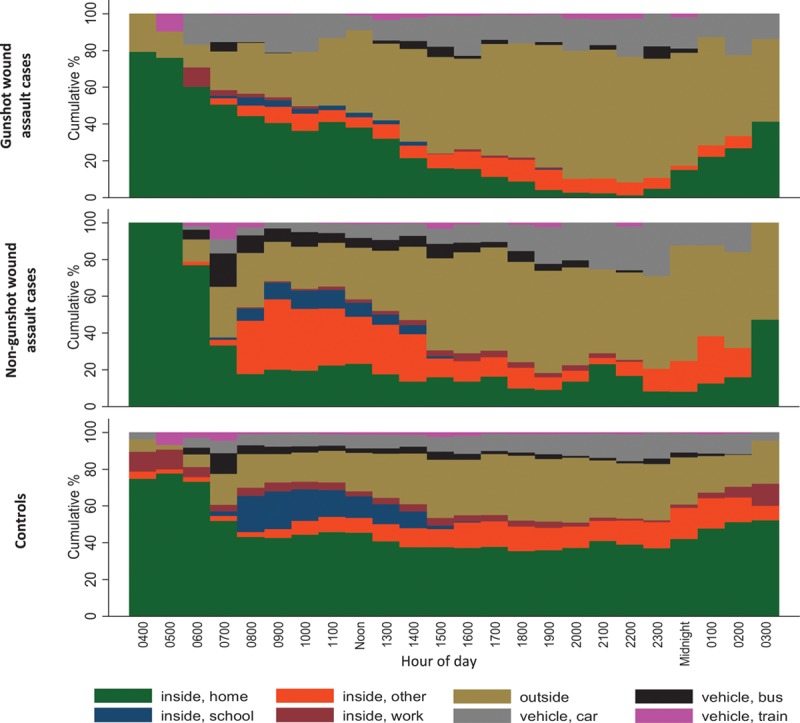
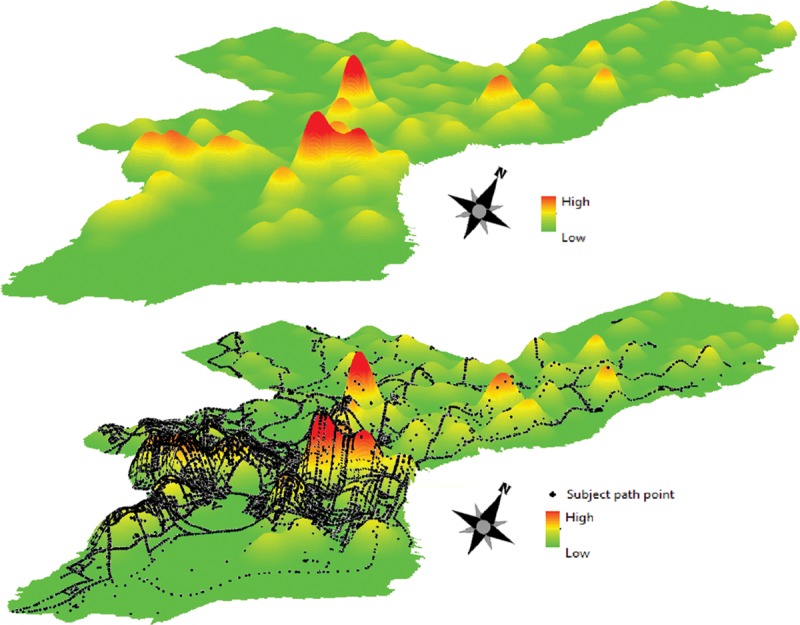
We mapped activity paths of 10- to 24-year-olds, including 143 assault patients shot with a firearm, 206 assault patients injured with other types of weapons, and 283 community controls, creating a step-by-step mapped record of how, when, where, and with whom they spent time over a full day from waking up until going to bed or being assaulted. Case-control analyses compared cases with time-matched controls to identify risk factors for assault. Case-crossover analyses compared cases at the time of assault with themselves earlier in the day to investigate whether exposure increases acted to the trigger assault.
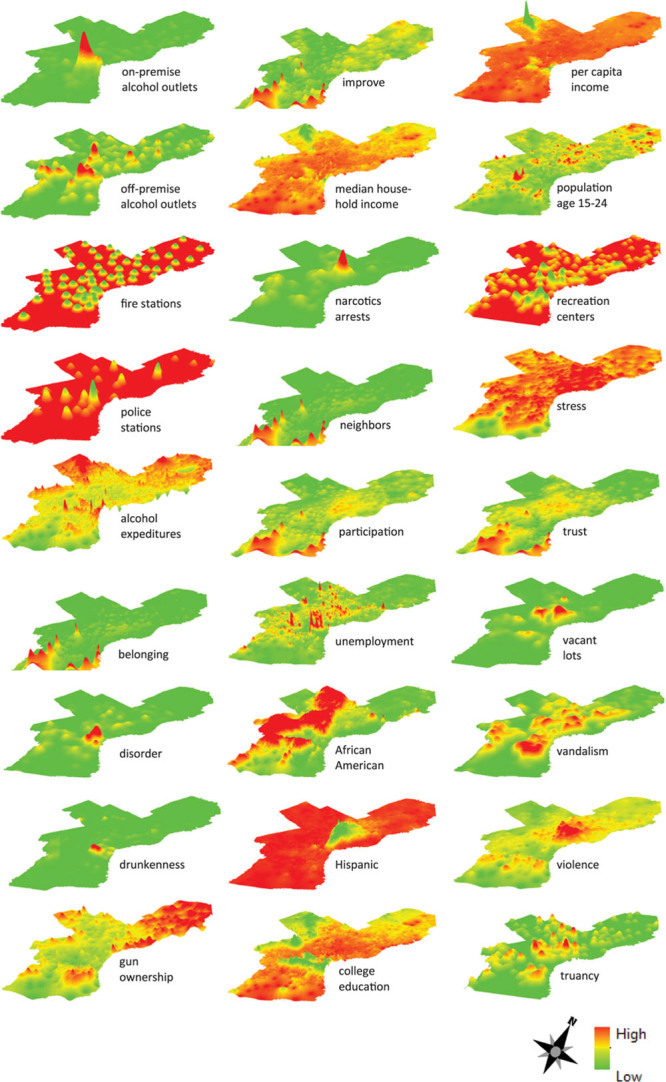
Gunshot assault risks included being alone (odds ratio [OR] = 1.6, 95% confidence interval [CI] = 1.3, 1.9) and were lower in areas with high neighbor connectedness (OR = 0.7, 95% CI = 0.6, 0.8). Acquiring a gun (OR = 1.4, 95% CI = 1.1, 1.6) and entering areas with more vacancy, violence, and vandalism (OR = 1.7, 95% CI = 1.1, 2.7) appeared to trigger the risk of getting shot shortly thereafter. Nongunshot assault risks included being in areas with recreation centers (OR = 1.2, 95% CI = 1.1, 1.4). Entering an area with higher truancy (OR = 1.6, 95% CI = 1.1, 2.5) and more vacancy, violence, and vandalism appeared to trigger the risk of nongunshot assault. Risks varied by age group.
We achieved a large-scale study of the activities of many boys, adolescents, and young men that systematically documented their experiences and empirically quantified risks for violence. Working at a temporal and spatial scale that is relevant to the dynamics of this phenomenon gave novel insights into triggers for violent assault.
我们收集了城市青年的详细活动路径,以调查他们的生活经历、在不同环境中度过的时间与暴力袭击风险之间的动态相互作用。
我们绘制了10至24岁人群的活动路径,其中包括143名遭枪击的袭击患者、206名受其他类型武器伤害的袭击患者以及283名社区对照者,创建了一份详细的活动记录,记录他们从醒来直至睡觉或遭受袭击的一整天里如何、何时、何地以及与谁共度时光。病例对照分析将病例与时间匹配的对照者进行比较,以确定袭击的风险因素。病例交叉分析将袭击发生时的病例与当天早些时候的自身情况进行比较,以调查暴露增加是否会引发袭击。
枪击袭击风险包括独自活动(比值比[OR]=1.6,95%置信区间[CI]=1.3,1.9),而在邻里联系紧密的地区风险较低(OR=0.7,95%CI=0.6,0.8)。获取枪支(OR=1.4,95%CI=1.1,1.6)以及进入空置率更高、暴力和破坏行为更多的地区(OR=1.7,95%CI=1.1,2.7)似乎会引发随后不久被枪击的风险。非枪击袭击风险包括身处有娱乐中心的地区(OR=1.2,95%CI=1.1,1.4)。进入逃学率更高(OR=1.6,95%CI=1.1,2.5)以及空置率更高、暴力和破坏行为更多的地区似乎会引发非枪击袭击的风险。风险因年龄组而异。
我们对众多男孩、青少年和青年男性的活动进行了大规模研究,系统地记录了他们的经历,并通过实证量化了暴力风险。在与这一现象动态相关的时间和空间尺度上开展研究,为暴力袭击的触发因素提供了新的见解。