Bouet Pierre-Emmanuel, Brun Stéphanie, Madar Hugo, Baisson Anne-Laure, Courtay Véronique, Gascoin-Lachambre Géraldine, Lasocki Sigismond, Sentilhes Loïc
Department of Obstetrics and Gynecology, Montreal University Hospital-Montreal-Canada.
Department of Obstetrics and Gynecology, Bordeaux University Hospital-Bordeaux-France.
Sci Rep. 2015 Sep 29;5:14732. doi: 10.1038/srep14732.
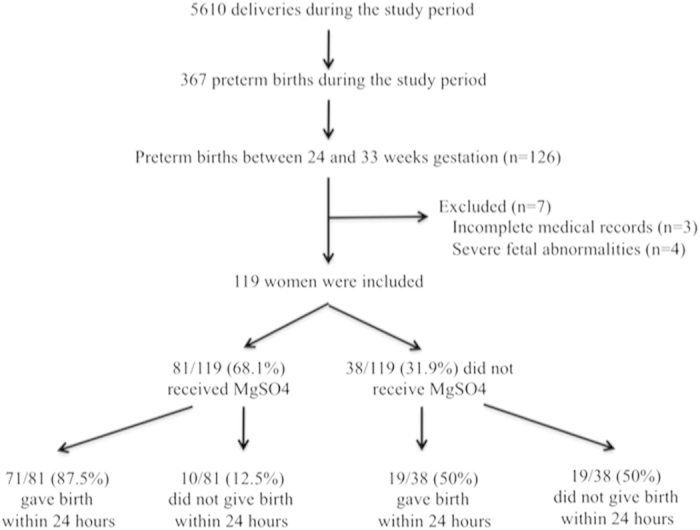
The aim of our study was to assess the feasibility of implementing a protocol for the use of magnesium sulfate to prevent cerebral palsy. This retrospective single-center study included all women with fetuses of gestational age <33 weeks of gestation whose birth was planned or expected within 24 hours from September 2011 to December 2012. They were to receive magnesium sulfate, administered intravenously as a 4-g bolus followed by a constant infusion of 1 g per hour. If delivery had not occurred after 12 hours and was no longer considered imminent, the infusion was to be discontinued. The study included 119 women, 81 (68.1%) of whom received magnesium sulfate. Among the latter, 71 (87.5%) gave birth within 24 hours. The reasons treatment was not given were: omission by medical team (19/38, 50%), urgent delivery (18/38, 47.4%), and contraindication to treatment (1/38, 2.6%). The mean gestational age at protocol implementation was 29.6 +/- 2.1 weeks. Maternal monitoring, especially at the onset of infusion, appeared suboptimal. No major maternal side effects were observed. Our study shows that implementing a protocol for prevention of cerebral palsy by magnesium sulfate is feasible in a tertiary obstetric center.
我们研究的目的是评估实施硫酸镁预防脑瘫方案的可行性。这项回顾性单中心研究纳入了所有孕周<33周且计划或预计在2011年9月至2012年12月的24小时内分娩的胎儿的孕妇。她们接受硫酸镁治疗,静脉推注4克,随后以每小时1克的速度持续输注。如果12小时后仍未分娩且不再被认为即将分娩,则停止输注。该研究纳入了119名女性,其中81名(68.1%)接受了硫酸镁治疗。在后者中,71名(87.5%)在24小时内分娩。未给予治疗的原因有:医疗团队遗漏(19/38,50%)、紧急分娩(18/38,47.4%)和治疗禁忌(1/38,2.6%)。实施方案时的平均孕周为29.6±2.1周。产妇监测,尤其是在输注开始时,似乎并不理想。未观察到重大的产妇副作用。我们的研究表明,在三级产科中心实施硫酸镁预防脑瘫方案是可行的。