Martini Matteo, Kilteni Konstantina, Maselli Antonella, Sanchez-Vives Maria V
Institut d'Investigacions Biomèdiques August Pi i Sunyer (IDIBAPS), Barcelona, Spain.
Event-Lab, Facultat de Psicologia, Universitat de Barcelona, Barcelona, Spain.
Sci Rep. 2015 Sep 29;5:13948. doi: 10.1038/srep13948.
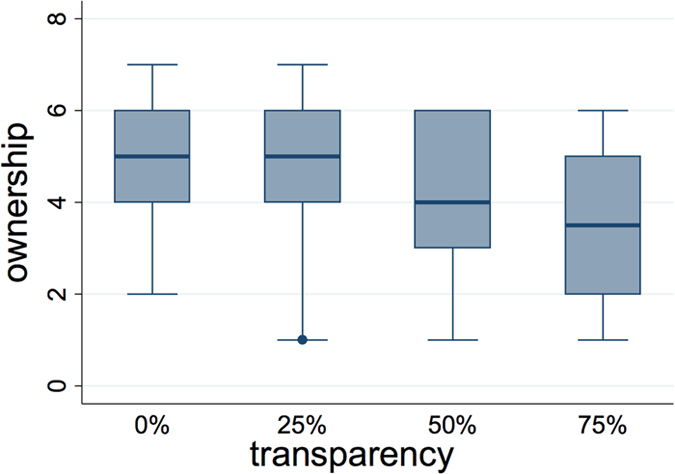
The feeling of "ownership" over an external dummy/virtual body (or body part) has been proven to have both physiological and behavioural consequences. For instance, the vision of an "embodied" dummy or virtual body can modulate pain perception. However, the impact of partial or total invisibility of the body on physiology and behaviour has been hardly explored since it presents obvious difficulties in the real world. In this study we explored how body transparency affects both body ownership and pain threshold. By means of virtual reality, we presented healthy participants with a virtual co-located body with four different levels of transparency, while participants were tested for pain threshold by increasing ramps of heat stimulation. We found that the strength of the body ownership illusion decreases when the body gets more transparent. Nevertheless, in the conditions where the body was semi-transparent, higher levels of ownership over a see-through body resulted in an increased pain sensitivity. Virtual body ownership can be used for the development of pain management interventions. However, we demonstrate that providing invisibility of the body does not increase pain threshold. Therefore, body transparency is not a good strategy to decrease pain in clinical contexts, yet this remains to be tested.
对外部虚拟人体模型/虚拟身体(或身体部位)的“所有权”感已被证明会产生生理和行为后果。例如,看到一个“具身化”的虚拟人体模型或虚拟身体可以调节疼痛感知。然而,由于在现实世界中存在明显困难,身体部分或完全不可见对生理和行为的影响几乎未被探索。在本研究中,我们探究了身体透明度如何影响身体所有权和疼痛阈值。通过虚拟现实技术,我们向健康参与者展示了具有四种不同透明度水平的虚拟同位置身体,同时通过逐渐增加热刺激强度来测试参与者的疼痛阈值。我们发现,当身体变得更加透明时,身体所有权错觉的强度会降低。然而,在身体为半透明的情况下,对透明身体更高程度的所有权会导致疼痛敏感性增加。虚拟身体所有权可用于疼痛管理干预措施的开发。然而,我们证明,使身体不可见并不会提高疼痛阈值。因此,在临床环境中,身体透明度并不是减轻疼痛的好策略,但这仍有待验证。