Aschenbrenner Andrew J, Balota David A, Fagan Anne M, Duchek Janet M, Benzinger Tammie L S, Morris John C
1Department of Psychology,Washington University in St. Louis,St. Louis,Missouri.
2Department of Neurology,Washington University in St. Louis,St. Louis,Missouri.
J Int Neuropsychol Soc. 2015 Sep;21(8):573-83. doi: 10.1017/S1355617715000776.
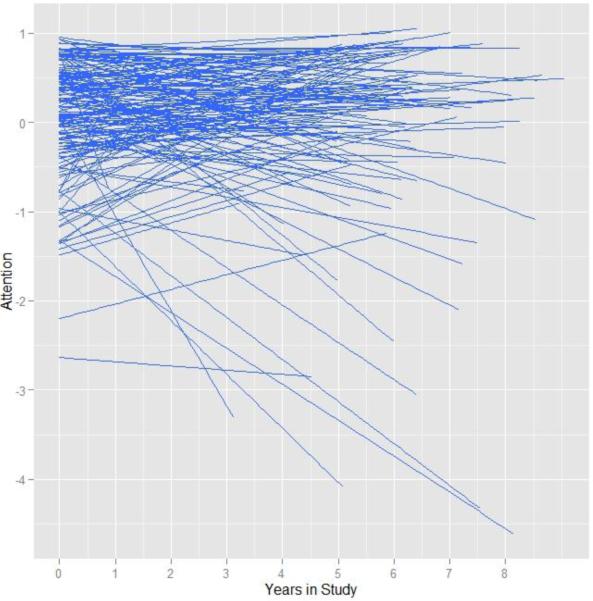
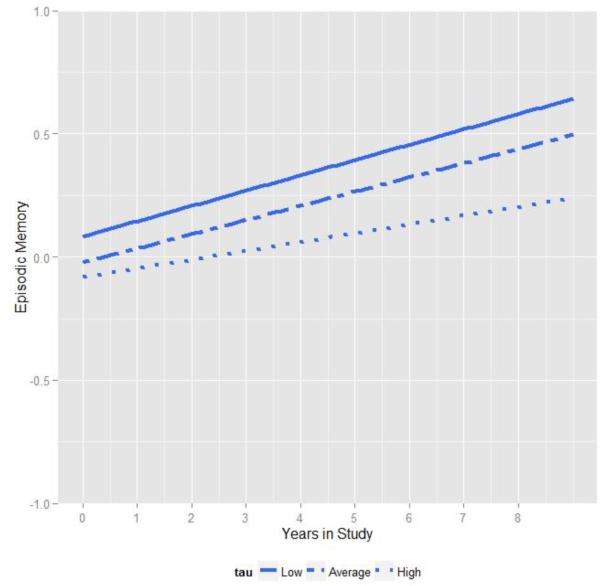
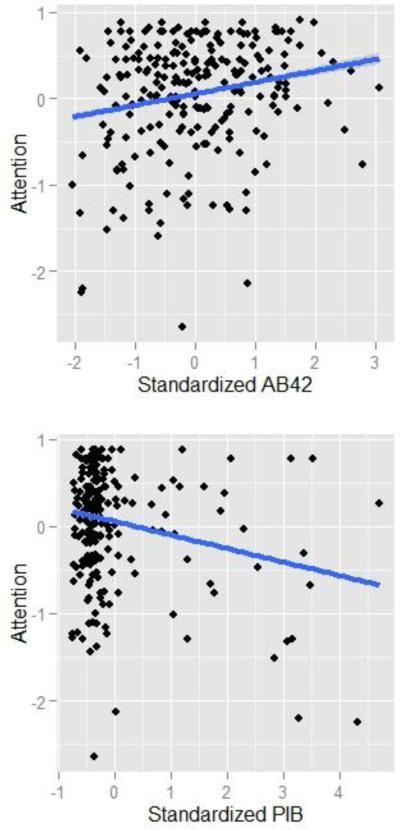
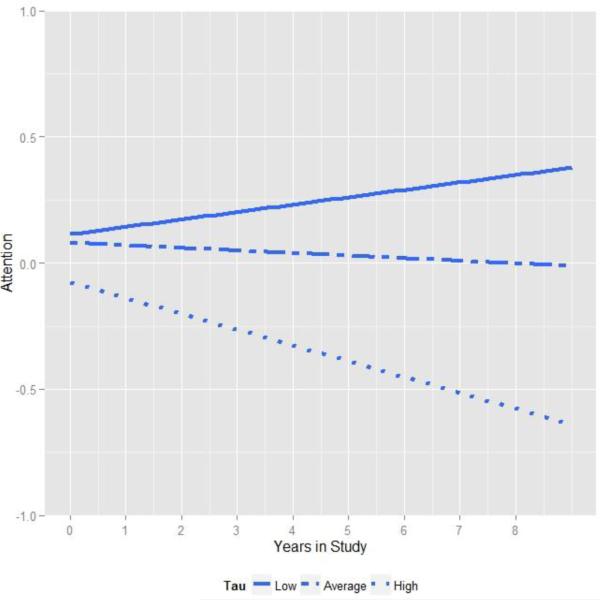
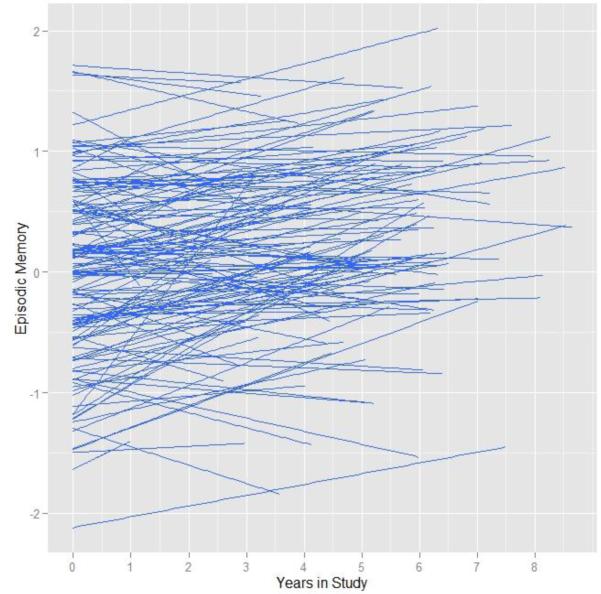
Cognitive measures that are sensitive to biological markers of Alzheimer disease (AD) pathology are needed to (a) facilitate preclinical staging, (b) identify individuals who are at the highest risk for developing clinical symptoms, and (c) serve as endpoints for evaluating the efficacy of interventions. The present study assesses the utility of two cognitive composite scores of attentional control and episodic memory as markers for preclinical AD pathology in a group of cognitively normal older adults (N = 238), as part of the Adult Children Study. All participants were given a baseline cognitive assessment and follow-up assessments every 3 years over an 8-year period, as well as a lumbar puncture within 2 years of the initial assessment to collect cerebrospinal fluid (CSF) and amyloid tracer Pittsburgh compound-B scan for amyloid imaging. Results indicated that attentional control was correlated with levels of Aβ42 at the initial assessment whereas episodic memory was not. Longitudinally, individuals with high CSF tau exhibited a decline in both attention and episodic memory over the course of the study. These results indicate that measures of attentional control and episodic memory can be used to evaluate cognitive decline in preclinical AD and provide support that CSF tau may be a key mechanism driving longitudinal cognitive change.
需要对阿尔茨海默病(AD)病理生物学标志物敏感的认知测量方法,以(a)促进临床前分期,(b)识别出现临床症状风险最高的个体,以及(c)作为评估干预效果的终点。作为成人子女研究的一部分,本研究评估了注意力控制和情景记忆的两种认知综合评分作为一组认知正常的老年人(N = 238)临床前AD病理标志物的效用。所有参与者在8年期间每3年进行一次基线认知评估和随访评估,并在初始评估的2年内进行腰椎穿刺,以收集脑脊液(CSF)和进行淀粉样蛋白示踪剂匹兹堡化合物B扫描以进行淀粉样蛋白成像。结果表明,在初始评估时,注意力控制与Aβ42水平相关,而情景记忆则不然。纵向来看,脑脊液tau水平高的个体在研究过程中注意力和情景记忆均出现下降。这些结果表明,注意力控制和情景记忆测量可用于评估临床前AD的认知衰退,并支持脑脊液tau可能是驱动纵向认知变化的关键机制。