Chu Dominique F
School of Computing, University of Kent, Canterbury, CT2 7NF, UK.
BMC Evol Biol. 2015 Sep 29;15:211. doi: 10.1186/s12862-015-0492-0.
The glucose effect is a well known phenomenon whereby cells, when presented with two different nutrients, show a diauxic growth pattern, i.e. an episode of exponential growth followed by a lag phase of reduced growth followed by a second phase of exponential growth. Diauxic growth is usually thought of as a an adaptation to maximise biomass production in an environment offering two or more carbon sources. While diauxic growth has been studied widely both experimentally and theoretically, the hypothesis that diauxic growth is a strategy to increase overall growth has remained an unconfirmed conjecture.
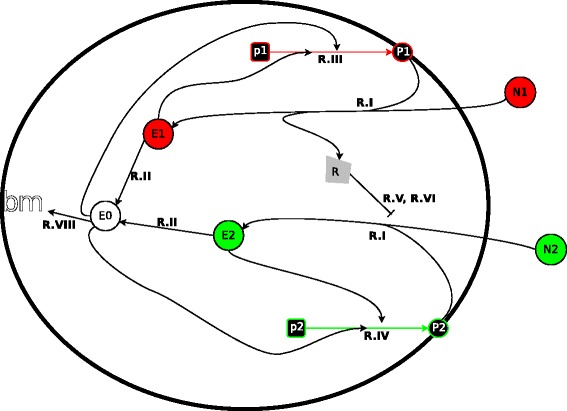
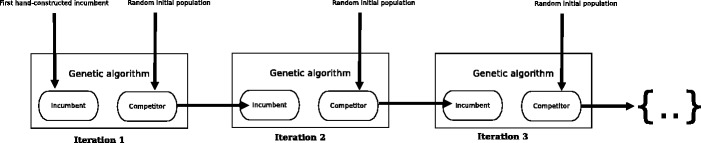
Here, we present a minimal mathematical model of a bacterial nutrient uptake system and metabolism. We subject this model to artificial evolution to test under which conditions diauxic growth evolves.
As a result, we find that, indeed, sequential uptake of nutrients emerges if there is competition for nutrients and the metabolism/uptake system is capacity limited.
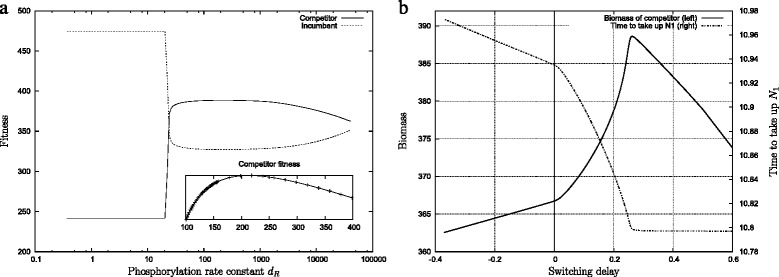
However, we also find that diauxic growth is a secondary effect of this system and that the speed-up of nutrient uptake is a much larger effect. Notably, this speed-up of nutrient uptake coincides with an overall reduction of efficiency.
Our two main conclusions are: (i) Cells competing for the same nutrients evolve rapid but inefficient growth dynamics. (ii) In the deterministic models we use here no substantial lag-phase evolves. This suggests that the lag-phase is a consequence of stochastic gene expression.
葡萄糖效应是一种众所周知的现象,即细胞在面对两种不同营养物质时,会呈现出双相生长模式,也就是一段指数增长期,随后是生长减缓的滞后期,接着是第二阶段的指数增长。双相生长通常被认为是一种适应性机制,以便在提供两种或更多碳源的环境中使生物量产量最大化。虽然双相生长已经在实验和理论上得到了广泛研究,但双相生长是一种增加整体生长的策略这一假设仍然是一个未经证实的推测。
在此,我们提出了一个细菌营养物质摄取系统和代谢的最小数学模型。我们对该模型进行人工进化,以测试在哪些条件下双相生长会进化产生。
结果,我们发现,如果存在营养物质竞争且代谢/摄取系统容量有限,确实会出现营养物质的顺序摄取。
然而,我们还发现双相生长是该系统的一种次要效应,而营养物质摄取速度的加快是一个更为显著的效应。值得注意的是,这种营养物质摄取速度的加快与效率的整体降低相吻合。
我们的两个主要结论是:(i)争夺相同营养物质的细胞会进化出快速但低效的生长动态。(ii)在我们这里使用的确定性模型中,不会进化出显著的滞后期。这表明滞后期是随机基因表达的结果。