Almutairi Abdulrahman, Sun Zhonghua, Poovathumkadavi Abduljaleel, Assar Tarek
Department of Medical Radiation Sciences, School of Science, Curtin University, Perth, 6845, Western Australia, Australia; Department of Medical Imaging, King Fahad Specialist Hospital, Dammam, 31444, Saudi Arabia.
Department of Medical Radiation Sciences, School of Science, Curtin University, Perth, 6845, Western Australia, Australia.
PLoS One. 2015 Sep 29;10(9):e0139275. doi: 10.1371/journal.pone.0139275. eCollection 2015.
One of the main drawbacks associated with Dual Energy Computed Tomography Angiography (DECTA) is the risk of developing contrast medium-induced nephropathy (CIN). The aim of the present study was firstly, to design an optimal CT imaging protocol by determining the feasibility of using a reduced contrast medium volume in peripheral arterial DECTA, and secondly, to compare the results with those obtained from using routine contrast medium volume.
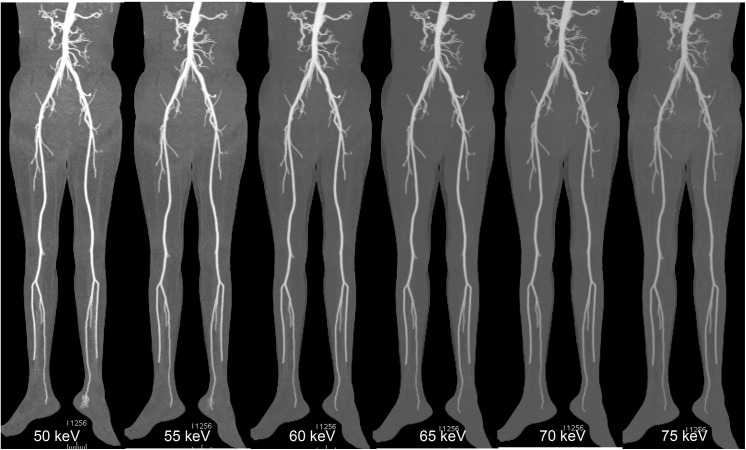
Thirty four patients underwent DECTA for the diagnosis of peripheral arterial disease. They were randomly divided into two groups: Group 1 (routine contrast volume group) with n = 17, injection rate 4-5 ml/s, and 1.5 ml/kg of contrast medium, and Group 2 ((low contrast volume group), with n = 17, injection rate 4-5ml/s, and contrast medium volume 0.75 ml/kg. A fast kilovoltage-switching 64-slice CT scanner in the dual-energy mode was employed for the study. A total of 6 datasets of monochromatic images at 50, 55, 60, 65, 70 and 75 keV levels were reconstructed with adaptive statistical iterative reconstruction (ASIR) at 50%. A 4-point scale was the tool for qualitative analysis of results. The two groups were compared and assessed quantitatively for image quality on the basis of signal-to-noise ratio (SNR) and contrast-to-noise-ratio (CNR). Radiation and contrast medium doses were also compared.
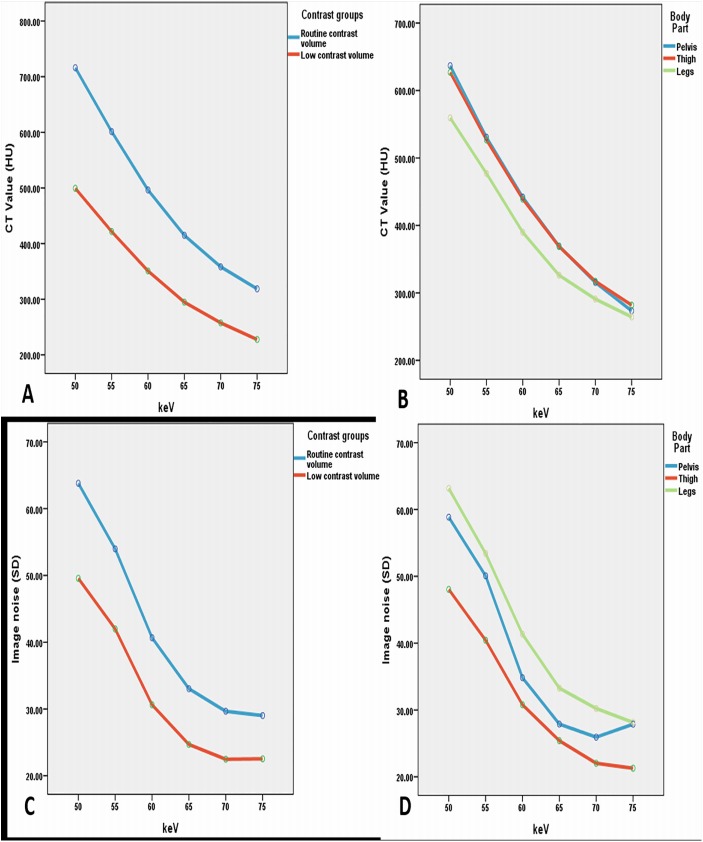
The overall mean CT attenuation and mean noise for all lower extremity body parts was significantly lower for the low volume contrast group (p<0.001), and varied significantly between groups (p = 0.001), body parts (p<0.001) and keVs (p<0.001). The interaction between group body parts was significant with CT attenuation and CNR (p = 0.002 and 0.003 respectively), and marginally significant with SNR (p = 0.047), with minimal changes noticed between the two groups. Group 2 (low contrast volume group) displayed the lowest image noise between 65 and 70 keV, recorded the highest SNR and CNR at 65 keV, and produced significantly lower results with respect to contrast medium volume and duration of contrast injection (p<0.001). The effect of radiation dose was not statistically significant between the two groups.
DECTA images created at 65 keV and 50% ASIR with low contrast medium volume protocol, yielded results that were comparable to routine contrast medium volume, with acceptable diagnostic images produced during the evaluation of peripheral arteries.
双能量计算机断层血管造影(DECTA)的主要缺点之一是发生造影剂诱导的肾病(CIN)的风险。本研究的目的,一是通过确定在外周动脉DECTA中使用减少的造影剂体积的可行性来设计最佳CT成像方案,二是将结果与使用常规造影剂体积获得的结果进行比较。
34例患者接受DECTA以诊断外周动脉疾病。他们被随机分为两组:第1组(常规造影剂体积组),n = 17,注射速率4 - 5 ml/s,造影剂1.5 ml/kg;第2组(低造影剂体积组),n = 17,注射速率4 - 5 ml/s,造影剂体积0.75 ml/kg。采用双能量模式的快速千伏切换64层CT扫描仪进行研究。使用自适应统计迭代重建(ASIR)50%重建了总共6组50、55、60、65、70和75 keV水平的单色图像数据集。采用4分制对结果进行定性分析。基于信噪比(SNR)和对比噪声比(CNR)对两组图像质量进行定量比较和评估。还比较了辐射剂量和造影剂剂量。
低造影剂体积组所有下肢身体部位的总体平均CT衰减和平均噪声显著更低(p<0.001),且在组间(p = 0.001)、身体部位间(p<0.001)和keV间(p<0.001)差异显著。组与身体部位之间在CT衰减和CNR方面的交互作用显著(分别为p = 0.002和0.003),在SNR方面有边缘显著性(p = 0.047),两组之间变化最小。第2组(低造影剂体积组)在65至70 keV之间显示出最低的图像噪声,在65 keV时记录到最高的SNR和CNR,并且在造影剂体积和造影剂注射持续时间方面产生的结果显著更低(p<0.001)。两组之间辐射剂量的影响无统计学意义。
采用低造影剂体积方案在65 keV和ASIR 50%条件下生成的DECTA图像,其结果与常规造影剂体积相当,在外周动脉评估过程中产生了可接受的诊断图像。