Fitterer Jessica L, Nelson Trisalyn A
Spatial Pattern Analysis and Research Lab, Department of Geography, University of Victoria, Victoria, British Columbia, Canada.
PLoS One. 2015 Sep 29;10(9):e0139344. doi: 10.1371/journal.pone.0139344. eCollection 2015.
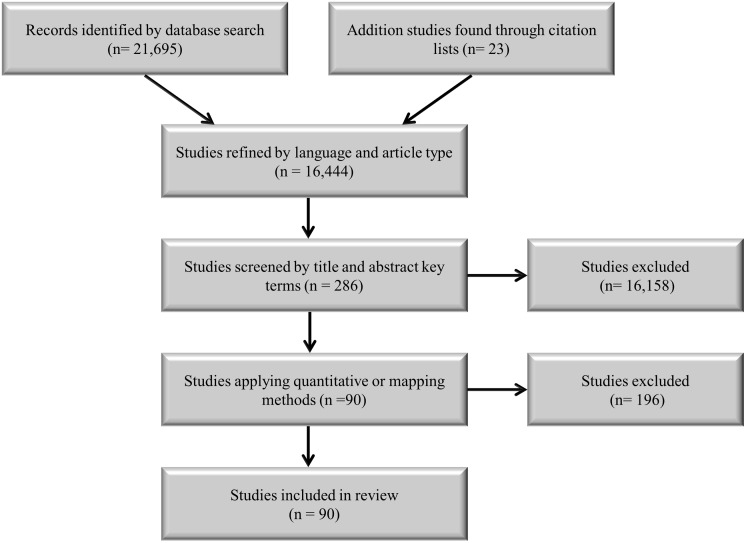
Modelling the relationship between alcohol consumption and crime generates new knowledge for crime prevention strategies. Advances in data, particularly data with spatial and temporal attributes, have led to a growing suite of applied methods for modelling. In support of alcohol and crime researchers we synthesized and critiqued existing methods of spatially and quantitatively modelling the effects of alcohol exposure on crime to aid method selection, and identify new opportunities for analysis strategies. We searched the alcohol-crime literature from 1950 to January 2014. Analyses that statistically evaluated or mapped the association between alcohol and crime were included. For modelling purposes, crime data were most often derived from generalized police reports, aggregated to large spatial units such as census tracts or postal codes, and standardized by residential population data. Sixty-eight of the 90 selected studies included geospatial data of which 48 used cross-sectional datasets. Regression was the prominent modelling choice (n = 78) though dependent on data many variations existed. There are opportunities to improve information for alcohol-attributable crime prevention by using alternative population data to standardize crime rates, sourcing crime information from non-traditional platforms (social media), increasing the number of panel studies, and conducting analysis at the local level (neighbourhood, block, or point). Due to the spatio-temporal advances in crime data, we expect a continued uptake of flexible Bayesian hierarchical modelling, a greater inclusion of spatial-temporal point pattern analysis, and shift toward prospective (forecast) modelling over small areas (e.g., blocks).
对酒精消费与犯罪之间的关系进行建模可为犯罪预防策略带来新知识。数据方面的进展,特别是具有空间和时间属性的数据,催生了越来越多的应用建模方法。为支持酒精与犯罪领域的研究人员,我们综合并审视了现有的对酒精暴露对犯罪的影响进行空间和定量建模的方法,以协助方法选择,并识别分析策略的新机遇。我们检索了1950年至2014年1月期间的酒精与犯罪文献。纳入了对酒精与犯罪之间的关联进行统计评估或制图的分析。出于建模目的,犯罪数据大多源自广义的警方报告,汇总到如普查区或邮政编码等大空间单元,并通过常住人口数据进行标准化。所选的90项研究中有68项包含地理空间数据,其中48项使用横断面数据集。回归是主要的建模选择(n = 78),不过因数据而异存在许多变体。通过使用替代人口数据来标准化犯罪率、从非传统平台(社交媒体)获取犯罪信息、增加面板研究的数量以及在地方层面(社区、街区或地点)进行分析,有机会改善酒精所致犯罪预防的信息。由于犯罪数据在时空方面的进展,我们预计灵活的贝叶斯分层建模将持续得到采用,更多地纳入时空点模式分析,并转向对小区域(如街区)的前瞻性(预测)建模。