Picciolini Odoardo, Squarza Chiara, Fontana Camilla, Giannì Maria Lorella, Cortinovis Ivan, Gangi Silvana, Gardon Laura, Presezzi Gisella, Fumagalli Monica, Mosca Fabio
NICU, Department of Clinical Sciences and Community Health, Fondazione IRCCS Ca' Granda Ospedale Maggiore Policlinico, Università degli Studi di Milano, Via Della Commenda 12, Milan, 20122, Italy.
Department of Clinical Sciences and Community Health-Laboratory of Medical Statistics, Biometry and Epidemiology, Università degli Studi di Milano, Via Della Commenda 12, Milan, 20122, Italy.
BMC Pediatr. 2015 Sep 30;15:139. doi: 10.1186/s12887-015-0457-x.
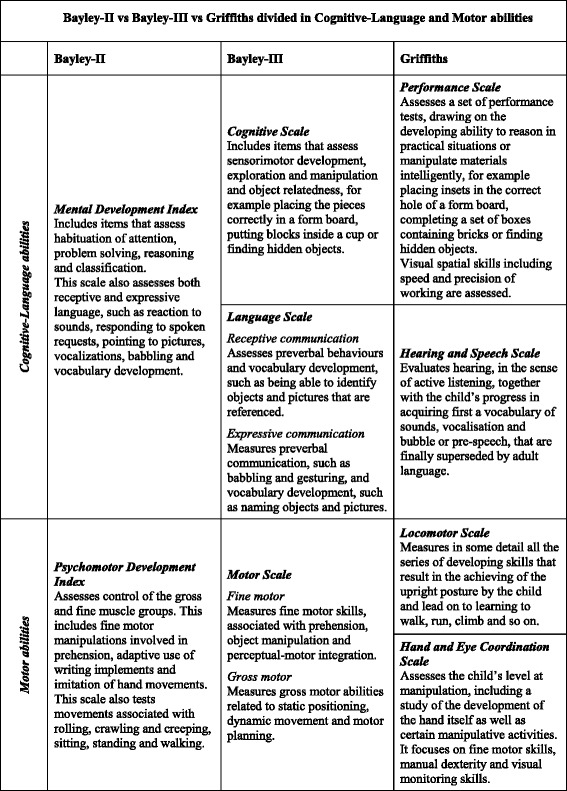
The availability of accurate assessment tools for the early detection of infants at risk for adverse neurodevelopmental outcomes is a major issue. The purpose of this study is to compare the outcomes of the Bayley Scales (Bayley-II vs Bayley-III) in a cohort of extremely low birth weight infants at 24 months corrected age, to define which edition shows the highest agreement with the Griffiths Mental Development Scales Revised.
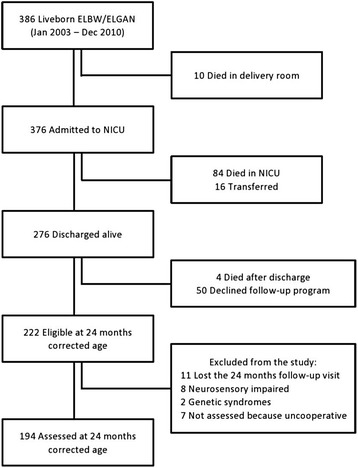
We performed a single-centre cohort study. We prospectively enrolled infants with a birth weight of 401-1000 g and/or gestational age < 28 weeks. Exclusion criteria were the presence of neurosensory disabilities and/or genetic abnormalities. Infants underwent neurodevelopmental evaluation at 24 months corrected age using the Griffiths and either the Bayley-II (birth years 2003-2006) or the Bayley-III (birth years 2007-2010).
A total of 194 infants were enrolled. Concordance was excellent between the Griffiths and the Bayley-III composite scores for both cognitive language and motor abilities (weighted K = 0.80 and 0.81, respectively) but poorer for the Bayley-II (weighted K = 0.63 and 0.50, respectively). The Youden's Index revealed higher values for the Bayley-III than for the Bayley-II (75.9 vs 69.6%). Compared with the Griffiths, the Bayley-III found 3% fewer infants as being severely impaired in cognitive-language abilities and 7.8% fewer infants as being mildly impaired in motor skills while the Bayley-II showed, compared with the Griffiths, higher rates of severely impaired children both for cognitive-language and motor abilities (14.1 and 15.3% more infants respectively).
Our study suggests that the Bayley-III, although having a higher agreement with the Griffiths compared to the Bayley-II, slightly tends to underestimate neurodevelopmental impairment compared with the Griffiths, whereas the Bayley-II tends to overestimate it.
On the basis of these findings, we recommend the use of multiple measures to assess neurodevelopmental outcomes of extremely low birth weight infants at 24 months.
拥有准确的评估工具以早期发现有神经发育不良后果风险的婴儿是一个重大问题。本研究的目的是比较贝利量表(贝利-II与贝利-III)在一组矫正年龄为24个月的极低出生体重婴儿中的结果,以确定哪个版本与修订后的格里菲斯心理发展量表一致性最高。
我们进行了一项单中心队列研究。我们前瞻性地纳入了出生体重为401 - 1000克和/或胎龄<28周的婴儿。排除标准为存在神经感觉障碍和/或遗传异常。婴儿在矫正年龄24个月时使用格里菲斯量表以及贝利-II(出生年份2003 - 2006)或贝利-III(出生年份2007 - 2010)进行神经发育评估。
共纳入194名婴儿。格里菲斯量表与贝利-III在认知语言和运动能力的综合得分方面一致性极佳(加权K分别为0.80和0.81),但贝利-II的一致性较差(加权K分别为0.63和0.50)。约登指数显示贝利-III的值高于贝利-II(75.9%对69.6%)。与格里菲斯量表相比,贝利-III发现认知语言能力严重受损的婴儿少3%,运动技能轻度受损的婴儿少7.8%,而贝利-II与格里菲斯量表相比,认知语言和运动能力严重受损儿童的比例更高(分别多14.1%和15.3%的婴儿)。
我们的研究表明,贝利-III虽然与格里菲斯量表的一致性高于贝利-II,但与格里菲斯量表相比,略微倾向于低估神经发育损害,而贝利-II则倾向于高估。
基于这些发现,我们建议使用多种测量方法来评估矫正年龄为24个月的极低出生体重婴儿的神经发育结果。