Burunat Iballa, Brattico Elvira, Puoliväli Tuomas, Ristaniemi Tapani, Sams Mikko, Toiviainen Petri
Finnish Centre for Interdisciplinary Music Research, Department of Music, University of Jyväskylä, Finland; Department of Mathematical Information Technology, University of Jyväskylä, Jyväskylä, Finland.
Center for Music in the Brain (MIB), Department of Clinical Medicine, Aarhus University, Aarhus, Denmark; Cognitive Brain Research Unit (CBRU), Institute of Behavioral Sciences, University of Helsinki, Helsinki, Finland; Advanced Magnetic Imaging (AMI) Centre, Aalto University School of Science, Espoo, Finland.
PLoS One. 2015 Sep 30;10(9):e0138238. doi: 10.1371/journal.pone.0138238. eCollection 2015.
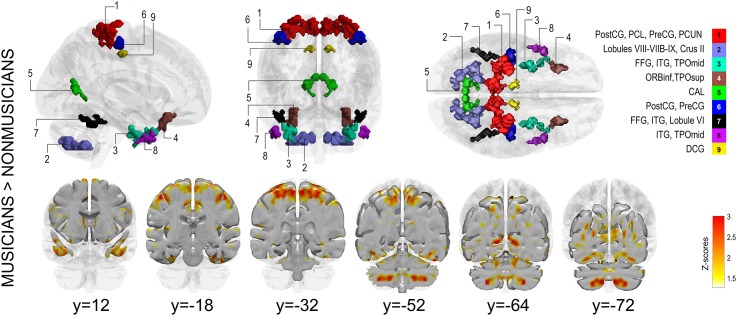
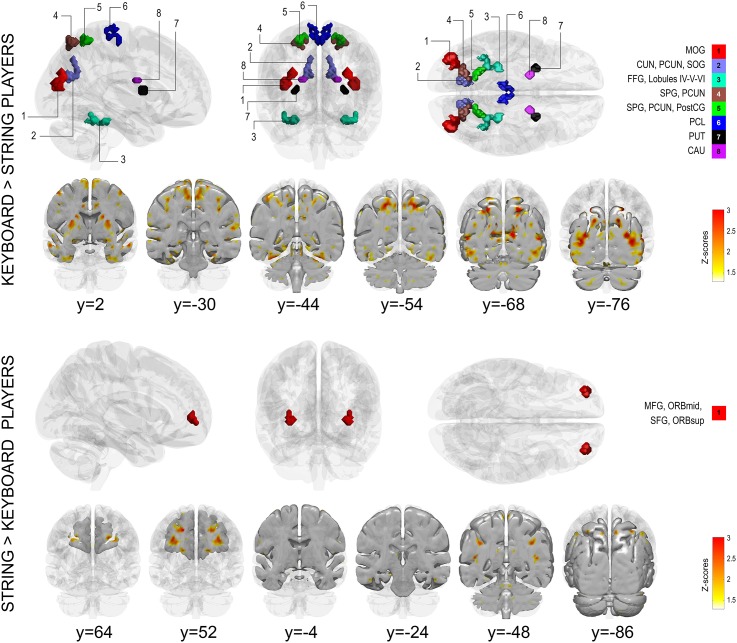
Musical training leads to sensory and motor neuroplastic changes in the human brain. Motivated by findings on enlarged corpus callosum in musicians and asymmetric somatomotor representation in string players, we investigated the relationship between musical training, callosal anatomy, and interhemispheric functional symmetry during music listening. Functional symmetry was increased in musicians compared to nonmusicians, and in keyboardists compared to string players. This increased functional symmetry was prominent in visual and motor brain networks. Callosal size did not significantly differ between groups except for the posterior callosum in musicians compared to nonmusicians. We conclude that the distinctive postural and kinematic symmetry in instrument playing cross-modally shapes information processing in sensory-motor cortical areas during music listening. This cross-modal plasticity suggests that motor training affects music perception.
音乐训练会导致人类大脑发生感觉和运动神经可塑性变化。受音乐家胼胝体增大及弦乐器演奏者躯体运动表征不对称等研究结果的启发,我们研究了音乐训练、胼胝体解剖结构以及音乐聆听过程中半球间功能对称性之间的关系。与非音乐家相比,音乐家的功能对称性增强;与弦乐器演奏者相比,键盘乐器演奏者的功能对称性增强。这种增强的功能对称性在视觉和运动脑网络中尤为显著。除了音乐家与非音乐家相比胼胝体后部大小存在差异外,两组之间胼胝体大小无显著差异。我们得出结论,乐器演奏中独特的姿势和运动对称性会跨模态地塑造音乐聆听过程中感觉运动皮层区域的信息处理。这种跨模态可塑性表明运动训练会影响音乐感知。