Konttinen Hanna, Llewellyn Clare, Wardle Jane, Silventoinen Karri, Joensuu Anni, Männistö Satu, Salomaa Veikko, Jousilahti Pekka, Kaprio Jaakko, Perola Markus, Haukkala Ari
Department of Social Research, University of Helsinki, Helsinki, Finland.
Department of Epidemiology and Public Health, University College London, London, UK.
Sci Rep. 2015 Oct 1;5:14726. doi: 10.1038/srep14726.
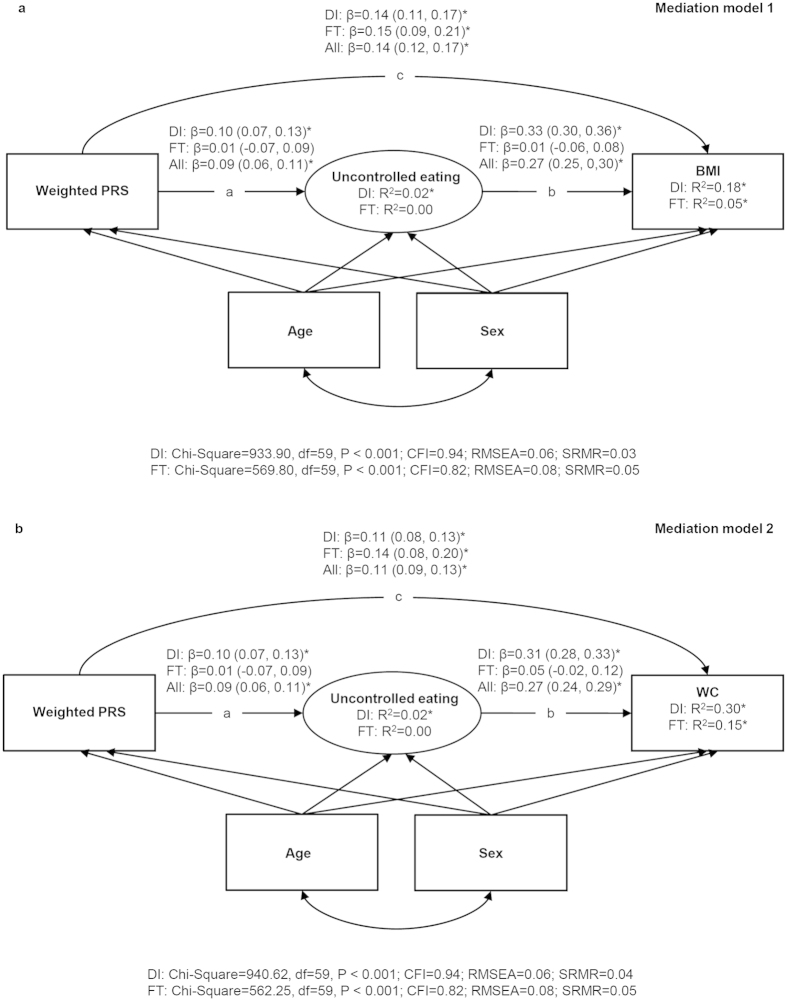
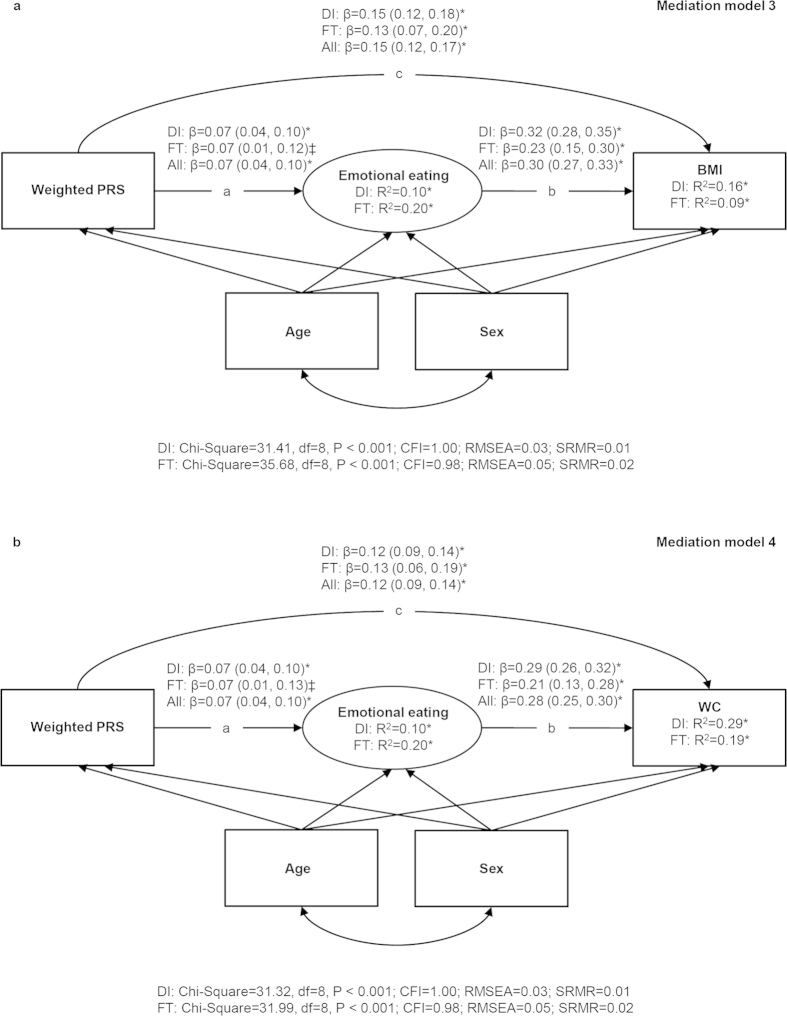
The mechanisms through which genes influence body weight are not well understood, but appetite has been implicated as one mediating pathway. Here we use data from two independent population-based Finnish cohorts (4632 adults aged 25-74 years from the DILGOM study and 1231 twin individuals aged 21-26 years from the FinnTwin12 study) to investigate whether two appetitive traits mediate the associations between known obesity-related genetic variants and adiposity. The results from structural equation modelling indicate that the effects of a polygenic risk score (90 obesity-related loci) on measured body mass index and waist circumference are partly mediated through higher levels of uncontrolled eating (βindirect = 0.030-0.032, P < 0.001 in DILGOM) and emotional eating (βindirect = 0.020-0.022, P < 0.001 in DILGOM and βindirect = 0.013-0.015, P = 0.043-0.044 in FinnTwin12). Our findings suggest that genetic predispositions to obesity may partly exert their effects through appetitive traits reflecting lack of control over eating or eating in response to negative emotions. Obesity prevention and treatment studies should examine the impact of targeting these eating behaviours, especially among individuals having a high genetic predisposition to obesity.
基因影响体重的机制尚未完全明确,但食欲被认为是其中一条介导途径。在此,我们利用来自两个基于人群的独立芬兰队列的数据(来自DILGOM研究的4632名25 - 74岁成年人以及来自FinnTwin12研究的1231名21 - 26岁双胞胎个体),来探究两种食欲特征是否介导了已知肥胖相关基因变异与肥胖之间的关联。结构方程模型的结果表明,多基因风险评分(90个肥胖相关位点)对测量的体重指数和腰围的影响部分是通过更高水平的无节制饮食(在DILGOM研究中,β间接效应 = 0.030 - 0.032,P < 0.001)和情绪化进食(在DILGOM研究中,β间接效应 = 0.020 - 0.022,P < 0.001;在FinnTwin12研究中,β间接效应 = 0.013 - 0.015,P = 0.043 - 0.044)介导的。我们的研究结果表明,肥胖的遗传易感性可能部分通过反映对饮食缺乏控制或因负面情绪而进食的食欲特征来发挥作用。肥胖预防和治疗研究应考察针对这些饮食行为的影响,尤其是在肥胖遗传易感性高的个体中。