Lencioni Alex, Hutchins Laura, Annis Sandy, Chen Wanchi, Ermisoglu Emre, Feng Zhidan, Mack Karen, Simpson Kacie, Lane Cheryl, Topaloglu Umit
BMC Bioinformatics. 2015;16 Suppl 13(Suppl 13):S6. doi: 10.1186/1471-2105-16-S13-S6. Epub 2015 Sep 25.
Comprehensive capture of Adverse Events (AEs) is crucial for monitoring for side effects of a therapy while assessing efficacy. For cancer studies, the National Cancer Institute has developed the Common Terminology Criteria for Adverse Events (CTCAE) as a required standard for recording attributes and grading AEs. The AE assessments should be part of the Electronic Health Record (EHR) system; yet, due to patient-centric EHR design and implementation, many EHR's don't provide straightforward functions to assess ongoing AEs to indicate a resolution or a grade change for clinical trials.
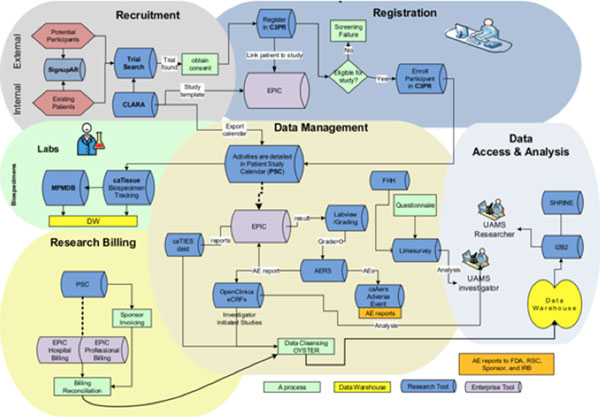
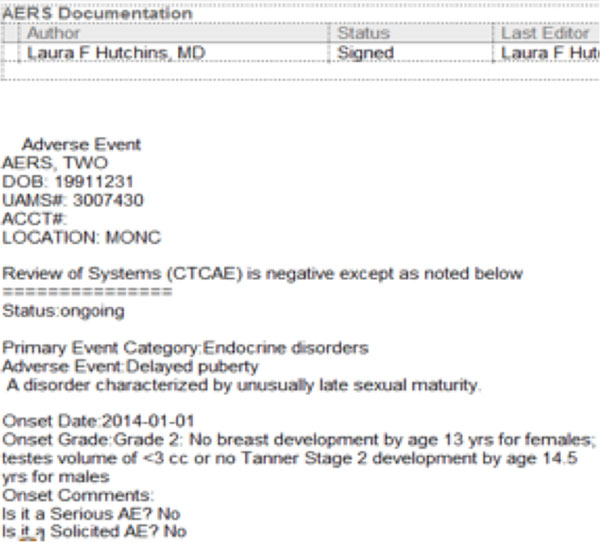
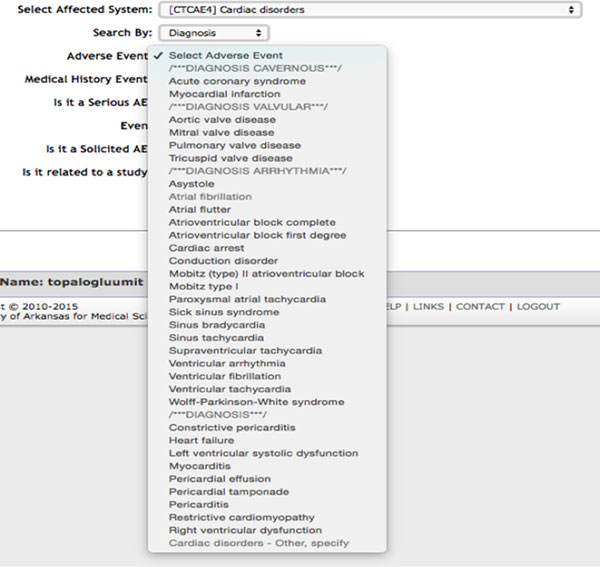
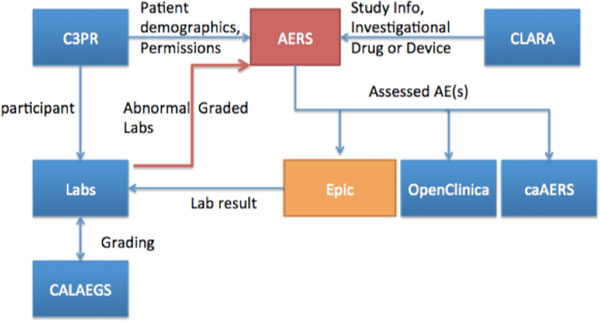
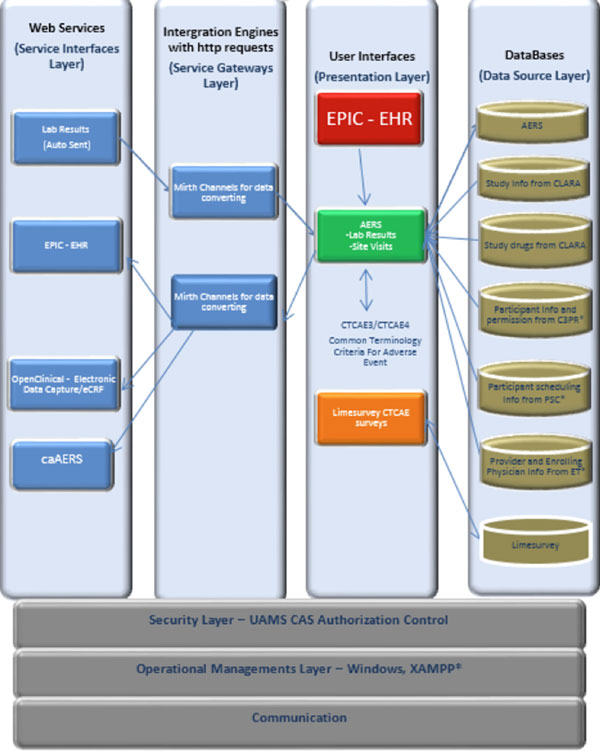
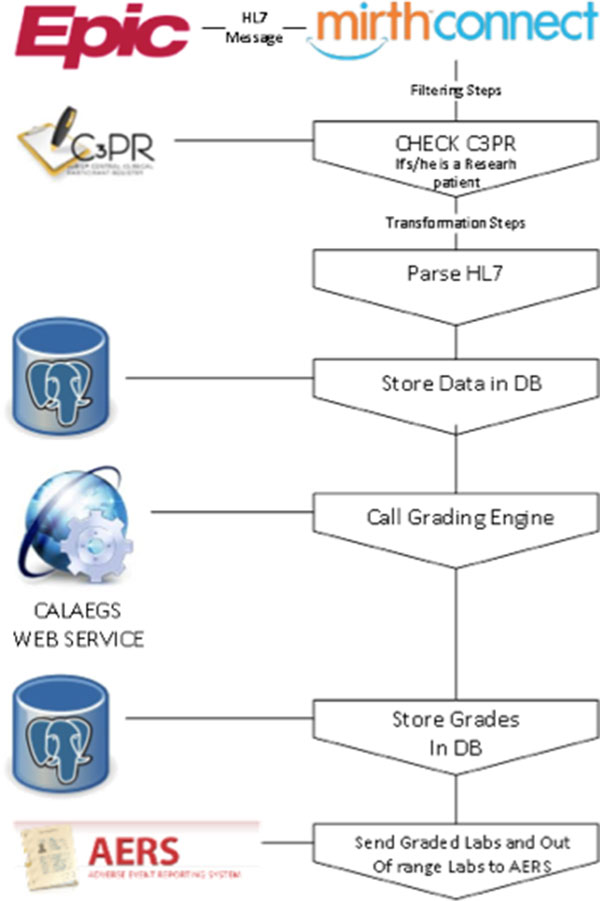
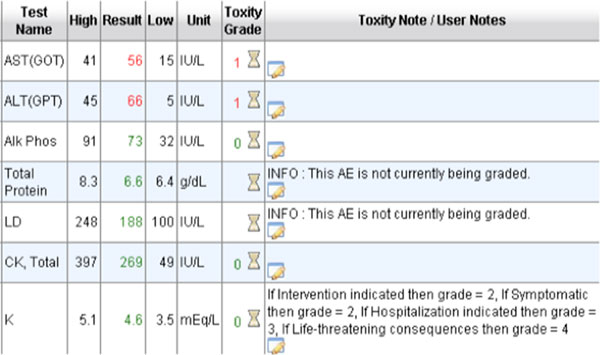
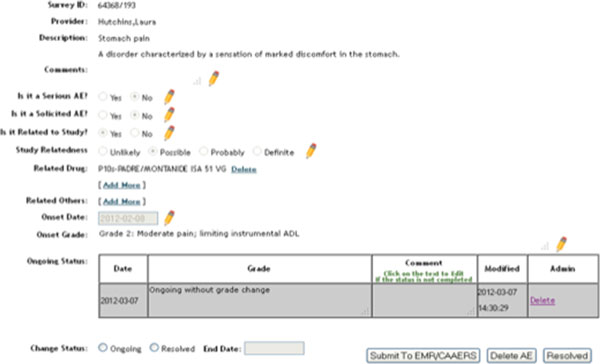
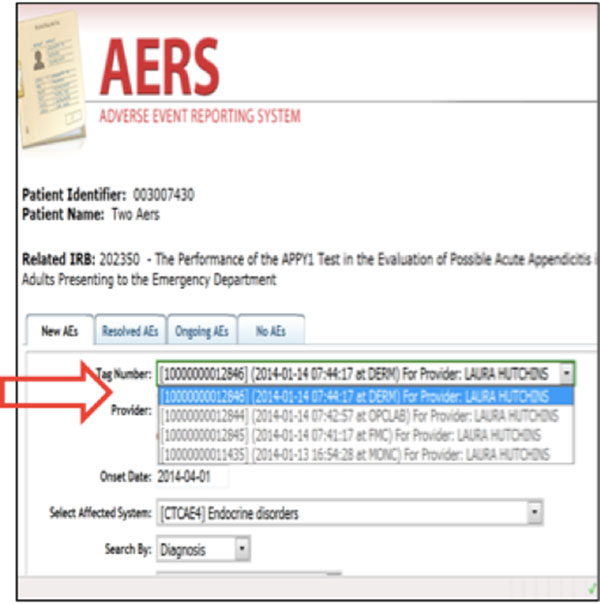
At UAMS, we have implemented a standards-based Adverse Event Reporting System (AERS) that is integrated with the Epic EHR and other research systems to track new and existing AEs, including automated lab result grading in a regulatory compliant manner. Within a patient's chart, providers can launch AERS, which opens the patient's ongoing AEs as default and allows providers to assess (resolution/ongoing) existing AEs. In another tab, it allows providers to create a new AE. Also, we have separated symptoms from diagnoses in the CTCAE to minimize inaccurate designation of the clinical observations. Upon completion of assessments, a physician would submit the AEs to the EHR via a Health Level 7 (HL7) message and then to other systems utilizing a Representational State Transfer Web Service.
AERS currently supports CTCAE version 3 and 4 with more than 65 cancer studies and 350 patients on those studies. This type of standard integrated into the EHR aids in research and data sharing in a compliant, efficient, and safe manner.
全面收集不良事件(AE)对于在评估疗效时监测治疗的副作用至关重要。对于癌症研究,美国国立癌症研究所已制定了不良事件通用术语标准(CTCAE),作为记录不良事件属性和分级的必需标准。不良事件评估应成为电子健康记录(EHR)系统的一部分;然而,由于以患者为中心的电子健康记录设计和实施,许多电子健康记录并未提供直接功能来评估正在发生的不良事件,以表明临床试验中的缓解情况或分级变化。
在阿肯色大学医学科学分校(UAMS),我们实施了一个基于标准的不良事件报告系统(AERS),该系统与Epic电子健康记录和其他研究系统集成,以跟踪新的和现有的不良事件,包括以符合法规的方式自动进行实验室结果分级。在患者病历中,医疗服务提供者可以启动AERS,它默认打开患者正在发生的不良事件,并允许医疗服务提供者评估(缓解/正在发生)现有的不良事件。在另一个标签中,它允许医疗服务提供者创建新的不良事件。此外,我们在CTCAE中将症状与诊断分开,以尽量减少临床观察的错误指定。评估完成后,医生将通过健康级别7(HL7)消息将不良事件提交到电子健康记录,然后通过代表性状态转移网络服务提交到其他系统。
AERS目前支持CTCAE第3版和第4版,有超过65项癌症研究以及参与这些研究的350名患者。这种集成到电子健康记录中的标准有助于以合规、高效和安全的方式进行研究和数据共享。