Hamada Tsutomu, Samukawa Takuya, Kumamoto Tomohiro, Hatanaka Kazuhito, Tsukuya Go, Yamamoto Masuki, Machida Kentaro, Watanabe Masaki, Mizuno Keiko, Higashimoto Ikkou, Inoue Yoshikazu, Inoue Hiromasa
Department of Pulmonary Medicine, Graduate School of Medical and Dental Sciences, Kagoshima University, 8-35-1 Sakuragaoka, Kagoshima, 890-8520, Japan.
Department of Molecular and Cellular Pathology, Graduate School of Medical and Dental Sciences, Kagoshima University, Kagoshima, Japan.
BMC Pulm Med. 2015 Sep 30;15:110. doi: 10.1186/s12890-015-0105-0.
Interstitial lung diseases (ILDs) are common in patients with connective tissue diseases (CTDs). Although the diagnosis of an underlying CTD in ILD (CTD-ILD) affects both prognosis and treatment, it is sometimes difficult to distinguish CTD-ILD from chronic fibrosing interstitial pneumonia (CFIP). B cell-activating factor belonging to the tumour necrosis factor family (BAFF) plays a crucial role in B cell development, survival, and antibody production.
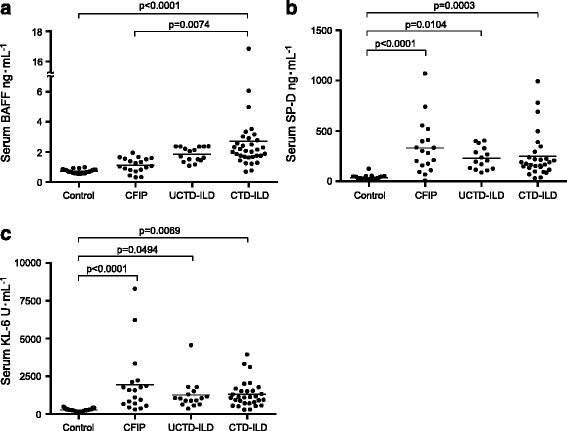
We examined serum levels of BAFF, surfactant protein D (SP-D), and Krebs von den Lungen-6 (KL-6) in 33 patients with CTD-ILD, 16 patients with undifferentiated CTD-ILD, 19 patients with CFIP, and 26 healthy volunteers. And we analysed the relationship between serum BAFF levels and pulmonary function, as well as the expression of BAFF in the lung tissue of patients with CTD-ILD.
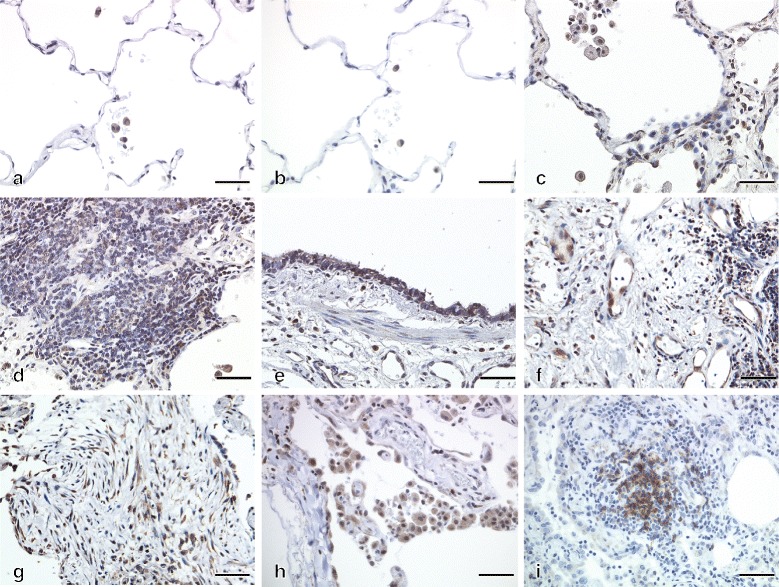
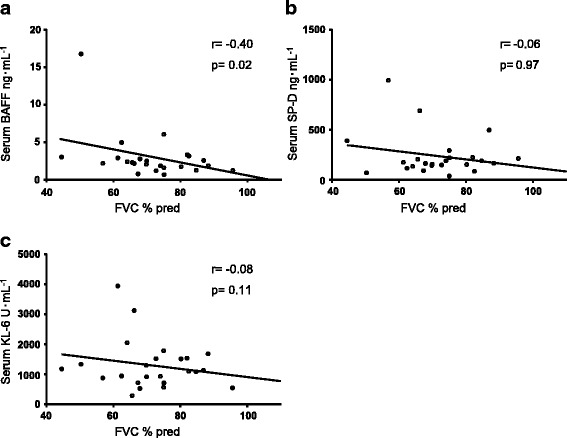
Serum levels of BAFF were significantly higher in CTD-ILD patients compared to healthy subjects and CFIP patients. However, there were no significant differences in serum levels of SP-D and KL-6. Furthermore, serum BAFF levels in CTD-ILD patients were inversely correlated with pulmonary function. BAFF was strongly expressed in the lungs of CTD-ILD patients, but weakly in normal lungs.
This is the first study to demonstrate that serum BAFF levels were significantly higher in CTD-ILD patients compared to healthy subjects and CFIP patients. Furthermore, serum BAFF levels were correlated with pulmonary function. We consider that serum BAFF levels in patients with CTD-ILD reflect the presence of ILDs disease activity and severity.
These finding suggest that BAFF may be a useful marker for distinguishing CTD-ILD from CFIP.
间质性肺疾病(ILDs)在结缔组织病(CTDs)患者中很常见。尽管ILD(CTD-ILD)中潜在CTD的诊断会影响预后和治疗,但有时很难将CTD-ILD与慢性纤维化间质性肺炎(CFIP)区分开来。肿瘤坏死因子家族的B细胞激活因子(BAFF)在B细胞发育、存活和抗体产生中起关键作用。
我们检测了33例CTD-ILD患者、16例未分化CTD-ILD患者、19例CFIP患者和26名健康志愿者的血清BAFF、表面活性蛋白D(SP-D)和克雷伯斯-冯-登-卢根-6(KL-6)水平。并且我们分析了血清BAFF水平与肺功能之间的关系,以及CTD-ILD患者肺组织中BAFF的表达。
与健康受试者和CFIP患者相比,CTD-ILD患者的血清BAFF水平显著更高。然而,SP-D和KL-6的血清水平没有显著差异。此外,CTD-ILD患者的血清BAFF水平与肺功能呈负相关。BAFF在CTD-ILD患者的肺中强烈表达,但在正常肺中表达较弱。
这是第一项证明CTD-ILD患者血清BAFF水平显著高于健康受试者和CFIP患者的研究。此外,血清BAFF水平与肺功能相关。我们认为CTD-ILD患者的血清BAFF水平反映了ILD疾病活动和严重程度的存在。
这些发现表明BAFF可能是区分CTD-ILD与CFIP的有用标志物。