Richard Aline, Rohrmann Sabine, Vandeleur Caroline L, Mohler-Kuo Meichun, Eichholzer Monika
Epidemiology, Biostatistics and Prevention Institute (EBPI), University of Zurich, Hirschengraben 84, CH-8001, Zurich, Switzerland.
Centre for Research in Psychiatric Epidemiology and Psychopathology, Department of Psychiatry, University Hospital of Lausanne, Site de Cery, 1008, Prilly, Switzerland.
BMC Psychiatry. 2015 Oct 1;15:213. doi: 10.1186/s12888-015-0597-4.
Several studies observed associations of various aspects of diet with mental health, but little is known about the relationship between following the 5-a-day recommendation for fruit and vegetables consumption and mental health. Thus, we examined the associations of the Swiss daily recommended fruit and vegetable intake with psychological distress.
Data from 20,220 individuals aged 15+ years from the 2012 Swiss Health Survey were analyzed. The recommended portions of fruit and vegetables per day were defined as 5-a-day (at least 2 portions of fruit and 3 of vegetables). The outcome was perceived psychological distress over the previous 4 weeks (measured by the 5-item mental health index [MHI-5]). High distress (MHI-5 score ≤ 52), moderate distress (MHI-5 > 52 and ≤ 72) and low distress (MHI-5 > 72 and ≤ 100) were differentiated and multinomial logistic regression analyses adjusted for known confounding factors were performed.
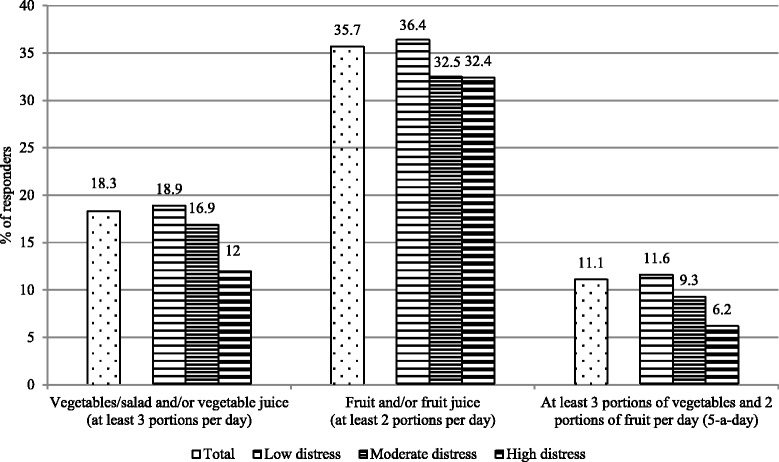
The 5-a-day recommendation was met by 11.6 % of the participants with low distress, 9.3 % of those with moderate distress, and 6.2 % of those with high distress. Consumers fulfilling the 5-a-day recommendation had lower odds of being highly or moderately distressed than individuals consuming less fruit and vegetables (moderate vs. low distress: OR = 0.82, 95 % confidence interval [CI] 0.69-0.97; high vs. low distress: OR = 0.55, 95 % CI 0.41-0.75).
Daily intake of 5 servings of fruit and vegetable was associated with lower psychological distress. Longitudinal studies are needed to further determine the causal nature of this relationship.
多项研究观察到饮食的各个方面与心理健康之间存在关联,但对于遵循每日五份水果和蔬菜的建议摄入量与心理健康之间的关系却知之甚少。因此,我们研究了瑞士每日建议的水果和蔬菜摄入量与心理困扰之间的关联。
分析了来自2012年瑞士健康调查的20220名15岁及以上个体的数据。每天建议的水果和蔬菜份数定义为每日五份(至少2份水果和3份蔬菜)。结果变量是过去4周内感知到的心理困扰(通过5项心理健康指数[MHI-5]测量)。区分了高度困扰(MHI-5得分≤52)、中度困扰(MHI-5>52且≤72)和低度困扰(MHI-5>72且≤100),并进行了针对已知混杂因素调整的多项逻辑回归分析。
低度困扰的参与者中有11.6%达到了每日五份的建议,中度困扰的参与者中有9.3%达到了该建议,高度困扰的参与者中有6.2%达到了该建议。达到每日五份建议的消费者比水果和蔬菜摄入量较少的个体出现高度或中度困扰的几率更低(中度困扰与低度困扰相比:比值比[OR]=0.82,95%置信区间[CI]0.69-0.97;高度困扰与低度困扰相比:OR=0.55,95%CI0.41-0.75)。
每日摄入五份水果和蔬菜与较低的心理困扰相关。需要进行纵向研究以进一步确定这种关系的因果性质。