Mauramo Elina, Lallukka Tea, Kanerva Noora, Salmela Jatta
Department of Public Health, Faculty of Medicine, University of Helsinki, P.O. Box 20, Helsinki, 00014, Finland.
Department of Food and Nutrition, Faculty of Agriculture and Forestry, University of Helsinki, Helsinki, Finland.
BMC Nutr. 2024 Dec 30;10(1):169. doi: 10.1186/s40795-024-00981-4.
Associations between fruit and vegetable consumption and mental health have been observed, but studies comparing different types of plant foods are sparse. This study among Finnish municipal employees examined associations of the consumption of a range of different plant foods with emotional well-being (EWB).
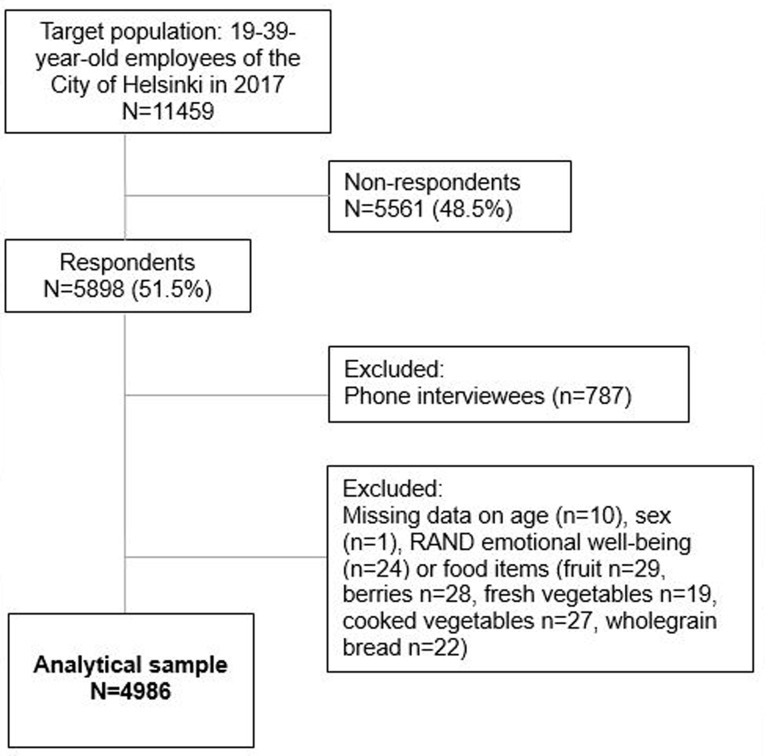
We used survey data from the Helsinki Health Study conducted in 2017 among 19-39-year-old employees of the City of Helsinki, Finland (N = 5898, response rate 51.5%, 80% women). Consumption of plant foods, including fruit, berries, fresh and cooked vegetables and wholegrain bread, was measured by a food frequency questionnaire and dichotomised into daily/non-daily consumption. The EWB scale of the RAND-36 questionnaire was dichotomised, with the lowest quartile indicating 'poor EWB' and the three higher quartiles indicating 'good EWB'. We used logistic regression for analysing the associations between plant food consumption and EWB. Analyses were sex-stratified and age, socioeconomic circumstances and psychosocial working conditions were adjusted for.
Prevalence of daily consumption of plant foods varied from 25% for berries and cooked vegetables to 70% for fresh vegetables. Daily consumption was associated with good EWB among both women and men. The strongest age-adjusted association was found for fresh vegetables, with women (OR 1.48, 95% CI 1.27-1.74) and men (OR 1.86, CI 1.37-2.52) with daily consumption having clearly higher odds of good EWB compared to non-daily consumers. Associations slightly attenuated but mostly remained after adjusting for socioeconomic circumstances and working conditions.
More frequent plant food consumption was associated with good EWB. Thus, the results support the need for interventions that investigate whether the promotion of plant food consumption could show potential mental health benefits among employees.
水果和蔬菜消费与心理健康之间的关联已被观察到,但比较不同类型植物性食物的研究较少。这项针对芬兰市政雇员的研究考察了一系列不同植物性食物的消费与情绪幸福感(EWB)之间的关联。
我们使用了2017年在芬兰赫尔辛基市19至39岁雇员中开展的赫尔辛基健康研究的调查数据(N = 5898,应答率51.5%,80%为女性)。通过食物频率问卷测量包括水果、浆果、新鲜和熟蔬菜以及全麦面包在内的植物性食物的消费量,并将其分为每日/非每日消费。RAND - 36问卷的EWB量表被二分,最低四分位数表示“情绪幸福感差”,较高的三个四分位数表示“情绪幸福感好”。我们使用逻辑回归分析植物性食物消费与EWB之间的关联。分析按性别分层,并对年龄、社会经济状况和心理社会工作条件进行了调整。
植物性食物的每日消费患病率从浆果和熟蔬菜的25%到新鲜蔬菜的70%不等。每日消费与男性和女性的良好情绪幸福感均相关。在年龄调整后,新鲜蔬菜的关联最强,与非每日消费者相比,每日消费的女性(比值比1.48,95%置信区间1.27 - 1.74)和男性(比值比1.86,置信区间1.37 - 2.52)具有良好情绪幸福感的几率明显更高。在调整社会经济状况和工作条件后,关联略有减弱但大多仍然存在。
更频繁地食用植物性食物与良好的情绪幸福感相关。因此,研究结果支持开展干预措施,以调查促进植物性食物消费是否能在雇员中显示出潜在的心理健康益处。