Nyabadza F, Bekele B T, Rúa M A, Malonza D M, Chiduku N, Kgosimore M
Department of Mathematical Science, University of Stellenbosch, South Africa.
South African Centre for Epidemiological Modelling and Analysis (SACEMA), Stellenbosch University, South Africa.
Biomed Res Int. 2015;2015:659651. doi: 10.1155/2015/659651. Epub 2015 Sep 6.
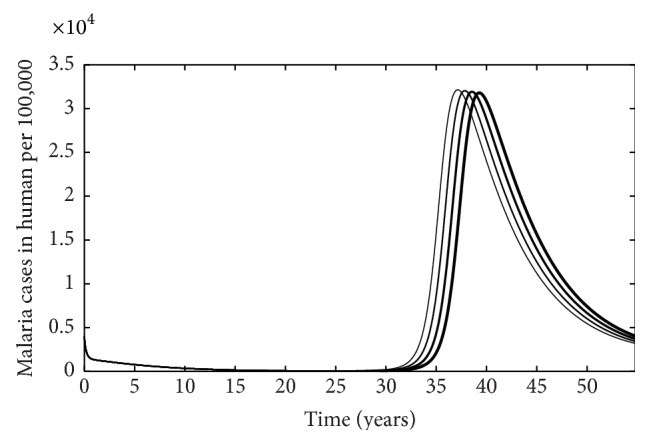
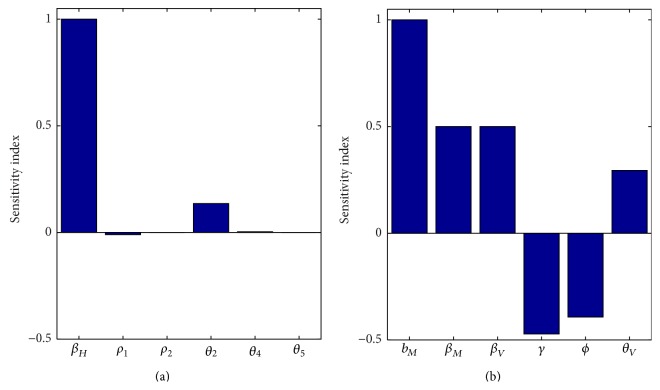
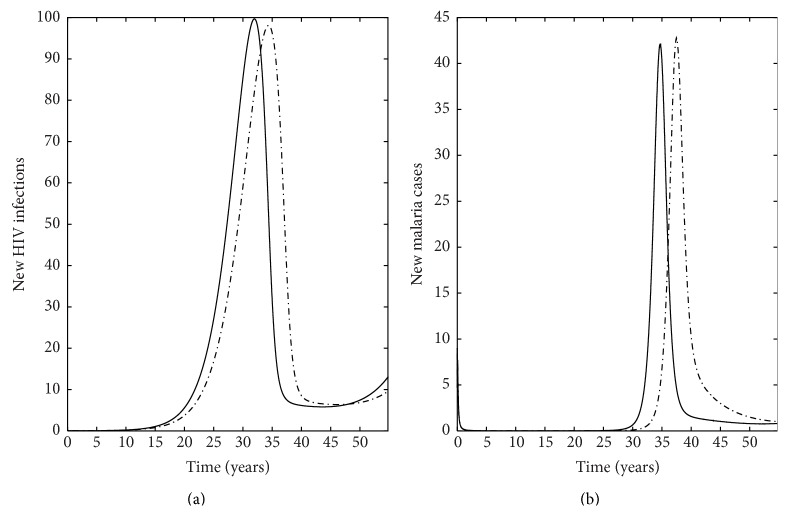
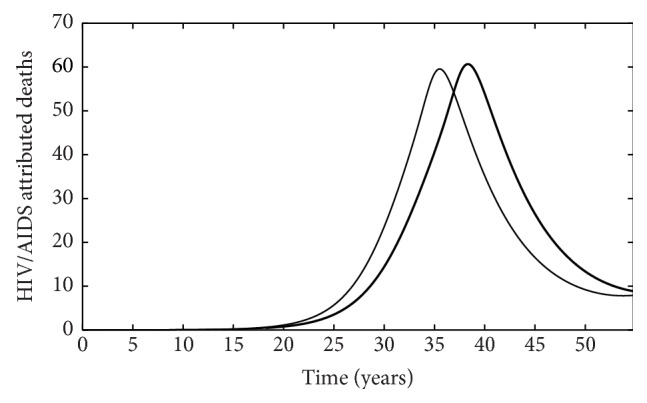
Most hosts harbor multiple pathogens at the same time in disease epidemiology. Multiple pathogens have the potential for interaction resulting in negative impacts on host fitness or alterations in pathogen transmission dynamics. In this paper we develop a mathematical model describing the dynamics of HIV-malaria coinfection. Additionally, we extended our model to examine the role treatment (of malaria and HIV) plays in altering populations' dynamics. Our model consists of 13 interlinked equations which allow us to explore multiple aspects of HIV-malaria transmission and treatment. We perform qualitative analysis of the model that includes positivity and boundedness of solutions. Furthermore, we evaluate the reproductive numbers corresponding to the submodels and investigate the long term behavior of the submodels. We also consider the qualitative dynamics of the full model. Sensitivity analysis is done to determine the impact of some chosen parameters on the dynamics of malaria. Finally, numerical simulations illustrate the potential impact of the treatment scenarios and confirm our analytical results.
在疾病流行病学中,大多数宿主同时感染多种病原体。多种病原体之间存在相互作用的可能性,这可能会对宿主健康产生负面影响,或改变病原体的传播动态。在本文中,我们建立了一个描述HIV-疟疾合并感染动态的数学模型。此外,我们扩展了模型,以研究(疟疾和HIV的)治疗在改变种群动态中所起的作用。我们的模型由13个相互关联的方程组成,这使我们能够探索HIV-疟疾传播与治疗的多个方面。我们对模型进行了定性分析,包括解的正性和有界性。此外,我们评估了与子模型相对应的繁殖数,并研究了子模型的长期行为。我们还考虑了完整模型的定性动态。进行了敏感性分析,以确定一些选定参数对疟疾动态的影响。最后,数值模拟说明了治疗方案的潜在影响,并证实了我们的分析结果。