Laboratory of Neuropsychology, The University of Hong Kong, Hong Kong ; Department of Affective Disorders, Guangzhou Brain Hospital, Affiliated Hospital of Guangzhou Medical University, Guangzhou, China ; Laboratory of Emotion and Cognition, Guangzhou Brain Hospital, Affiliated Hospital of Guangzhou Medical University, Guangzhou, China ; Laboratory of Cognitive Affective Neuroscience, The University of Hong Kong, Hong Kong.
Department of Affective Disorders, Guangzhou Brain Hospital, Affiliated Hospital of Guangzhou Medical University, Guangzhou, China ; Laboratory of Emotion and Cognition, Guangzhou Brain Hospital, Affiliated Hospital of Guangzhou Medical University, Guangzhou, China.
EBioMedicine. 2015 Jul 10;2(8):919-28. doi: 10.1016/j.ebiom.2015.06.027. eCollection 2015 Aug.
Validating the high-risk (HR) and ultra-high-risk (UHR) stages of bipolar disorder (BP) may help enable early intervention strategies.
We followed up with 44 offspring of parents with BP, subdividing into the HR and UHR categories. The offspring were aged 8-28 years and were free of any current DSM-IV diagnoses. Our multilevel, integrative approach encompassed gray matter (GM) volumes, brain network connectivity, neuropsychological performance, and clinical outcomes.
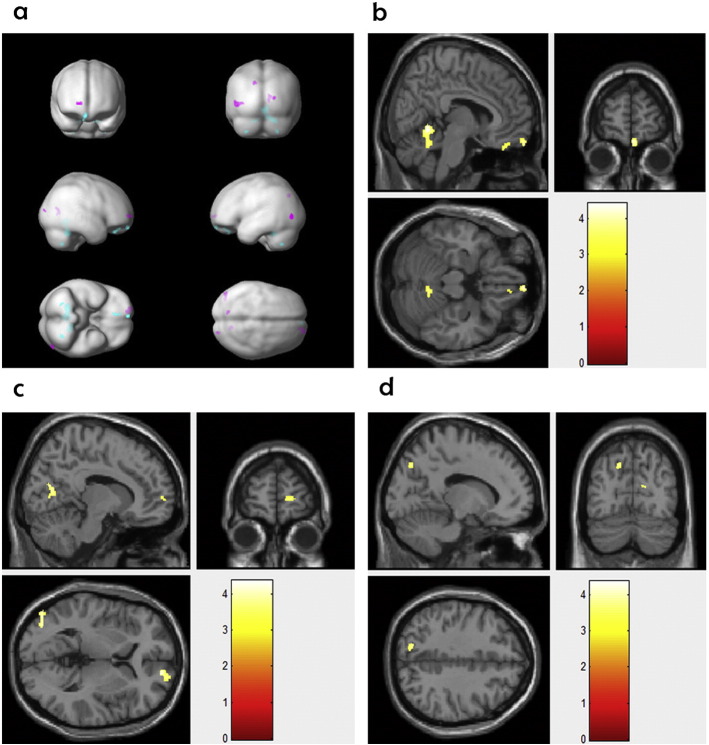
Compared with the healthy controls (HCs) (n = 33), the HR offspring (n = 26) showed GM volume reductions in the right orbitofrontal cortex. Compared with the HR offspring, the UHR offspring (n = 18) exhibited increased GM volumes in four regions. Both the HR and UHR offspring displayed abnormalities in the inferior occipital cortex regarding the measures of degree and centrality, reflecting the connections and roles of the region, respectively. In the UHR versus the HR offspring, the UHR offspring exhibited upwards-shifted small world topologies that reflect high clustering and efficiency in the brain networks. Compared with the HCs, the UHR offspring had significantly lower assortativity, which was suggestive of vulnerability. Finally, processing speed, visual-spatial, and general function were impaired in the UHR offspring but not in the HR offspring.
The abnormalities observed in the HR offspring appear to be inherited, whereas those associated with the UHR offspring represent stage-specific changes predisposing them to developing the disorder.
验证双相情感障碍(BP)的高危(HR)和超高危(UHR)阶段可能有助于实施早期干预策略。
我们对 44 名父母患有 BP 的子女进行了随访,将他们分为 HR 和 UHR 两类。这些子女年龄在 8-28 岁之间,没有任何当前 DSM-IV 诊断。我们采用多层次、综合的方法,包括脑灰质(GM)体积、脑网络连接、神经心理学表现和临床结果。
与健康对照组(HCs)(n=33)相比,HR 子女(n=26)右侧眶额皮层 GM 体积减少。与 HR 子女相比,UHR 子女(n=18)有四个区域的 GM 体积增加。HR 和 UHR 子女的下枕叶皮层在度和中心性的测量中都存在异常,分别反映了该区域的连接和作用。与 HR 子女相比,UHR 子女表现出向上移位的小世界拓扑结构,反映了大脑网络的高聚类和效率。与 HCs 相比,UHR 子女的聚类系数明显降低,这表明其具有脆弱性。最后,UHR 子女的处理速度、视觉空间和一般功能受损,但 HR 子女没有。
HR 子女的异常似乎是遗传的,而与 UHR 子女相关的异常则代表特定阶段的变化,使他们容易患上这种疾病。