Cho Shih-Feng, Yang Yi-Hsin, Liu Yi-Chang, Hsiao Hui-Hua, Huang Chiung-Tang, Wu Cheng-Han, Tsai Yu-Fen, Wang Hui-Ching, Liu Ta-Chih
Graduate Institute of Clinical Medicine, College of Medicine, Kaohsiung Medical University, Kaohsiung, Taiwan; Division of Hematology and Oncology, Department of Internal Medicine, Kaohsiung Medical University Hospital, Kaohsiung Medical University, Kaohsiung, Taiwan.
School of Pharmacy, Kaohsiung Medical University, Kaohsiung, Taiwan.
PLoS One. 2015 Oct 1;10(10):e0139289. doi: 10.1371/journal.pone.0139289. eCollection 2015.
The purpose of this study was to investigate the association between previous exposure to statins and the risk of non-Hodgkin lymphoma (NHL).
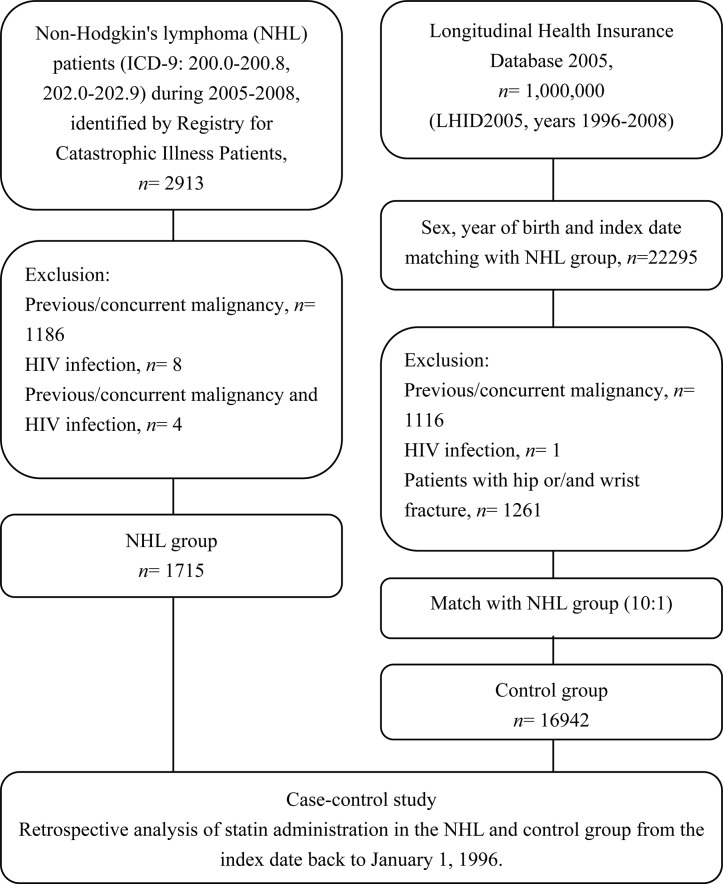
This nationwide population-based case-control study was conducted using the National Health Insurance Research Database of Taiwan. The NHL group consisted of the patients with a first-time diagnosis of NHL between 2005 and 2008. The cases of the control group were pair-matched to the NHL group according to sex, year of birth and date of NHL diagnosis (index date). The statin administration data from both groups were retrospectively collected from the index date to January 1, 1996. The cumulative defined daily dose (cDDD) was estimated to evaluate the statin exposure. Adjusted odds ratios (ORs) and 95% confidence intervals (CIs) were estimated using multivariate logistic regression.
The study population was composed of 1715 NHL patients and 16942 control subjects. The analysis revealed that previous statin administration was associated with a reduced risk of subsequent NHL with an adjusted OR of 0.52 (95% CI, 0.43-0.62). Additionally, there was a dose-response relationship between statin administration and the risk of NHL. The adjusted ORs were 0.63 (95% CI, 0.46-0.86), 0.58 (95% CI, 0.42-0.79), 0.51 (95% CI, 0.38-0.67), and 0.36 (95% CI, 0.24-0.53) for the subjects with statin administrations of fewer than 28, 28 to 90, 91 to 365, and more than 365 cDDDs, respectively, relative to the subjects without any statin administration.
The results of this study suggest that previous statin administration is associated with a lower risk of subsequent NHL. As statins are widely used medications, the magnitude of the risk reduction may have a substantial influence on public health. Further studies to confirm our findings are warranted.
本研究旨在调查既往使用他汀类药物与非霍奇金淋巴瘤(NHL)风险之间的关联。
本全国性基于人群的病例对照研究使用了台湾地区的国民健康保险研究数据库。NHL组由2005年至2008年间首次诊断为NHL的患者组成。对照组病例根据性别、出生年份和NHL诊断日期(索引日期)与NHL组进行配对。回顾性收集两组从索引日期至1996年1月1日的他汀类药物给药数据。估计累积限定日剂量(cDDD)以评估他汀类药物暴露情况。使用多因素逻辑回归估计调整后的比值比(OR)和95%置信区间(CI)。
研究人群包括1715例NHL患者和16942例对照对象。分析显示,既往使用他汀类药物与后续NHL风险降低相关,调整后的OR为0.52(95%CI,0.43 - 0.62)。此外,他汀类药物给药与NHL风险之间存在剂量反应关系。与未使用任何他汀类药物的对象相比,他汀类药物给药量少于28、28至90、91至365和超过365 cDDD的对象调整后的OR分别为0.63(95%CI,0.46 - 0.86)、0.58(95%CI,0.42 - 0.79)、0.51(95%CI,0.38 - 0.67)和0.36(95%CI,0.24 - 0.53)。
本研究结果表明,既往使用他汀类药物与后续NHL风险较低相关。由于他汀类药物是广泛使用的药物,风险降低的幅度可能对公众健康有重大影响。有必要进行进一步研究以证实我们的发现。