Pastori Daniele, Baratta Francesco, Carnevale Roberto, Cangemi Roberto, Del Ben Maria, Bucci Tommaso, Polimeni Licia, Labbadia Giancarlo, Nocella Cristina, Scardella Laura, Pani Arianna, Pignatelli Pasquale, Violi Francesco, Angelico Francesco
Department of Internal Medicine and Medical Specialties, Sapienza University, Rome, Italy.
Department of Anatomical, Histological, Forensic Medicine and Orthopedics Sciences, Rome, Italy.
Clin Transl Gastroenterol. 2015 Oct 1;6(10):e113. doi: 10.1038/ctg.2015.43.
Reduced vitamin E levels have been reported in patients with non-alcoholic steatohepatitis (NASH), but no conclusive data on patients with simple steatosis (SS) are available. Aim of this study was to investigate the association between serum vitamin E levels and SS.
A cohort of 312 patients with cardio-metabolic risk factors was screened for liver steatosis by ultrasonography (US). We reasonably classified as SS patients with US-fatty liver, normal liver function tests (LFTs) and with Cytokeratin 18 <246 mIU/ml. Liver biopsy was performed in 41 patients with US-fatty liver and persistent elevation of LFTs (>6 months). Serum cholesterol-adjusted vitamin E (Vit E/chol) levels were measured.
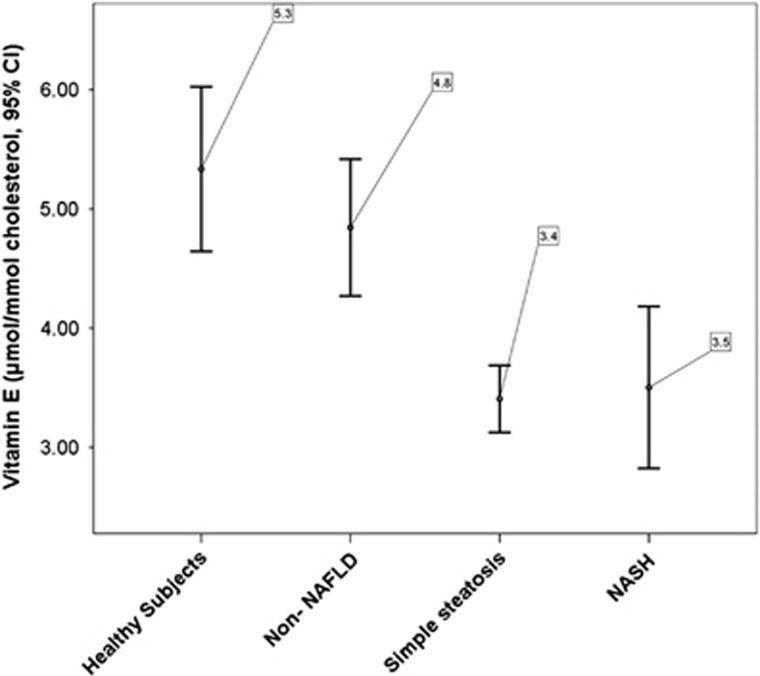
Mean age was 53.9±12.5 years and 38.4% were women. Non-alcoholic fatty liver disease (NAFLD) was detected at US in 244 patients; of those 39 had biopsy-proven NASH and 2 borderline NASH. Vit E/chol was reduced in both SS (3.4±2.0, P<0.001), and NASH (3.5±2.1, P=0.006) compared with non-NAFLD patients (4.8±2.0 μmol/mmol chol). No difference was found between SS and NASH (P=0.785). After excluding patients with NASH, a multivariable logistic regression analysis found that Vit E/chol (odds ratio (OR): 0.716, 95% confidence interval (CI) 0.602-0.851, P<0.001), alanine aminotransferase (ALT, OR: 1.093, 95% CI 1.029-1.161, P=0.004), body mass index (OR: 1.162, 95% CI 1.055-1.279, P=0.002) and metabolic syndrome (OR: 5.725, 95% CI 2.247-14.591, P<0.001) were factors independently associated with the presence of SS.
Reduced vitamin E serum levels are associated with SS, with a similar reduction between patients with SS and NASH, compared with non-NAFLD patients. Our findings suggest that the potential benefit of vitamin E supplementation should be investigated also in patients with SS.
已有报道称非酒精性脂肪性肝炎(NASH)患者的维生素E水平降低,但关于单纯性脂肪变性(SS)患者尚无确凿数据。本研究的目的是调查血清维生素E水平与SS之间的关联。
通过超声检查(US)对312例有心血管代谢危险因素的患者进行肝脏脂肪变性筛查。我们将超声检查显示脂肪肝、肝功能检查(LFTs)正常且细胞角蛋白18<246 mIU/ml的患者合理分类为SS患者。对41例超声检查显示脂肪肝且LFTs持续升高(>6个月)的患者进行了肝活检。测量了血清胆固醇校正的维生素E(维生素E/胆固醇)水平。
平均年龄为53.9±12.5岁,女性占38.4%。超声检查发现244例患者患有非酒精性脂肪性肝病(NAFLD);其中39例经活检证实为NASH,2例为临界NASH。与非NAFLD患者(4.8±2.0 μmol/mmol胆固醇)相比,SS患者(3.4±2.0,P<0.001)和NASH患者(3.5±2.1,P=0.006)的维生素E/胆固醇水平均降低。SS和NASH之间未发现差异(P=0.785)。排除NASH患者后,多变量逻辑回归分析发现,维生素E/胆固醇(比值比(OR):0.716,95%置信区间(CI)0.602-0.851,P<0.001)、丙氨酸转氨酶(ALT,OR:1.093,95%CI 1.029-1.161,P=0.004)、体重指数(OR:1.162,95%CI 1.055-1.279,P=0.002)和代谢综合征(OR:5.725,95%CI 2.247-14.591,P<0.001)是与SS存在独立相关的因素。
与非NAFLD患者相比,血清维生素E水平降低与SS相关,SS患者和NASH患者的降低程度相似。我们的研究结果表明,也应在SS患者中研究补充维生素E的潜在益处。