Rimmer Craig John, Gill Kathryn Ann, Greenfield Sheila, Dowswell George
Sandwell and West Birmingham Hospitals NHS Trust, Birmingham, UK.
University of Birmingham, Birmingham, UK.
BMC Health Serv Res. 2015 Oct 1;15:444. doi: 10.1186/s12913-015-1108-5.
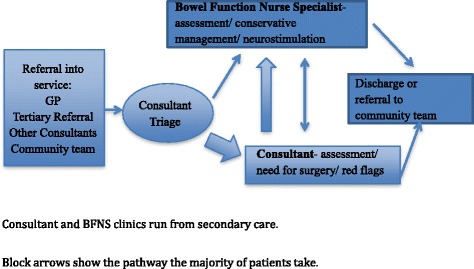
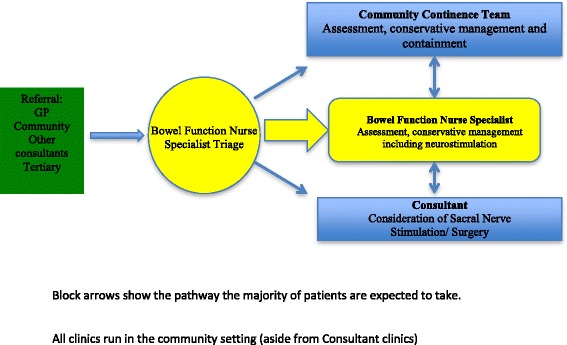
Faecal incontinence is a common, distressing and debilitating condition which remains largely hidden, leading to social isolation and loss of confidence. Patients with faecal incontinence experience delays in accessing appropriate treatment services due to embarrassment and lack of enquiry from primary care health professionals. Despite the publication of three government documents related to continence services in the last decade, these services are still fragmented with asynchronous delivery and poor inter-professional integration. The aim of the study was to describe a novel integrated care pathway for the management of faecal incontinence and examine the experiences of patients with faecal incontinence in relation to this pathway.
A focus group (eight participants) and narrative, qualitative individual interviews (five participants) were used to explore the views of patients with faecal incontinence, relating to access and quality of incontinence services and the new integrated care pathway. Emerging themes were identified from the transcribed focus group and interviews via the thematic analysis method.
The concept of an integrated care pathway is attractive for increasing accessibility, streamlining of the patient pathway and providing a dedicated service for the management of faecal incontinence. Patients' initial experiences of the pathway are positive.
A new ICP was developed and the initial patient evaluation of it was positive. Service users made various suggestions how the FI pathway could have been improved. The issues that patients were most concerned about were access to continence services, GP awareness of continence services and prompt, effective management of their condition. This service was set up within the pelvic floor dysfunction unit with BFNS and an integrated community continence team. The authors are aware that this is not a standard service setup across the country. The fact that it may be uncomfortable for patients to talk about their condition may have led to potential bias when discussing their beliefs or experiences. As with most qualitative studies, our aim was to identify a range of experiences rather than define our participant sample as being representative. Our participant sample was diverse in the key characteristics but a longitudinal study may reveal further important aspects of an ICP for FI.
An integrated care pathway for faecal incontinence appears to have potential to address the long-standing service delivery issues that have blighted continence services historically.
大便失禁是一种常见、令人痛苦且使人衰弱的病症,很大程度上仍不为人所知,会导致社交孤立和信心丧失。由于尴尬以及初级保健卫生专业人员缺乏询问,大便失禁患者在获得适当治疗服务方面存在延迟。尽管在过去十年中发布了三份与失禁服务相关的政府文件,但这些服务仍然零散,提供不同步且专业间整合不佳。本研究的目的是描述一种用于管理大便失禁的新型综合护理路径,并考察大便失禁患者对该路径的体验。
采用一个焦点小组(8名参与者)和叙述性定性个人访谈(5名参与者)来探讨大便失禁患者对失禁服务的可及性和质量以及新的综合护理路径的看法。通过主题分析方法从转录的焦点小组和访谈中确定新出现的主题。
综合护理路径的概念对于提高可及性、简化患者就医流程以及为大便失禁管理提供专门服务具有吸引力。患者对该路径的初步体验是积极的。
开发了一种新的综合护理路径,患者对其初步评价是积极的。服务使用者就如何改进大便失禁路径提出了各种建议。患者最关心的问题是获得失禁服务、全科医生对失禁服务的认知以及对其病情的及时、有效管理。该服务是在盆底功能障碍科室与英国国家卫生服务体系(NHS)的膀胱和肠道护理服务(BFNS)以及一个综合社区失禁护理团队内设立的。作者意识到这并非全国范围内的标准服务设置。患者谈论病情可能会感到不适这一事实,可能在讨论他们的信念或经历时导致潜在偏差。与大多数定性研究一样,我们的目的是识别一系列体验,而非将我们的参与者样本定义为具有代表性。我们的参与者样本在关键特征方面具有多样性,但纵向研究可能会揭示大便失禁综合护理路径的更多重要方面。
大便失禁综合护理路径似乎有潜力解决长期以来困扰失禁服务的服务提供问题。