Department of Surgery and Colorectal Surgery, Maastricht University Medical Centre, Maastricht, The Netherlands.
Department of Gastroenterology-Hepatology, Maastricht University Medical Centre, Maastricht, The Netherlands.
Qual Life Res. 2024 Nov;33(11):3121-3129. doi: 10.1007/s11136-024-03756-3. Epub 2024 Aug 14.
Faecal incontinence (FI) is a prevalent and debilitating anorectal problem causing embarrassment, anxiety, and social isolation, diminishing quality of life. At present there is no optimal treatment option for FI. Consequently, treatments primarily focus on symptom reduction and improving quality of life. Understanding patient experiences and outcomes they seek from treatment is crucial for improving care. This study aims to explore how FI impacts patients' lives and identify important treatment outcomes as part of the development of a Core Outcome Set (COS).
Patients with FI were recruited from outpatient clinics in the Netherlands. Semi-structured interviews were performed, audio recorded, transcribed per verbatim and coded. Thematic analysis was performed to identify (sub)themes and categories relevant to the patients.
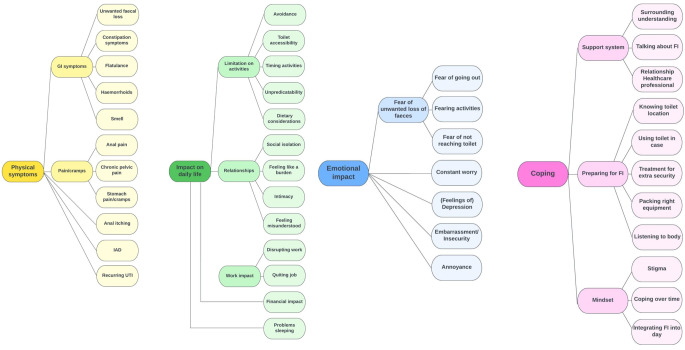
Twelve interviews were conducted before saturation was reached (75% female, 25% male, mean age 63, range 39-83 year). Four main themes emerged 'Physical symptoms', 'Impact on daily life', 'Emotional impact' and 'Coping'. Patients expressed how FI severely limits daily activities and emotional wellbeing. Treatment priorities centred on resuming normal activities rather than solely on symptom reduction.
The impact of FI extends far beyond uncontrolled loss of faeces, affecting psychological, emotional, and social wellbeing. Patients prioritise outcomes focussed on reclaiming normalcy and independence rather than focusing on physical symptoms alone. Integrating these patient-centered outcomes in future studies could enhance treatment satisfaction and patient-perceived treatment success. Furthermore, the outcomes identified in this study can be included in a Delphi survey alongside other relevant outcomes, paving the way for the development of a COS.
粪便失禁(FI)是一种普遍且使人虚弱的肛肠问题,会导致尴尬、焦虑和社交孤立,降低生活质量。目前,FI 没有最佳的治疗选择。因此,治疗主要侧重于减轻症状和改善生活质量。了解患者的体验以及他们对治疗的期望结果对于改善护理至关重要。本研究旨在探讨 FI 如何影响患者的生活,并确定重要的治疗结果,作为制定核心结局集(COS)的一部分。
从荷兰的门诊诊所招募 FI 患者。进行半结构化访谈,录音,逐字转录并进行编码。采用主题分析方法识别与患者相关的(子)主题和类别。
在达到饱和度之前进行了 12 次访谈(75%为女性,25%为男性,平均年龄 63 岁,范围 39-83 岁)。出现了四个主要主题:“身体症状”、“对日常生活的影响”、“情绪影响”和“应对”。患者表示 FI 严重限制了日常活动和情绪健康。治疗重点集中在恢复正常活动上,而不仅仅是减轻症状。
FI 的影响远远超出了无法控制的粪便流失,影响了心理、情感和社会健康。患者优先考虑的是恢复正常生活和独立,而不仅仅是关注身体症状。在未来的研究中纳入这些以患者为中心的结果可以提高治疗满意度和患者对治疗效果的感知。此外,本研究确定的结果可以与其他相关结果一起纳入 Delphi 调查,为开发 COS 铺平道路。