Division of Endocrinology and Metabolism, Department of Internal Medicine, Kangbuk Samsung Hospital, Sungkyunkwan University School of Medicine, Seoul, Korea.
Endocrinol Metab (Seoul). 2015 Sep;30(3):263-9. doi: 10.3803/EnM.2015.30.3.263.
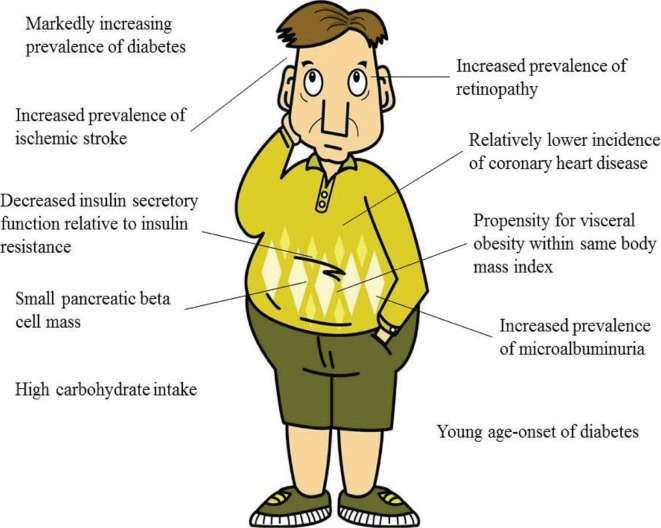
The prevalence of diabetes is increasing globally, particularly in Asia. According to the 2013 Diabetes Atlas, an estimated 366 million people are affected by diabetes worldwide; 36% of those affected live in the Western Pacific region, with a significant proportion in East Asia. The reasons for this marked increase in the prevalence of diabetes can be extrapolated from several distinct features of the Asian region. First, the two most populated countries, China and India, are located in Asia. Second, Asians have experienced extremely rapid economic growth, including rapid changes in dietary patterns, during the past decades. As a result, Asians tend to have more visceral fat within the same body mass index range compared with Westerners. In addition, increased insulin resistance relative to reduced insulin secretory function is another important feature of Asian individuals with diabetes. Young age of disease onset is also a distinctive characteristic of these patients. Moreover, changing dietary patterns, such as increased consumption of white rice and processed red meat, contributes to the deteriorated lifestyle of this region. Recent studies suggest a distinctive responsiveness to novel anti-diabetic agents in Asia; however, further research and efforts to reverse the increasing prevalence of diabetes are needed worldwide.
糖尿病的患病率在全球范围内不断上升,特别是在亚洲。根据 2013 年《糖尿病地图》,全球约有 3.66 亿人受糖尿病影响;其中 36%的患者居住在西太平洋地区,东亚地区的比例相当高。亚洲糖尿病患病率显著上升的原因可以从亚洲地区的几个显著特征中推断出来。首先,人口最多的两个国家中国和印度都位于亚洲。其次,在过去几十年里,亚洲经历了极其迅速的经济增长,包括饮食模式的快速变化。因此,亚洲人在相同的体重指数范围内,内脏脂肪往往比西方人更多。此外,与胰岛素分泌功能降低相比,胰岛素抵抗增加是亚洲糖尿病患者的另一个重要特征。发病年龄较小也是这些患者的一个显著特征。此外,饮食模式的改变,如白米和加工红肉消费的增加,导致了该地区生活方式的恶化。最近的研究表明,亚洲人对新型抗糖尿病药物有独特的反应;然而,全球仍需要进一步研究和努力来扭转糖尿病患病率不断上升的趋势。