Dong Jiangling, Dong Yanjun, Dong Yanlan, Chen Fang, Mitch William E, Zhang Liping
College of Life Sciences, Sichuan University, Chengdu 610065, China.
Baylor College of Medicine, Nephrology Division, Houston, TX, 77030.
Int J Obes (Lond). 2016 Mar;40(3):434-442. doi: 10.1038/ijo.2015.200. Epub 2015 Oct 5.
BACKGROUND/OBJECTIVE: In mice, a high-fat diet (HFD) induces obesity, insulin resistance and myostatin production. We tested whether inhibition of myostatin in mice can reverse these HFD-induced abnormalities.
SUBJECTS/METHODS: C57BL/6 mice were fed a HFD for 16 weeks including the final 4 weeks some mice were treated with an anti-myostatin peptibody. Body composition, the respiratory exchange ratio plus glucose and insulin tolerance tests were examined. Myostatin knock down in C2C12 cells was performed using small hairpin RNA lentivirus. Adipose tissue-derived stem cells were cultured to measure their responses to conditioned media from C2C12 cells lacking myostatin, or to recombinant myostatin or irisin. Isolated peritoneal macrophages were treated with myostatin or irisin to determine whether myostatin or irisin induce inflammatory mechanisms.
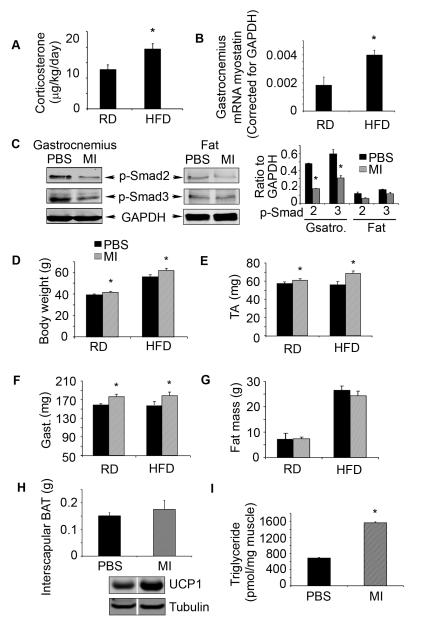
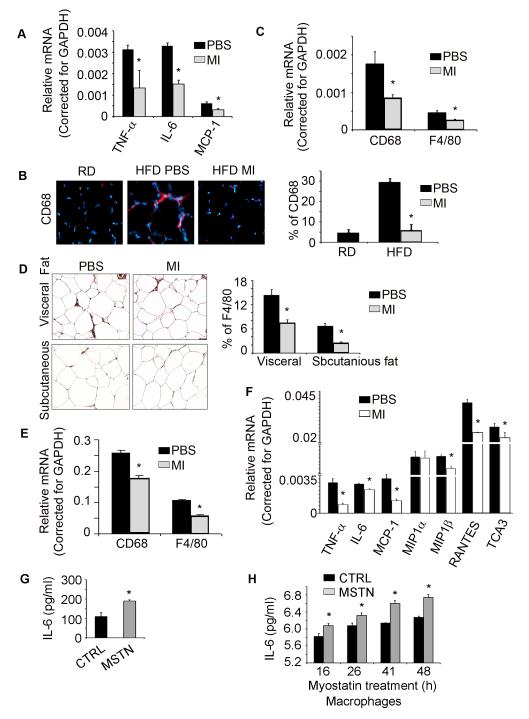
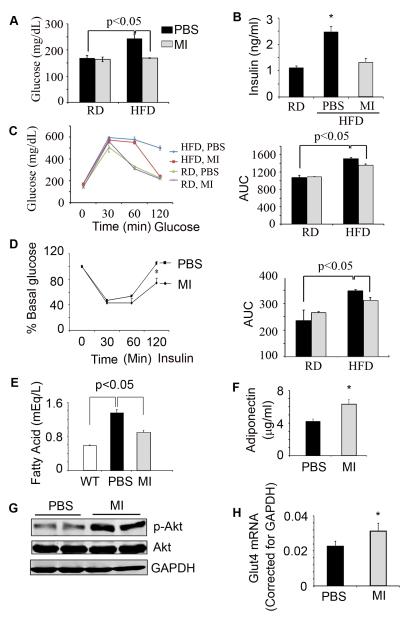
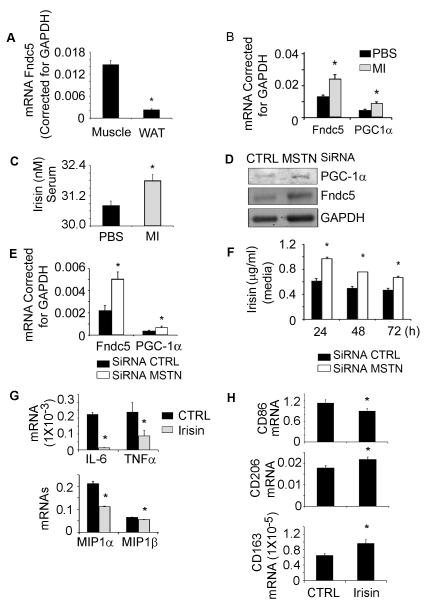
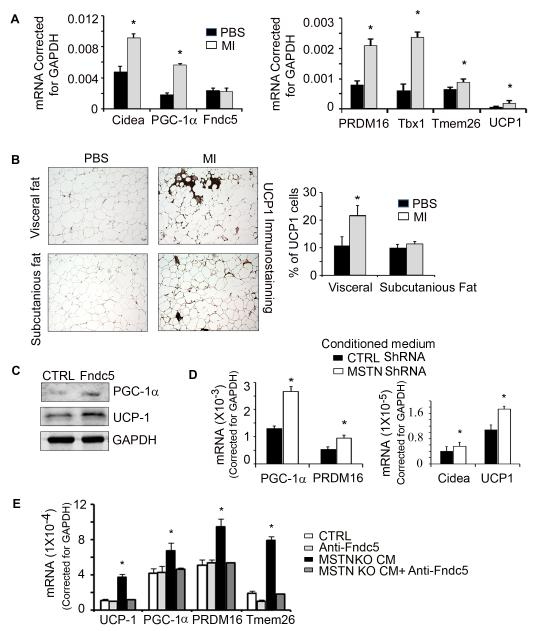
In HFD-fed mice, peptibody treatment stimulated muscle growth and improved insulin resistance. The improved glucose and insulin tolerances were confirmed when we found increased muscle expression of p-Akt and the glucose transporter, Glut4. In HFD-fed mice, the peptibody suppressed macrophage infiltration and the expression of proinflammatory cytokines in both the muscle and adipocytes. Inhibition of myostatin caused the conversion of white (WAT) to brown adipose tissue, whereas stimulating fatty acid oxidation and increasing energy expenditure. The related mechanism is a muscle-to-fat cross talk mediated by irisin. Myostatin inhibition increased peroxisome proliferator-activated receptor gamma, coactivator 1α expression and irisin production in the muscle. Irisin then stimulated WAT browning. Irisin also suppresses inflammation and stimulates macrophage polarization from M1 to M2 types.
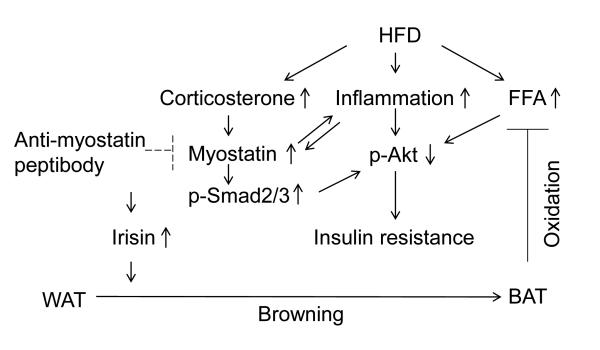
These results uncover a metabolic pathway from an increase in myostatin that suppresses irisin leading to the activation of inflammatory cytokines and insulin resistance. Thus, myostatin is a potential therapeutic target to treat insulin resistance of type II diabetes as well as the shortage of brown/beige fat in obesity.
背景/目的:在小鼠中,高脂饮食(HFD)会诱发肥胖、胰岛素抵抗和肌肉生长抑制素的产生。我们测试了抑制小鼠体内的肌肉生长抑制素是否能逆转这些由高脂饮食诱发的异常情况。
受试者/方法:C57BL/6小鼠被喂食高脂饮食16周,在最后4周,部分小鼠用抗肌肉生长抑制素肽抗体进行治疗。检测身体组成、呼吸交换率以及葡萄糖和胰岛素耐量试验。使用小发夹RNA慢病毒在C2C12细胞中敲低肌肉生长抑制素。培养脂肪组织来源的干细胞,以测量它们对来自缺乏肌肉生长抑制素的C2C12细胞的条件培养基、重组肌肉生长抑制素或鸢尾素的反应。用肌肉生长抑制素或鸢尾素处理分离的腹膜巨噬细胞,以确定肌肉生长抑制素或鸢尾素是否诱导炎症机制。
在喂食高脂饮食的小鼠中,肽抗体治疗刺激了肌肉生长并改善了胰岛素抵抗。当我们发现肌肉中p-Akt和葡萄糖转运蛋白Glut4的表达增加时,葡萄糖和胰岛素耐量得到改善得到了证实。在喂食高脂饮食的小鼠中,肽抗体抑制了巨噬细胞浸润以及肌肉和脂肪细胞中促炎细胞因子的表达。抑制肌肉生长抑制素导致白色脂肪组织(WAT)向棕色脂肪组织转化,同时刺激脂肪酸氧化并增加能量消耗。相关机制是由鸢尾素介导的肌肉与脂肪之间的相互作用。抑制肌肉生长抑制素会增加肌肉中过氧化物酶体增殖物激活受体γ共激活因子1α的表达和鸢尾素的产生。然后鸢尾素刺激白色脂肪组织褐变。鸢尾素还能抑制炎症并刺激巨噬细胞从M1型向M2型极化。
这些结果揭示了一条代谢途径,即肌肉生长抑制素增加会抑制鸢尾素,导致炎性细胞因子激活和胰岛素抵抗。因此,肌肉生长抑制素是治疗II型糖尿病胰岛素抵抗以及肥胖症中棕色/米色脂肪缺乏的潜在治疗靶点。