Sharma Sumit, Tapashetti Roopali P, Patil Sudhir R, Kalra Sonali Medsinge, Bhat Geetha K, Guvva Sowjanya
Reader, Department of Periodontology, Jaipur Dental College and Hospital, Jaipur, Rajasthan, India.
Reader, Department of Periodontology, Al-Badar Dental College and Hospital, Gulbarga, Karnataka, India.
J Int Oral Health. 2015 Sep;7(9):101-7.
Periodontal disease is one of the most common and complex disease affecting mankind. Being multifactorial in etiology it encompasses a variety of infectious entities with various unique microbial constellations and immune responses. A bacteriologic cause alone seems insufficient in explaining several clinical features of the periodontal disease. Recent studies suggest that periodontal herpes viruses comprise an important source of triggering periodontal tissue destruction. The following study aims to assess human cytomegalovirus (HCMV), Epstein-Barr virus (EBV-I) interaction with the established periodontopathic bacteriae, Porphyromonas gingivalis (Pg) and Aggregatibacter actinomycetemcomitans (Aa) in pathogenesis of aggressive periodontitis (AgP) using Hotstart polymerase chain reaction (PCR).
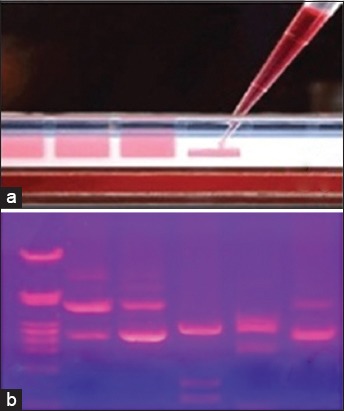
A total of 30 subjects, 15 with AgP and 15 healthy controls contributed random subgingival plaque samples. PCR methodology was used to identify the subgingival herpesviruses, Pg, and Aa. Yates corrected Chi-square test was employed to identify a statistical association between herpesviruses and periodontopathic bacteriae.
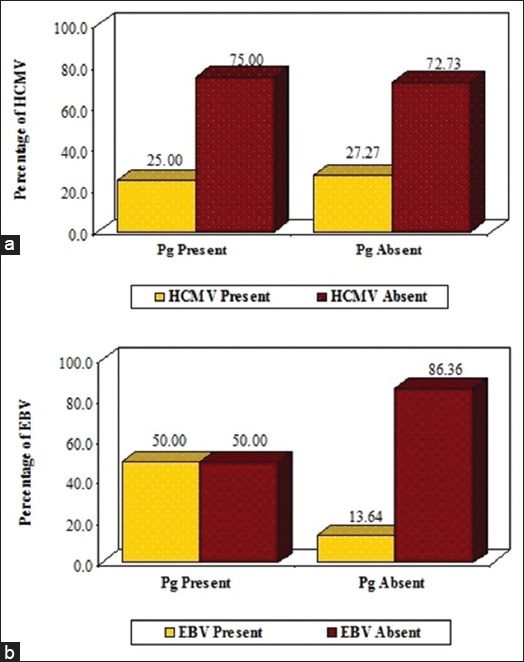
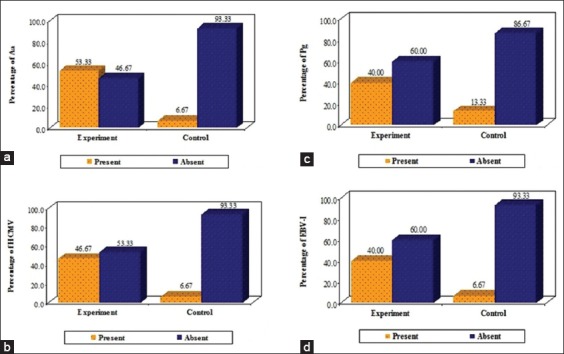
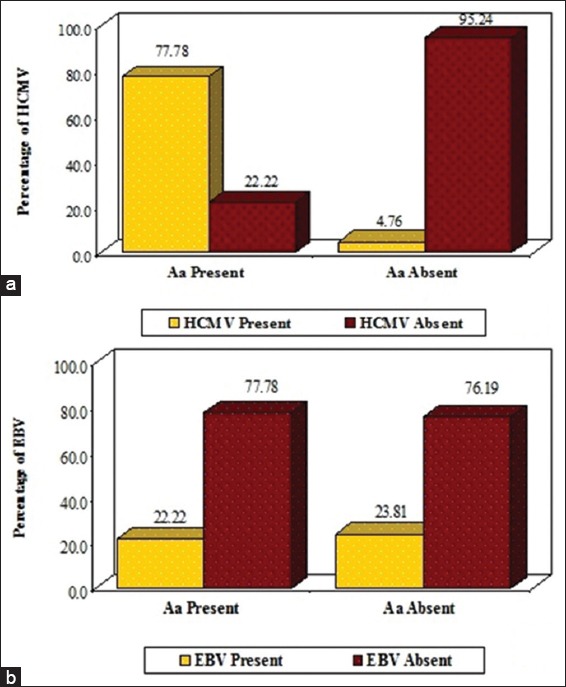
Findings suggested that viruses may be pertinent to disease progression. The prevalence of the periodontopathic bacteria Aa was found in 53.33% (P = 0.0168, S) and Pg in 40% (P = 0.2155, NS) of the AgP patients. Herpesviruses, HCMV and EBV-I were found to have a prevalence of 46.67% (P = 0.039, S) and 40% (P = 0.084, NS). The viral and bacterial co-infection was found to be 77.78% (P = 0.0002, S) with Aa and HCMV.
The present data reveals, viruses may exert periodontopathic effect by causing local immunosupression which may set a stage for the subgingival colonization and multiplication of periodontal bacteriae. Further studies are needed to develop an understanding into the significance of herpesviruses in human periodontitis which, may allow for improved diagnosis, more specific therapy and ultimately disease prevention.
牙周病是影响人类的最常见、最复杂的疾病之一。其病因是多因素的,涵盖了多种具有独特微生物群落和免疫反应的感染性病原体。仅细菌学病因似乎不足以解释牙周病的几种临床特征。最近的研究表明,牙周疱疹病毒是引发牙周组织破坏的重要来源。以下研究旨在使用热启动聚合酶链反应(PCR)评估人类巨细胞病毒(HCMV)、爱泼斯坦 - 巴尔病毒(EBV - I)与已确定的牙周病原菌牙龈卟啉单胞菌(Pg)和伴放线聚集杆菌(Aa)在侵袭性牙周炎(AgP)发病机制中的相互作用。
共有30名受试者,15名AgP患者和15名健康对照者提供了随机的龈下菌斑样本。采用PCR方法鉴定龈下疱疹病毒、Pg和Aa。采用耶茨校正卡方检验来确定疱疹病毒与牙周病原菌之间的统计学关联。
研究结果表明病毒可能与疾病进展相关。在AgP患者中,牙周病原菌Aa的患病率为53.33%(P = 0.0168,具有统计学意义),Pg的患病率为40%(P = 0.2155,无统计学意义)。发现疱疹病毒HCMV和EBV - I的患病率分别为46.67%(P = 0.039,具有统计学意义)和40%(P = 0.084,无统计学意义)。病毒与细菌的合并感染中,Aa和HCMV的合并感染率为77.78%(P = 0.0002,具有统计学意义)。
目前的数据表明,病毒可能通过引起局部免疫抑制发挥牙周致病作用,这可能为牙周细菌在龈下定植和繁殖创造条件。需要进一步研究以了解疱疹病毒在人类牙周炎中的意义,这可能有助于改善诊断、制定更具针对性的治疗方法并最终预防疾病。