Huang Chun-Jung, McAllister Matthew J, Slusher Aaron L, Webb Heather E, Mock J Thomas, Acevedo Edmund O
Exercise Biochemistry Laboratory, Department of Exercise Science and Health Promotion, Florida Atlantic University, 777 Glades Road, FH11A-126B, Boca Raton, FL 33431 USA.
Department of Kinesiology, Mississippi State University, Starkville, MS USA.
Sports Med Open. 2015;1(1):32. doi: 10.1186/s40798-015-0031-y. Epub 2015 Sep 23.
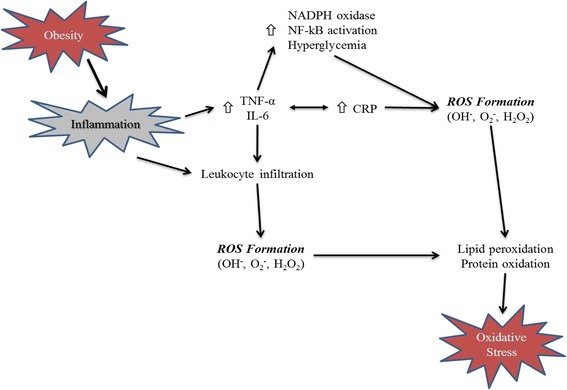
Obesity-related oxidative stress, the imbalance between pro-oxidants and antioxidants (e.g., nitric oxide), has been linked to metabolic and cardiovascular disease, including endothelial dysfunction and atherosclerosis. Reactive oxygen species (ROS) are essential for physiological functions including gene expression, cellular growth, infection defense, and modulating endothelial function. However, elevated ROS and/or diminished antioxidant capacity leading to oxidative stress can lead to dysfunction. Physical activity also results in an acute state of oxidative stress. However, it is likely that chronic physical activity provides a stimulus for favorable oxidative adaptations and enhanced physiological performance and physical health, although distinct responses between aerobic and anaerobic activities warrant further investigation. Studies support the benefits of dietary modification as well as exercise interventions in alleviating oxidative stress susceptibility. Since obese individuals tend to demonstrate elevated markers of oxidative stress, the implications for this population are significant. Therefore, in this review our aim is to discuss (i) the role of oxidative stress and inflammation as associated with obesity-related diseases, (ii) the potential concerns and benefits of exercise-mediated oxidative stress, and (iii) the advantageous role of dietary modification, including acute or chronic caloric restriction and vitamin D supplementation.
肥胖相关的氧化应激,即促氧化剂与抗氧化剂(如一氧化氮)之间的失衡,已与代谢和心血管疾病相关联,包括内皮功能障碍和动脉粥样硬化。活性氧(ROS)对于包括基因表达、细胞生长、感染防御和调节内皮功能在内的生理功能至关重要。然而,ROS升高和/或抗氧化能力下降导致氧化应激会引发功能障碍。体育活动也会导致急性氧化应激状态。然而,尽管有氧活动和无氧活动之间的不同反应值得进一步研究,但长期体育活动可能会刺激产生有益的氧化适应,提高生理表现和身体健康水平。研究支持饮食调整以及运动干预在减轻氧化应激易感性方面的益处。由于肥胖个体往往表现出氧化应激标志物升高,因此这一人群受到的影响很大。因此,在本综述中,我们的目的是讨论:(i)氧化应激和炎症在肥胖相关疾病中的作用;(ii)运动介导的氧化应激的潜在问题和益处;(iii)饮食调整的有益作用,包括急性或慢性热量限制以及补充维生素D。