Kim Min-Cheol, Whisler Jordan, Silberberg Yaron R, Kamm Roger D, Asada H Harry
BioSystems and Micromechanics IRG, Singapore MIT Alliance for Research and Technology, Singapore; Department of Mechanical Engineering, Massachusetts Institute of Technology, Cambridge, Massachusetts, United States of America.
Department of Mechanical Engineering, Massachusetts Institute of Technology, Cambridge, Massachusetts, United States of America.
PLoS Comput Biol. 2015 Oct 5;11(10):e1004535. doi: 10.1371/journal.pcbi.1004535. eCollection 2015 Oct.
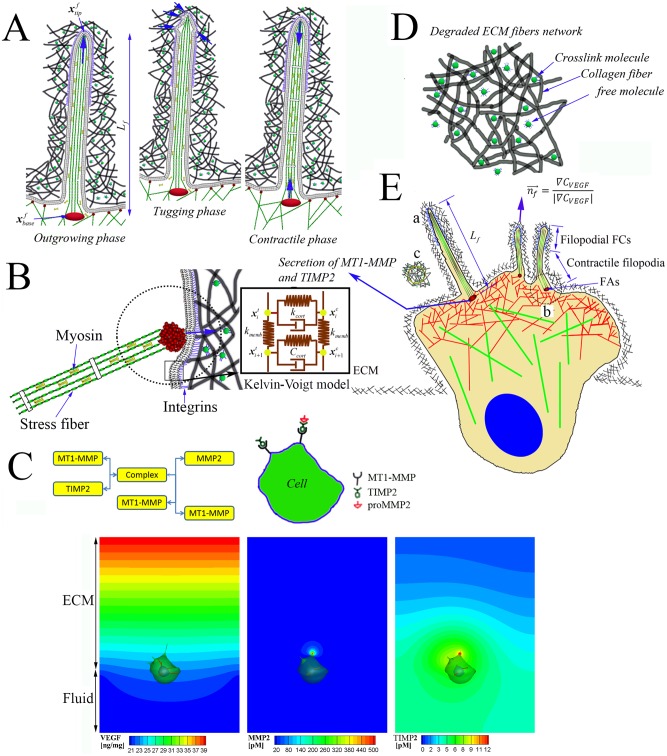
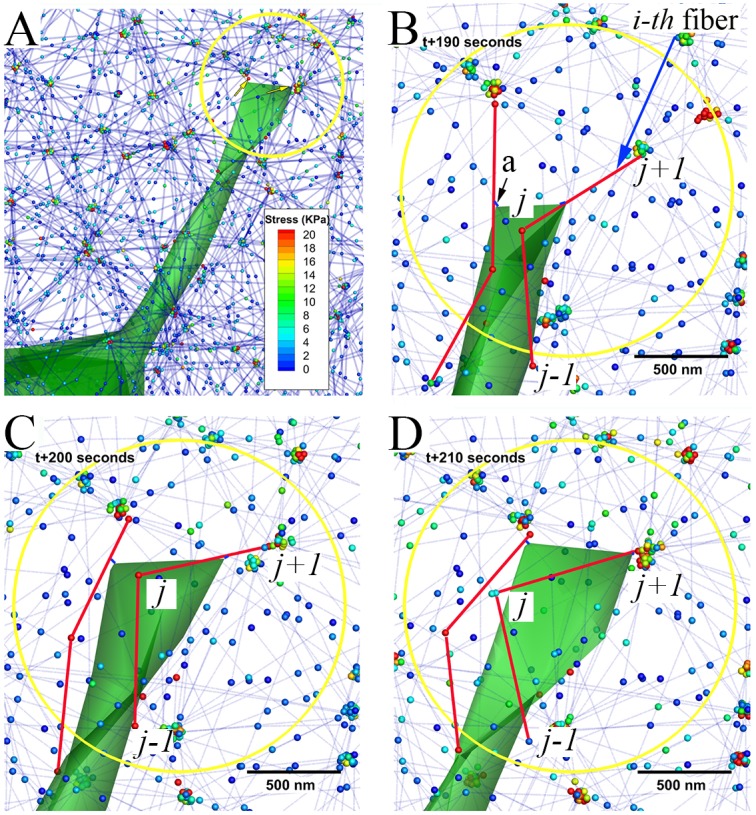
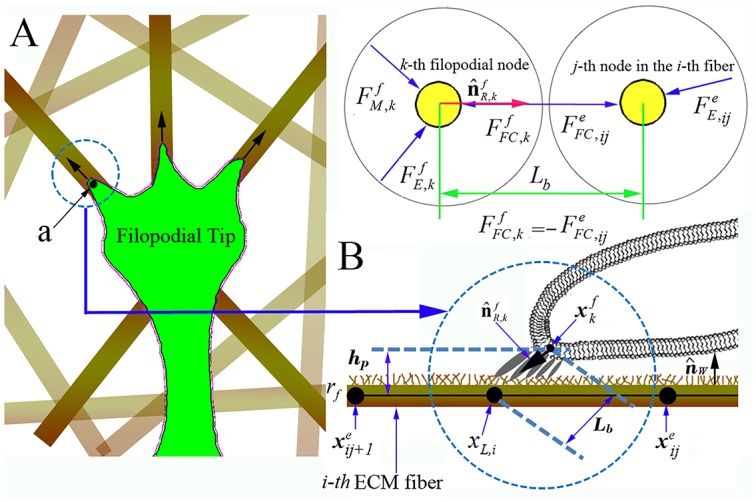
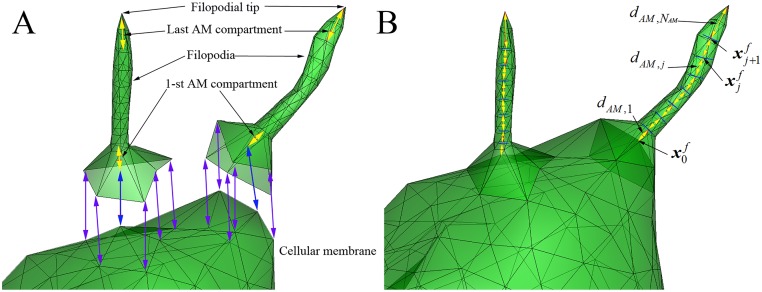
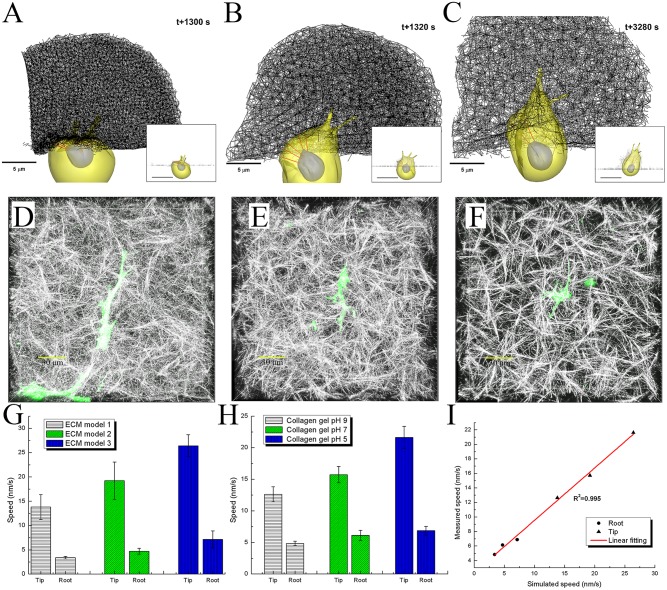
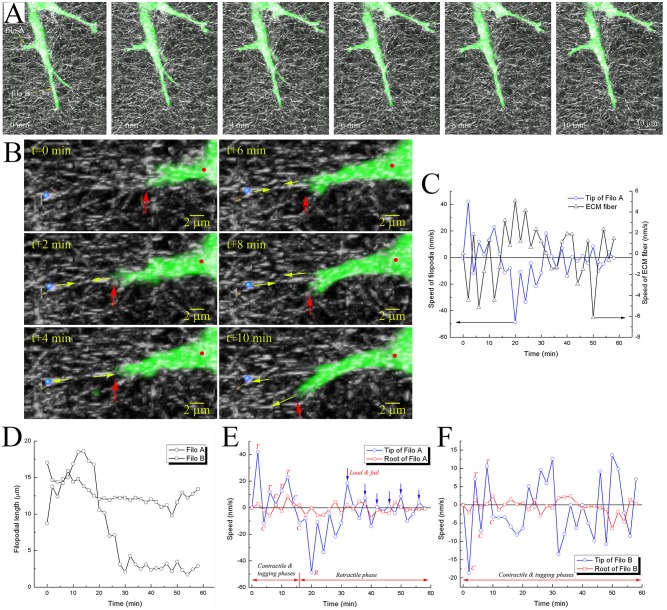
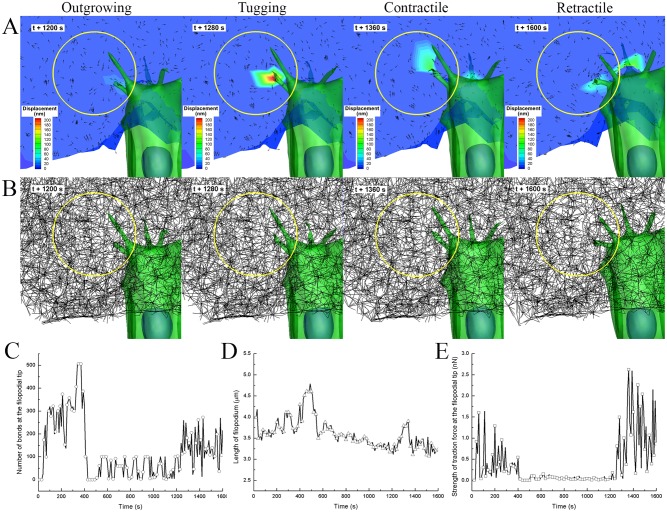
The dynamics of filopodia interacting with the surrounding extracellular matrix (ECM) play a key role in various cell-ECM interactions, but their mechanisms of interaction with the ECM in 3D environment remain poorly understood. Based on first principles, here we construct an individual-based, force-based computational model integrating four modules of 1) filopodia penetration dynamics; 2) intracellular mechanics of cellular and nuclear membranes, contractile actin stress fibers, and focal adhesion dynamics; 3) structural mechanics of ECM fiber networks; and 4) reaction-diffusion mass transfers of seven biochemical concentrations in related with chemotaxis, proteolysis, haptotaxis, and degradation in ECM to predict dynamic behaviors of filopodia that penetrate into a 3D ECM fiber network. The tip of each filopodium crawls along ECM fibers, tugs the surrounding fibers, and contracts or retracts depending on the strength of the binding and the ECM stiffness and pore size. This filopodium-ECM interaction is modeled as a stochastic process based on binding kinetics between integrins along the filopodial shaft and the ligands on the surrounding ECM fibers. This filopodia stochastic model is integrated into migratory dynamics of a whole cell in order to predict the cell invasion into 3D ECM in response to chemotaxis, haptotaxis, and durotaxis cues. Predicted average filopodia speed and that of the cell membrane advance agreed with experiments of 3D HUVEC migration at r(2) > 0.95 for diverse ECMs with different pore sizes and stiffness.
丝状伪足与周围细胞外基质(ECM)相互作用的动力学在各种细胞与ECM的相互作用中起着关键作用,但其在三维环境中与ECM相互作用的机制仍知之甚少。基于第一原理,我们在此构建了一个基于个体、基于力的计算模型,该模型整合了四个模块:1)丝状伪足穿透动力学;2)细胞膜和核膜、收缩性肌动蛋白应力纤维以及粘着斑动力学的细胞内力学;3)ECM纤维网络的结构力学;4)与趋化性、蛋白水解、触觉趋化性以及ECM中的降解相关的七种生化浓度的反应扩散传质,以预测穿透三维ECM纤维网络的丝状伪足的动态行为。每个丝状伪足的尖端沿着ECM纤维爬行,拉扯周围的纤维,并根据结合强度、ECM硬度和孔径收缩或缩回。这种丝状伪足与ECM的相互作用被建模为一个基于丝状伪足轴上的整合素与周围ECM纤维上的配体之间结合动力学的随机过程。这个丝状伪足随机模型被整合到整个细胞的迁移动力学中,以预测细胞在趋化性、触觉趋化性和硬度趋化性线索作用下对三维ECM的侵袭。预测的丝状伪足平均速度和细胞膜前进速度与不同孔径和硬度的多种ECM条件下三维人脐静脉内皮细胞(HUVEC)迁移实验结果相符,相关系数r(2) > 0.95。