Yang Jiyuan, Kopeček Jindřich
Department of Pharmaceutics and Pharmaceutical Chemistry, University of Utah, Salt Lake City, UT 84112, USA.
Department of Pharmaceutics and Pharmaceutical Chemistry, University of Utah, Salt Lake City, UT 84112, USA; Department of Bioengineering, University of Utah, Salt Lake City, UT 84112, USA.
J Control Release. 2016 Oct 28;240:9-23. doi: 10.1016/j.jconrel.2015.10.003. Epub 2015 Oct 3.
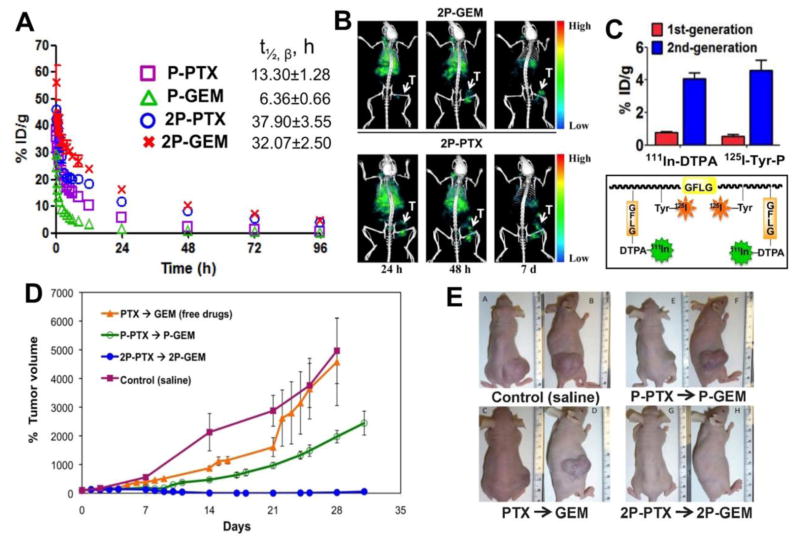
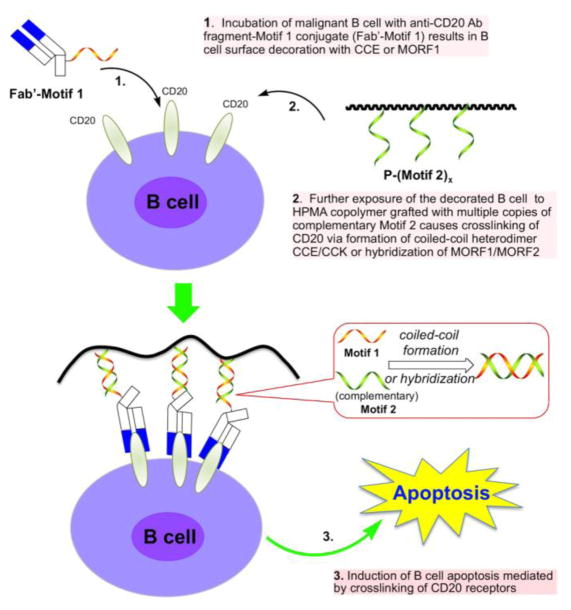
The state-of-the art in water-soluble macromolecular therapeutics has been reviewed. First the design principles for polymer-drug conjugates are discussed followed by two recent developments in the field: a) The design, synthesis and properties of backbone degradable N-(2-hydroxypropyl)methacrylamide (HPMA) copolymer-drug conjugates. The enhanced intravascular half-life of such conjugates creates a concentration gradient (blood vs. tumor) for an extended time interval resulting in increased solid tumor accumulation by enhanced permeability and retention (EPR) effect with concomitant increase in efficacy. b) Drug-free macromolecular therapeutics is a new paradigm in macromolecular therapeutics. Apoptosis in malignant cell is induced by crosslinking of cell surface non-internalizing receptors. Crosslinking of receptors is mediated by the biorecognition of two nanoconjugates containing high-fidelity complementary motifs (peptides or oligonucleotides). Results for the treatment of B cell lymphomas in animal models and patient cells demonstrate the high translational potential of this approach.
本文综述了水溶性大分子治疗药物的研究现状。首先讨论了聚合物-药物偶联物的设计原则,接着介绍了该领域最近的两项进展:a)主链可降解的N-(2-羟丙基)甲基丙烯酰胺(HPMA)共聚物-药物偶联物的设计、合成及性质。这类偶联物在血管内的半衰期延长,能在较长时间内形成浓度梯度(血液与肿瘤之间),通过增强的渗透和滞留(EPR)效应使实体瘤的蓄积增加,同时疗效提高。b)无药大分子治疗药物是大分子治疗领域的一种新范例。通过细胞表面非内化受体的交联诱导恶性细胞凋亡。受体的交联由两个含有高保真互补基序(肽或寡核苷酸)的纳米偶联物的生物识别介导。动物模型和患者细胞中B细胞淋巴瘤的治疗结果证明了该方法具有很高的转化潜力。