Huang Renhua, Gorman Kevin T, Vinci Chris R, Dobrovetsky Elena, Gräslund Susanne, Kay Brian K
Department of Biological Sciences, University of Illinois at Chicago, 900 S. Ashland Ave., Chicago, IL 60607, USA.
Structural Genomics Consortium, University of Toronto, 101 College St., Toronto, ON M5G1L7, Canada.
Int J Mol Sci. 2015 Sep 30;16(10):23587-603. doi: 10.3390/ijms161023587.
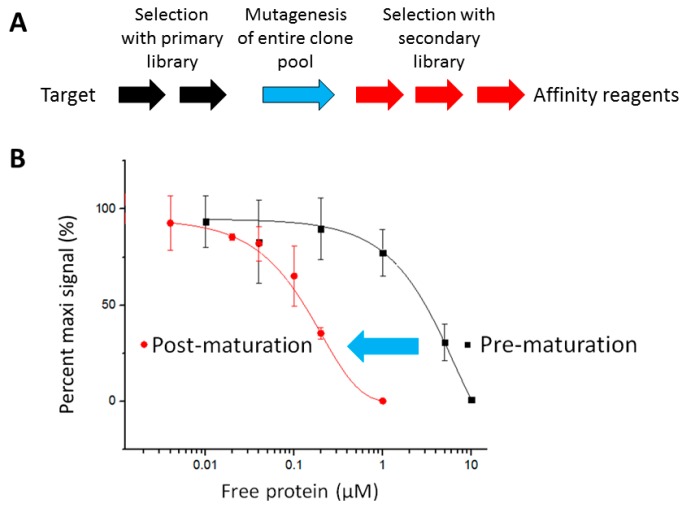
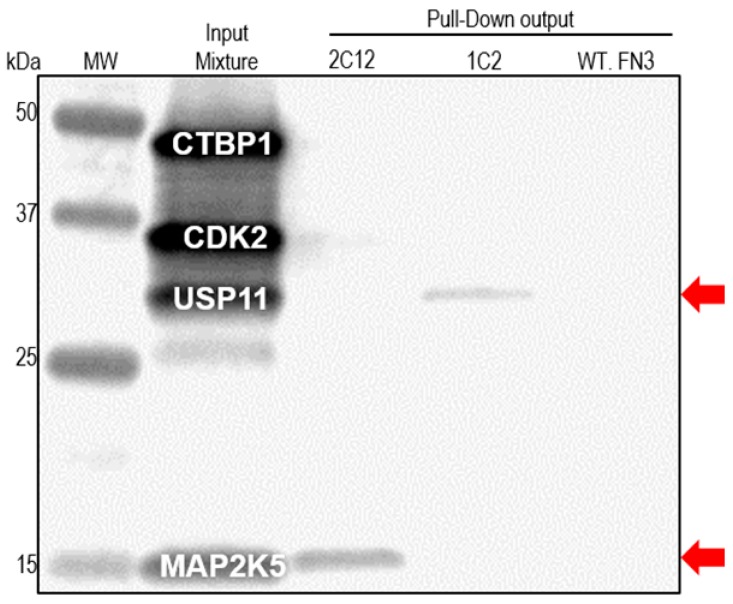
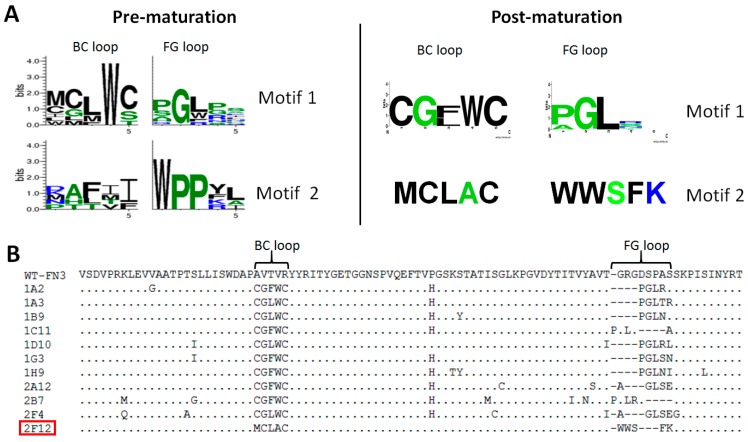
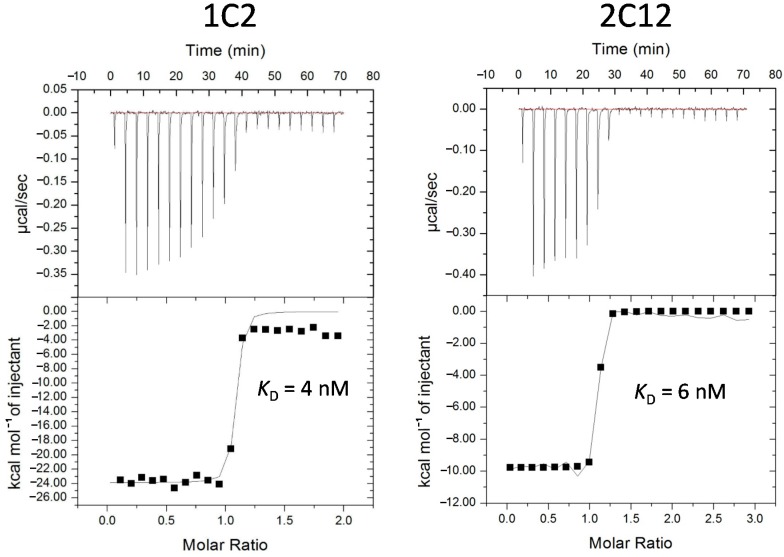
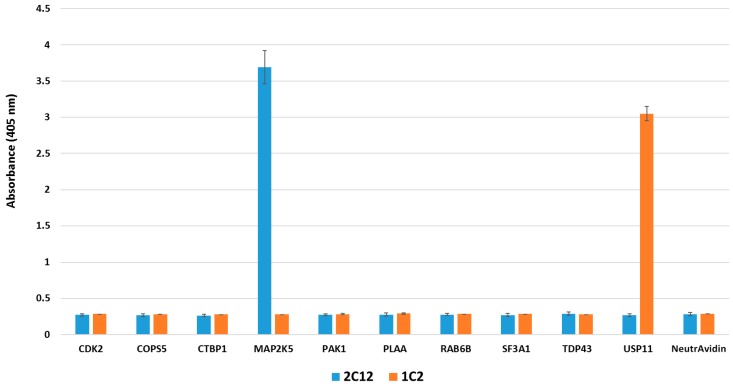
Often when generating recombinant affinity reagents to a target, one singles out an individual binder, constructs a secondary library of variants, and affinity selects a tighter or more specific binder. To enhance the throughput of this general approach, we have developed a more integrated strategy where the "affinity maturation" step is part of the phage-display pipeline, rather than a follow-on process. In our new schema, we perform two rounds of affinity selection, followed by error-prone PCR on the pools of recovered clones, generation of secondary libraries, and three additional rounds of affinity selection, under conditions of off-rate competition. We demonstrate the utility of this approach by generating low nanomolar fibronectin type III (FN3) monobodies to five human proteins: ubiquitin-conjugating enzyme E2 R1 (CDC34), COP9 signalosome complex subunit 5 (COPS5), mitogen-activated protein kinase kinase 5 (MAP2K5), Splicing factor 3A subunit 1 (SF3A1) and ubiquitin carboxyl-terminal hydrolase 11 (USP11). The affinities of the resulting monobodies are typically in the single-digit nanomolar range. We demonstrate the utility of two binders by pulling down the targets from a spiked lysate of HeLa cells. This integrated approach should be applicable to directed evolution of any phage-displayed affinity reagent scaffold.
在生成针对某一靶标的重组亲和试剂时,通常会挑选出一个单独的结合分子,构建一个变体二级文库,然后通过亲和筛选出亲和力更强或特异性更高的结合分子。为提高这种常规方法的通量,我们开发了一种更具整体性的策略,即将“亲和力成熟”步骤纳入噬菌体展示流程,而非后续过程。在我们的新方案中,我们进行两轮亲和筛选,随后对回收克隆池进行易错PCR,生成二级文库,并在解离速率竞争条件下再进行三轮亲和筛选。我们通过生成针对五种人类蛋白质的低纳摩尔亲和力的III型纤连蛋白(FN3)单克隆抗体来证明该方法的实用性,这五种蛋白质分别是泛素结合酶E2 R1(CDC34)、COP9信号体复合物亚基5(COPS5)、丝裂原活化蛋白激酶激酶5(MAP2K5)、剪接因子3A亚基1(SF3A1)和泛素羧基末端水解酶11(USP11)。所得单克隆抗体的亲和力通常在个位数纳摩尔范围内。我们通过从HeLa细胞的加标裂解物中下拉靶标来证明两种结合分子的实用性。这种整合方法应适用于任何噬菌体展示的亲和试剂支架的定向进化。