Anoh Augustin Etile, Akoua-Koffi Chantal, Couacy-Hymann Emmanuel, Pauly Maude, Schubert Grit, Mossoun Arsène, Weiss Sabrina, Leendertz Siv Aina J, Jarvis Michael A, Leendertz Fabian H, Ehlers Bernhard
Centre de Recherche pour le Développement, Université Alassane Ouattara de Bouake, 01 BP V18, Bouake, Côte d'Ivoire.
LANADA/Laboratoire Central de Pathologie Animale, Bingerville, 206, Côte d'Ivoire.
Virol J. 2015 Oct 5;12:155. doi: 10.1186/s12985-015-0394-1.
Cytomegaloviruses (CMVs) are herpesviruses that infect many mammalian species, including humans. Infection generally passes undetected, but the virus can cause serious disease in individuals with impaired immune function. Human CMV (HCMV) is circulating with high seroprevalence (60-100 %) on all continents. However, little information is available on HCMV genoprevalence and genetic diversity in subsaharan Africa, especially in rural areas of West Africa that are at high risk of human-to-human HCMV transmission. In addition, there is a potential for zoonotic spillover of pathogens through bushmeat hunting and handling in these areas as shown for various retroviruses. Although HCMV and nonhuman CMVs are regarded as species-specific, potential human infection with CMVs of non-human primate (NHP) origin, shown to circulate in the local NHP population, has not been studied.
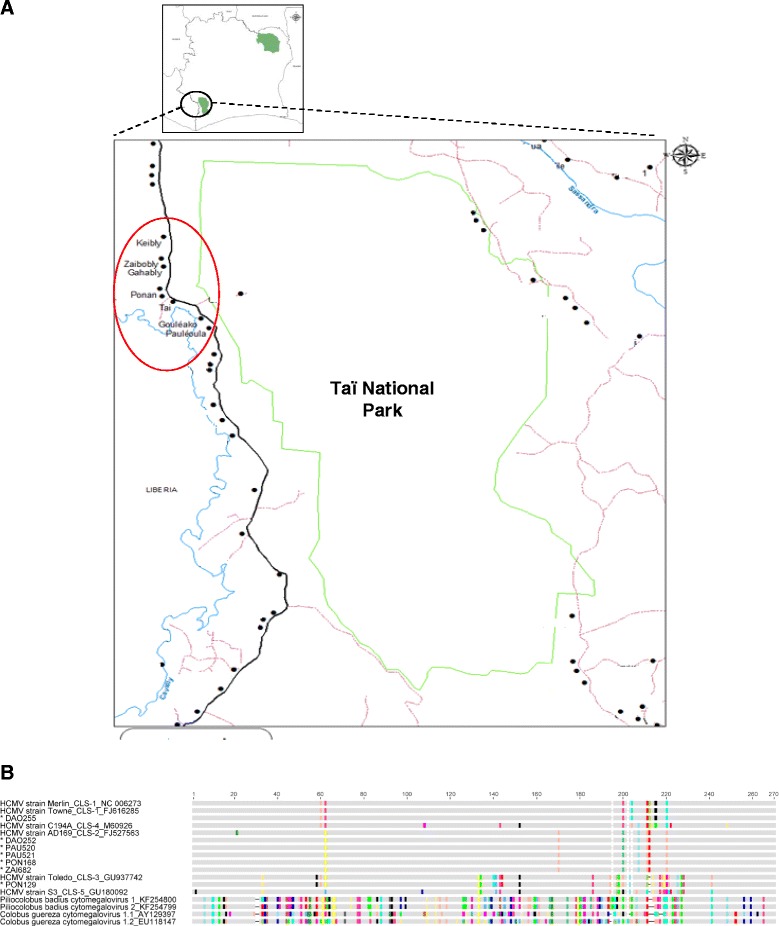
Analysis of 657 human oral swabs and fecal samples collected from 518 individuals living in 8 villages of Côte d'Ivoire with generic PCR for identification of human and NHP CMVs revealed shedding of HCMV in 2.5 % of the individuals. Determination of glycoprotein B sequences showed identity with strains Towne, AD169 and Toledo, respectively. NHP CMV sequences were not detected.
HCMV is actively circulating in a proportion of the rural Côte d'Ivoire human population with circulating strains being closely related to those previously identified in non-African countries. The lack of NHP CMVs in human populations in an environment conducive to cross-species infection supports zoonotic transmission of CMVs to humans being at most a rare event.
巨细胞病毒(CMV)是一种疱疹病毒,可感染包括人类在内的许多哺乳动物物种。感染通常未被察觉,但该病毒可在免疫功能受损的个体中引发严重疾病。人类巨细胞病毒(HCMV)在各大洲均有高血清流行率(60%-100%)传播。然而,关于撒哈拉以南非洲地区,尤其是西非农村地区HCMV基因流行率和遗传多样性的信息却很少,而这些地区存在较高的人际间HCMV传播风险。此外,正如各种逆转录病毒所示,在这些地区,通过猎捕和处理丛林肉存在病原体跨物种传播的可能性。尽管HCMV和非人CMV被认为具有物种特异性,但尚未对当地非人灵长类动物(NHP)群体中传播的、源自NHP的CMV潜在人类感染情况进行研究。
对从科特迪瓦8个村庄的518名居民采集的657份人类口腔拭子和粪便样本进行分析,采用通用PCR鉴定人类和NHP的CMV,结果显示2.5%的个体排出HCMV。糖蛋白B序列测定分别显示与汤氏株、AD169株和托莱多株相同。未检测到NHP CMV序列。
HCMV在科特迪瓦农村部分人群中活跃传播,传播的毒株与先前在非非洲国家鉴定的毒株密切相关。在有利于跨物种感染的环境中,人群中未检测到NHP CMV,这表明CMV跨物种传播给人类最多是一种罕见事件。