Malik Manasi, Parikh Ishita, Vasquez Jared B, Smith Conor, Tai Leon, Bu Guojun, LaDu Mary Jo, Fardo David W, Rebeck G William, Estus Steven
Department of Physiology and Sanders-Brown Center on Aging, University of Kentucky, 800 S. Limestone St, Lexington, KY, 40536, USA.
Department of Anatomy and Cell Biology, University of Illinois, Chicago, IL, USA.
Mol Neurodegener. 2015 Oct 5;10:52. doi: 10.1186/s13024-015-0048-1.
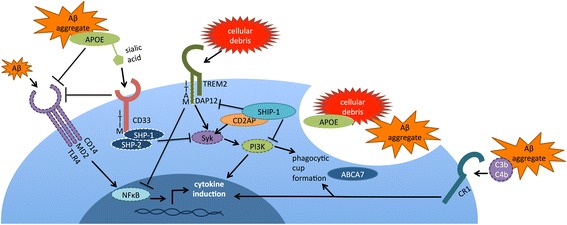
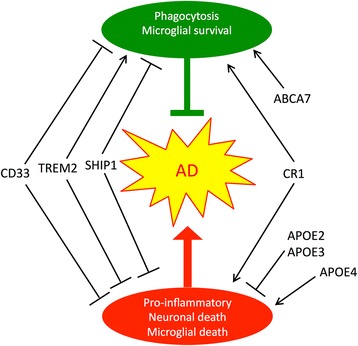
In the past five years, a series of large-scale genetic studies have revealed novel risk factors for Alzheimer's disease (AD). Analyses of these risk factors have focused attention upon the role of immune processes in AD, specifically microglial function. In this review, we discuss interpretation of genetic studies. We then focus upon six genes implicated by AD genetics that impact microglial function: TREM2, CD33, CR1, ABCA7, SHIP1, and APOE. We review the literature regarding the biological functions of these six proteins and their putative role in AD pathogenesis. We then present a model for how these factors may interact to modulate microglial function in AD.
在过去五年中,一系列大规模基因研究揭示了阿尔茨海默病(AD)的新风险因素。对这些风险因素的分析将注意力集中在免疫过程在AD中的作用,特别是小胶质细胞功能上。在本综述中,我们讨论基因研究的解读。然后,我们重点关注AD遗传学涉及的六个影响小胶质细胞功能的基因:触发受体表达于髓样细胞2(TREM2)、CD33、补体受体1(CR1)、三磷酸腺苷结合盒转运体A7(ABCA7)、肌醇多磷酸-5-磷酸酶1(SHIP1)和载脂蛋白E(APOE)。我们回顾了关于这六种蛋白质生物学功能及其在AD发病机制中假定作用的文献。然后,我们提出了一个模型,说明这些因素如何相互作用以调节AD中的小胶质细胞功能。