Nakamura Akihiro, Monma Yuto, Kajitani Shoko, Noda Kazuki, Nakajima Sota, Endo Hideaki, Takahashi Tohru, Nozaki Eiji
Department of Cardiology, Iwate Prefectural Central Hospital, 1-4-1 Ueda, Morioka, 020-0066, Japan.
Heart Vessels. 2016 Sep;31(9):1446-55. doi: 10.1007/s00380-015-0757-y. Epub 2015 Oct 6.
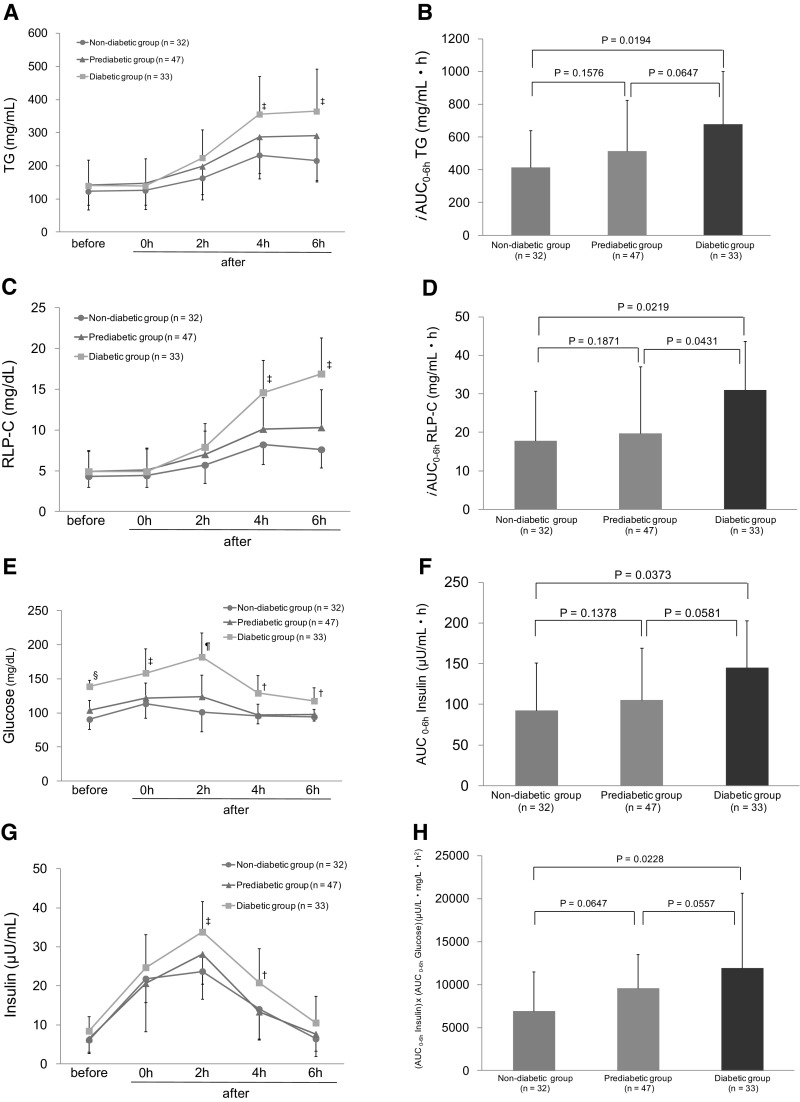
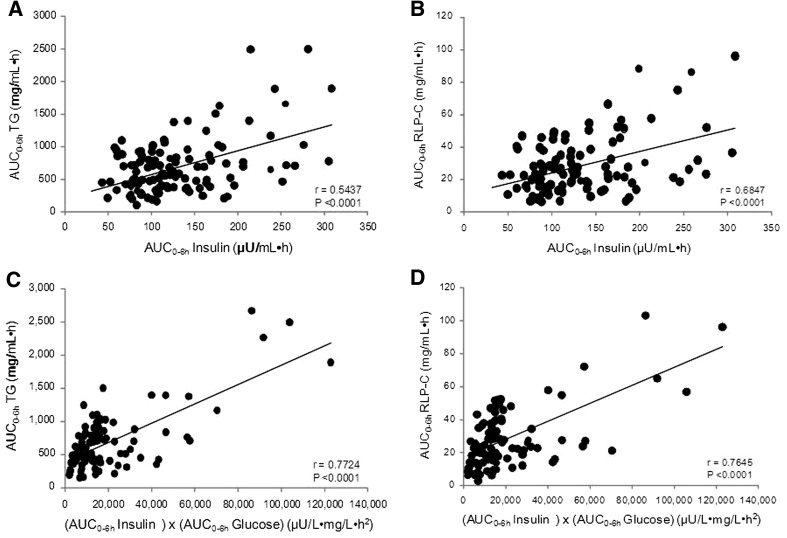
Both postprandial hyperlipidemia and hyperinsulinemia have been thought to play an important role in the development of atherosclerosis, and to be a potent risk factor for cardiovascular event. To examine effects of glycemic state on postprandial hyperlipidemia and hyperinsulinemia in patients with coronary artery disease (CAD), a total of 112 consecutive male pati ents with angiographically confirmed CAD were loaded with a high-fat and high-glucose test meal. CAD patients were divided into three groups as "non-diabetic", "prediabetic", and "diabetic" CAD groups. The serum triglyceride (TG) and remnant-like particle cholesterol (RLP-C) levels at the 6th hour in diabetic CAD group showed significantly higher than non-diabetic CAD group, and the incremental area under the curves (iAUCs) of these levels in diabetic CAD group were significantly greater than non-diabetic CAD group (TG, P = 0.0194; RLP-C, P = 0.0219). There were no significant differences in the iAUCs of TG or RLP-C between prediabetic and non-diabetic CAD group. The AUCs of plasma insulin levels or insulin resistance index (IRI): (AUCs of insulin) × (AUCs of glucose) as the insulin resistance marker were greater in diabetic CAD group than non-diabetic CAD group (insulin, P = 0.0373; IRI, P = 0.0228). The AUCs of serum TG or RLP-C levels showed a correlation with the AUCs of plasma insulin (AUC-TG, r = 0.5437, P < 0.0001; AUC-RLP-C, r = 0.6847, P < 0.0001), and they correlated well with the insulin resistance index (AUC-TG, r = 0.7724, P < 0.0001; AUC-RLP-C, r = 0.7645, P < 0.0001). We found that the insulin resistance showed a close relationship with postprandial hyperlipidemia in CAD patients. Diabetic, but not prediabetic state, may be a risk for postprandial impaired lipid metabolism in CAD patients.
餐后高脂血症和高胰岛素血症均被认为在动脉粥样硬化的发展过程中起重要作用,并且是心血管事件的一个重要危险因素。为了研究血糖状态对冠心病(CAD)患者餐后高脂血症和高胰岛素血症的影响,对112例经血管造影证实为CAD的男性患者连续给予高脂高糖试验餐。CAD患者被分为三组,即“非糖尿病”、“糖尿病前期”和“糖尿病”CAD组。糖尿病CAD组在第6小时的血清甘油三酯(TG)和残粒样颗粒胆固醇(RLP-C)水平显著高于非糖尿病CAD组,且糖尿病CAD组这些水平的曲线下增量面积(iAUCs)显著大于非糖尿病CAD组(TG,P = 0.0194;RLP-C,P = 0.0219)。糖尿病前期和非糖尿病CAD组之间TG或RLP-C的iAUCs无显著差异。糖尿病CAD组的血浆胰岛素水平或胰岛素抵抗指数(IRI):作为胰岛素抵抗标志物的(胰岛素的AUC)×(葡萄糖的AUC)的AUC大于非糖尿病CAD组(胰岛素,P = 0.0373;IRI,P = 0.0228)。血清TG或RLP-C水平的AUC与血浆胰岛素的AUC呈相关性(AUC-TG,r = 0.5437,P < 0.0001;AUC-RLP-C,r = 0.6847,P < 0.0001),并且它们与胰岛素抵抗指数相关性良好(AUC-TG,r = 0.7724,P < 0.0001;AUC-RLP-C,r = 0.7645,P < 0.0001)。我们发现胰岛素抵抗与CAD患者的餐后高脂血症密切相关。糖尿病状态而非糖尿病前期状态可能是CAD患者餐后脂质代谢受损的一个危险因素。