Gautier Hélène O B, Evans Kimberley A, Volbracht Katrin, James Rachel, Sitnikov Sergey, Lundgaard Iben, James Fiona, Lao-Peregrin Cristina, Reynolds Richard, Franklin Robin J M, Káradóttir Ragnhildur T
Wellcome Trust-Medical Research Council Cambridge Stem Cell Institute and Department of Veterinary Medicine, University of Cambridge, Tennis Court Road, Cambridge CB2 1QR, UK.
Faculty of Medicine, Division of Brain Sciences, Imperial College London, Hammersmith Hospital, London W12 0NN, UK.
Nat Commun. 2015 Oct 6;6:8518. doi: 10.1038/ncomms9518.
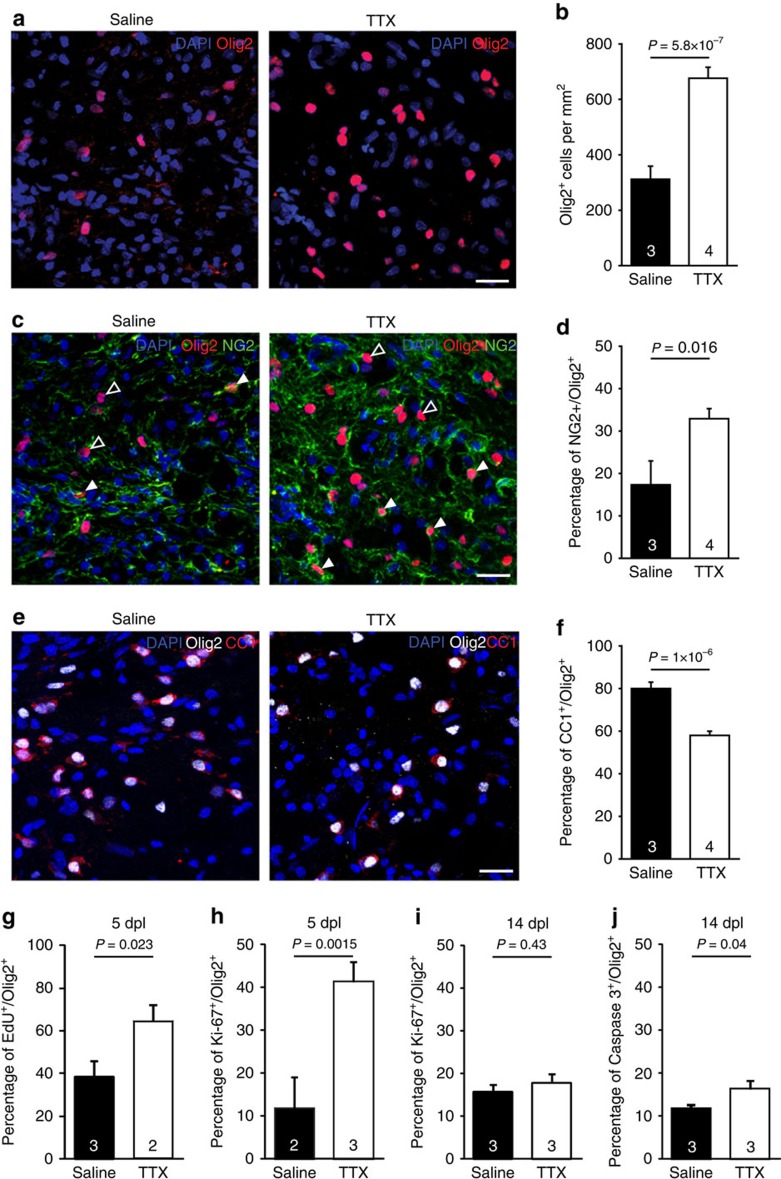
Myelin regeneration can occur spontaneously in demyelinating diseases such as multiple sclerosis (MS). However, the underlying mechanisms and causes of its frequent failure remain incompletely understood. Here we show, using an in-vivo remyelination model, that demyelinated axons are electrically active and generate de novo synapses with recruited oligodendrocyte progenitor cells (OPCs), which, early after lesion induction, sense neuronal activity by expressing AMPA (α-amino-3-hydroxy-5-methyl-4-isoxazolepropionic acid)/kainate receptors. Blocking neuronal activity, axonal vesicular release or AMPA receptors in demyelinated lesions results in reduced remyelination. In the absence of neuronal activity there is a ∼6-fold increase in OPC number within the lesions and a reduced proportion of differentiated oligodendrocytes. These findings reveal that neuronal activity and release of glutamate instruct OPCs to differentiate into new myelinating oligodendrocytes that recover lost function. Co-localization of OPCs with the presynaptic protein VGluT2 in MS lesions implies that this mechanism may provide novel targets to therapeutically enhance remyelination.
髓鞘再生可在诸如多发性硬化症(MS)等脱髓鞘疾病中自发发生。然而,其频繁失败的潜在机制和原因仍未完全明确。在此,我们利用体内髓鞘再生模型表明,脱髓鞘轴突具有电活性,并与募集的少突胶质前体细胞(OPC)形成新生突触,在损伤诱导后早期,这些细胞通过表达α-氨基-3-羟基-5-甲基-4-异恶唑丙酸(AMPA)/海人藻酸受体来感知神经元活动。阻断脱髓鞘损伤中的神经元活动、轴突囊泡释放或AMPA受体,会导致髓鞘再生减少。在缺乏神经元活动的情况下,损伤部位的OPC数量增加约6倍,分化的少突胶质细胞比例降低。这些发现揭示,神经元活动和谷氨酸释放指导OPC分化为新的髓鞘形成少突胶质细胞,从而恢复丧失的功能。MS损伤中OPC与突触前蛋白VGluT2的共定位意味着该机制可能为治疗性增强髓鞘再生提供新的靶点。