Tricker Penny J
Australian Centre for Plant Functional Genomics, School of Agriculture, Food and Wine, University of Adelaide , Urrbrae, SA, Australia.
Front Plant Sci. 2015 Sep 7;6:699. doi: 10.3389/fpls.2015.00699. eCollection 2015.
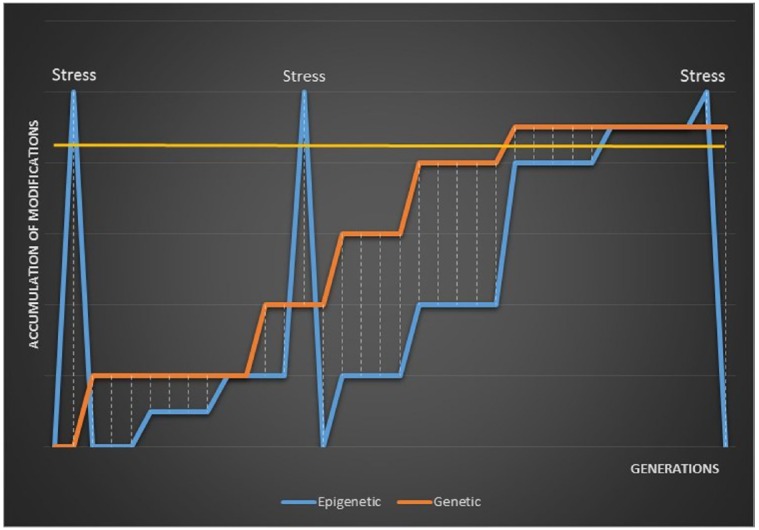
The transgenerational inheritance of stress-induced epigenetic modifications is still controversial. Despite several examples of defense "priming" and induced genetic rearrangements, the involvement and persistence of transgenerational epigenetic modifications is not known to be general. Here I argue that non-transmission of epigenetic marks through meiosis may be regarded as an epigenetic modification in itself, and that we should understand the implications for plant evolution in the context of both selection for and selection against transgenerational epigenetic memory. Recent data suggest that both epigenetic inheritance and resetting are mechanistically directed and targeted. Stress-induced epigenetic modifications may buffer against DNA sequence-based evolution to maintain plasticity, or may form part of plasticity's adaptive potential. To date we have tended to concentrate on the question of whether and for how long epigenetic memory persists. I argue that we should now re-direct our question to investigate the differences between where it persists and where it does not, to understand the higher order evolutionary methods in play and their contribution.
应激诱导的表观遗传修饰的跨代遗传仍然存在争议。尽管有几个防御“预激发”和诱导基因重排的例子,但跨代表观遗传修饰的参与和持续性是否普遍尚不清楚。在此我认为,减数分裂过程中表观遗传标记的不传递本身可能被视为一种表观遗传修饰,而且我们应该在选择跨代表观遗传记忆和选择反对跨代表观遗传记忆的背景下理解其对植物进化的影响。最近的数据表明,表观遗传遗传和重置在机制上都是有导向和有针对性的。应激诱导的表观遗传修饰可能缓冲基于DNA序列的进化以维持可塑性,或者可能构成可塑性适应潜力的一部分。迄今为止,我们倾向于专注于表观遗传记忆是否以及持续多久的问题。我认为我们现在应该重新引导我们的问题去研究它持续存在和不存在的地方之间的差异,以了解正在起作用的高阶进化方式及其贡献。