Johnston J G, van der Kooy D
Department of Anatomy, University of Toronto, ON, Canada.
Proc Natl Acad Sci U S A. 1989 Feb;86(3):1066-70. doi: 10.1073/pnas.86.3.1066.
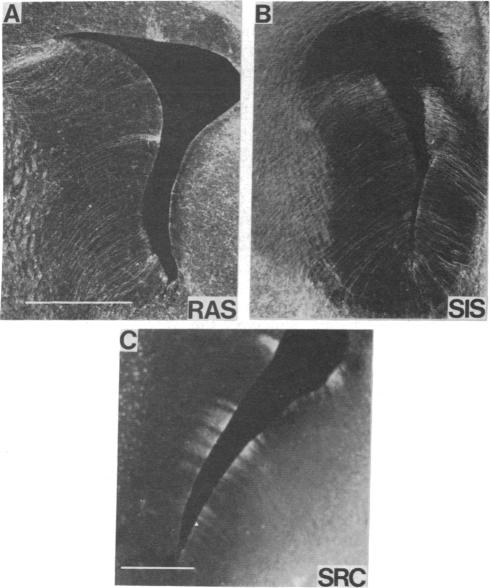
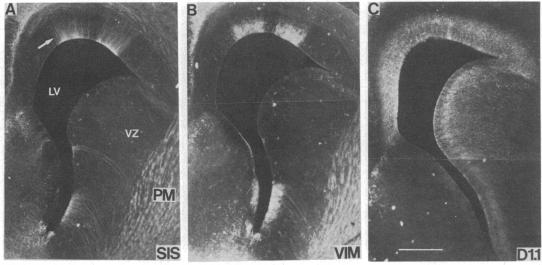
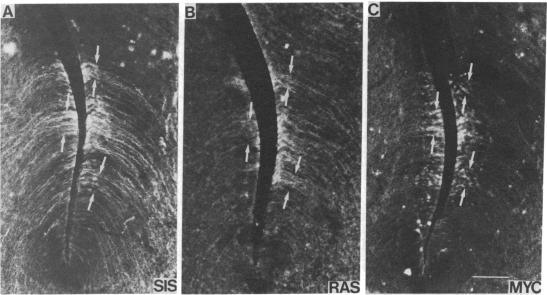
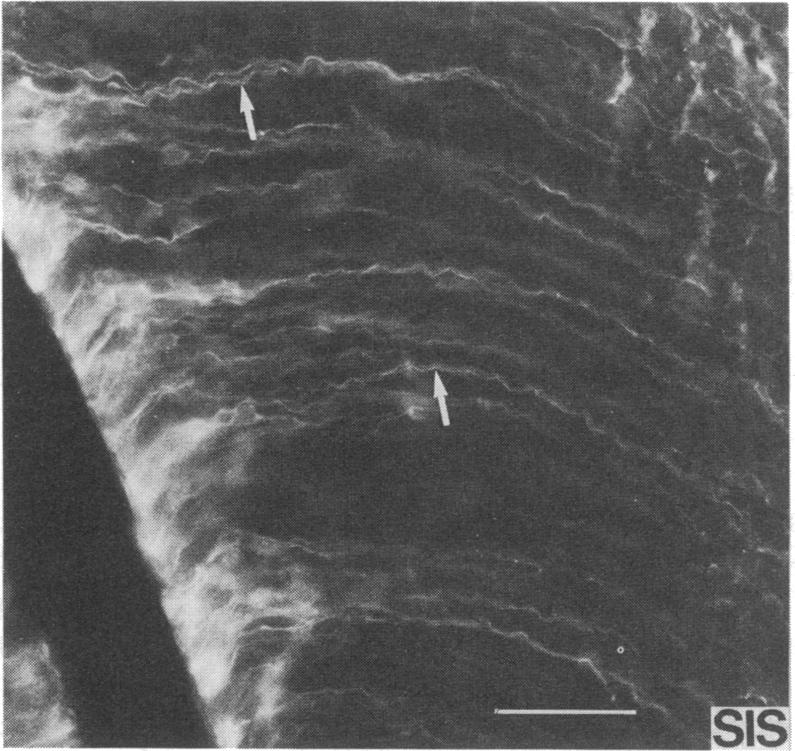
Immunocytochemical studies using monoclonal antibodies directed against oncogenic peptides revealed a heterogeneous distribution of the peptides within the ventricular zone of the embryonic day 18 rat forebrain. The sis-, src-, ras-, and myc-encoded peptides were concentrated in the same isolated clusters of 5-25 radial glial cells (also identified by vimentin staining), providing a transient columnar compartmentalization to the ventricular zone. An increased number of [3H]thymidine-labeled ventricular zone cells were observed within the protooncogene stained radial glial cell columns as compared to noncolumn areas. The columnar heterogeneity of radial glial cells reveals the mosaicism of the embryonic ventricular zone and the differential proliferation of its cells.
使用针对致癌肽的单克隆抗体进行的免疫细胞化学研究显示,在胚胎第18天大鼠前脑的脑室区,这些肽呈异质性分布。sis、src、ras和myc编码的肽集中在由5 - 25个放射状胶质细胞组成的相同孤立细胞簇中(也通过波形蛋白染色鉴定),为脑室区提供了一种短暂的柱状分隔。与非柱状区域相比,在原癌基因染色的放射状胶质细胞柱内观察到更多的[³H]胸腺嘧啶核苷标记的脑室区细胞。放射状胶质细胞的柱状异质性揭示了胚胎脑室区的镶嵌性及其细胞的差异增殖。