Arrospide Arantzazu, Rue Montserrat, van Ravesteyn Nicolien T, Comas Merce, Larrañaga Nerea, Sarriugarte Garbiñe, Mar Javier
Gipuzkoa AP-OSI Research Unit, Integrated Health Organization Alto Deba, Avda Navarra 16, 20500, Arrasate-Mondragón, Gipuzkoa, Spain.
Public Health Division of Gipuzkoa, BIODONOSTIA Research Institute, Paseo Dr Beguiristain s/n, 20014, Donostia, Gipuzkoa, Spain.
BMC Cancer. 2015 Oct 12;15:671. doi: 10.1186/s12885-015-1700-4.
Since the breast cancer screening programme in the Basque Country (BCSPBC) was started in 1996, more than 400,000 women aged 50 to 69 years have been invited to participate. Based on epidemiological observations and simulation techniques it is possible to extend observed short term data into anticipated long term results. The aim of this study was to assess the effectiveness of the programme through 2011 by quantifying the outcomes in breast cancer mortality, life-years gained, false positive results, and overdiagnosis.
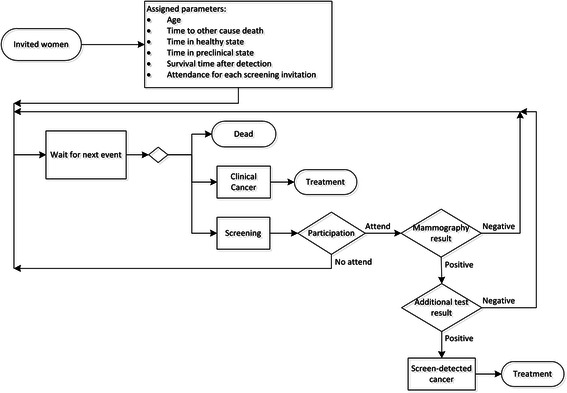
A discrete event simulation model was constructed to reproduce the natural history of breast cancer (disease-free, pre-clinical, symptomatic, and disease-specific death) and the actual observed characteristics of the screening programme during the evaluated period in the Basque women population. Goodness-of-fit statistics were applied for model validation. The screening effects were measured as differences in benefits and harms between the screened and unscreened populations. Breast cancer mortality reduction and life-years gained were considered as screening benefits, whereas, overdiagnosis and false positive results were assessed as harms. Results for a single cohort were also obtained.
The screening programme yielded a 16 % reduction in breast cancer mortality and a 10 % increase in the incidence of breast cancer through 2011. Almost 2 % of all the women in the programme had a false positive result during the evaluation period. When a single cohort was analysed, the number of deaths decreased by 13 %, and 4 % of screen-detected cancers were overdiagnosed. Each woman with BC detected by the screening programme gained 2.5 life years due to early detection corrected by lead time.
Fifteen years after the screening programme started, this study supports an important decrease in breast cancer mortality due to the screening programme, with reasonable risk of overdiagnosis and false positive results, and sustains the continuation of the breast cancer screening programme in the Basque population.
自1996年巴斯克地区乳腺癌筛查项目(BCSPBC)启动以来,已有超过40万名50至69岁的女性受邀参与。基于流行病学观察和模拟技术,有可能将观察到的短期数据扩展为预期的长期结果。本研究的目的是通过量化乳腺癌死亡率、获得的生命年数、假阳性结果和过度诊断等结果,评估该项目截至2011年的有效性。
构建了一个离散事件模拟模型,以再现乳腺癌的自然史(无病、临床前期、有症状和因病死亡)以及评估期间巴斯克女性人群中筛查项目的实际观察特征。采用拟合优度统计进行模型验证。筛查效果通过筛查人群和未筛查人群之间的益处和危害差异来衡量。乳腺癌死亡率降低和获得的生命年数被视为筛查益处,而过度诊断和假阳性结果被评估为危害。还获得了单个队列的结果。
截至2011年,筛查项目使乳腺癌死亡率降低了16%,乳腺癌发病率增加了10%。在评估期间,该项目中近2%的女性出现了假阳性结果。对单个队列进行分析时,死亡人数减少了13%,筛查发现的癌症中有4%被过度诊断。筛查项目检测出的每例乳腺癌患者因提前期校正后的早期发现而多获得了2.5个生命年。
筛查项目启动15年后,本研究支持该筛查项目使乳腺癌死亡率显著降低,同时存在合理的过度诊断和假阳性结果风险,并支持在巴斯克人群中继续开展乳腺癌筛查项目。