Lagerlund Magdalena, Merlo Juan, Vicente Raquel Pérez, Zackrisson Sophia
Department of Translational Medicine, Diagnostic Radiology, Lund University, Skåne University Hospital, Malmö, Sweden.
Unit for Social Epidemiology, Department of Clinical Sciences, Faculty of Medicine, Lund University, Malmö, Sweden.
PLoS One. 2015 Oct 13;10(10):e0140244. doi: 10.1371/journal.pone.0140244. eCollection 2015.
The public health impact of population-based mammography screening programs depends on high participation rates. Thus, monitoring participation rates, as well as understanding and considering the factors influencing attendance, is important. With the goal to acquire information on the appropriate level of intervention for increasing screening participation our study aimed to (1) examine whether, over and above individual factors, the neighborhood of residence influences a woman's mammography non-attendance, and (2) evaluate, whether knowing a woman's neighborhood of residence would be sufficient to predict non-attendance.
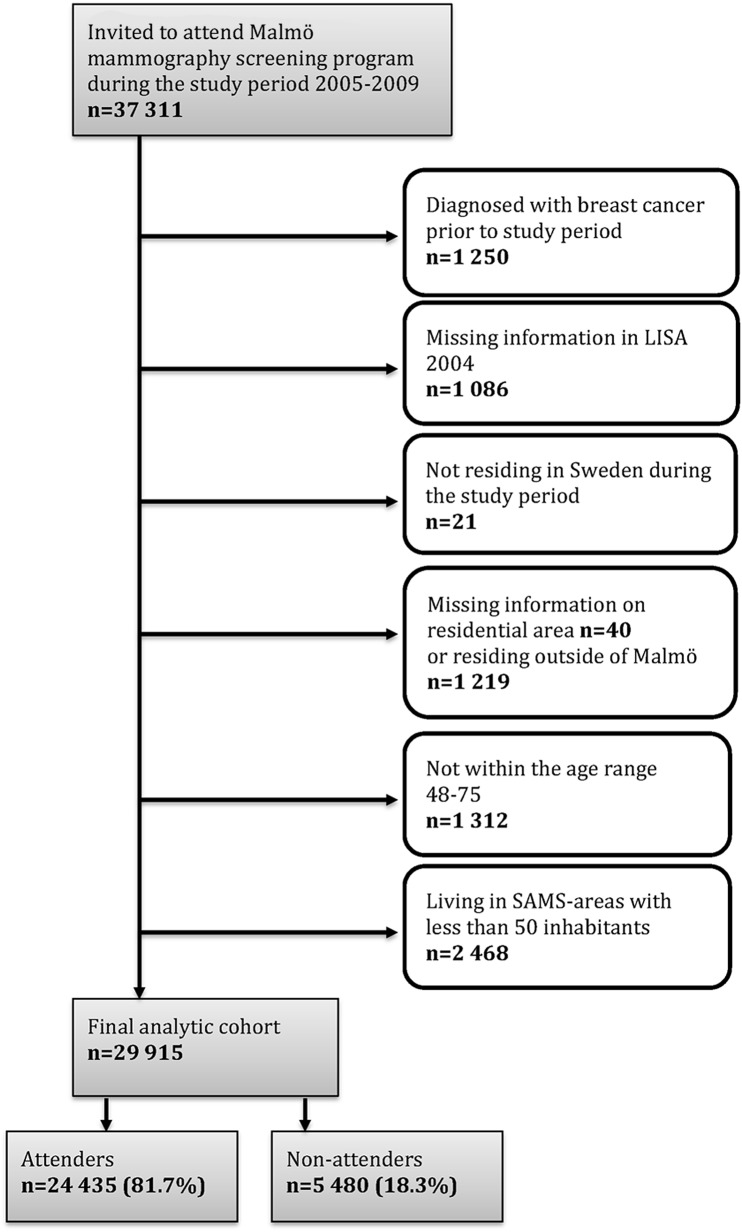
We analyze all women invited to mammography screening in 2005-09, residing in the city of Malmö, Sweden. Information regarding mammography screening attendance was linked to data on area of residence, demographic and socioeconomic characteristics available from Statistics Sweden. The influence of individual and neighborhood factors was assessed by multilevel logistic regression analysis with 29,901 women nested within 212 neighborhoods.
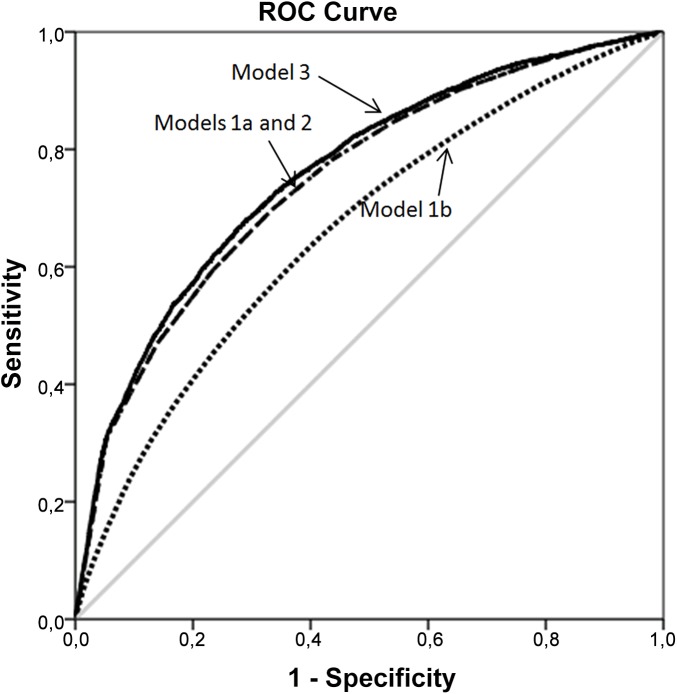
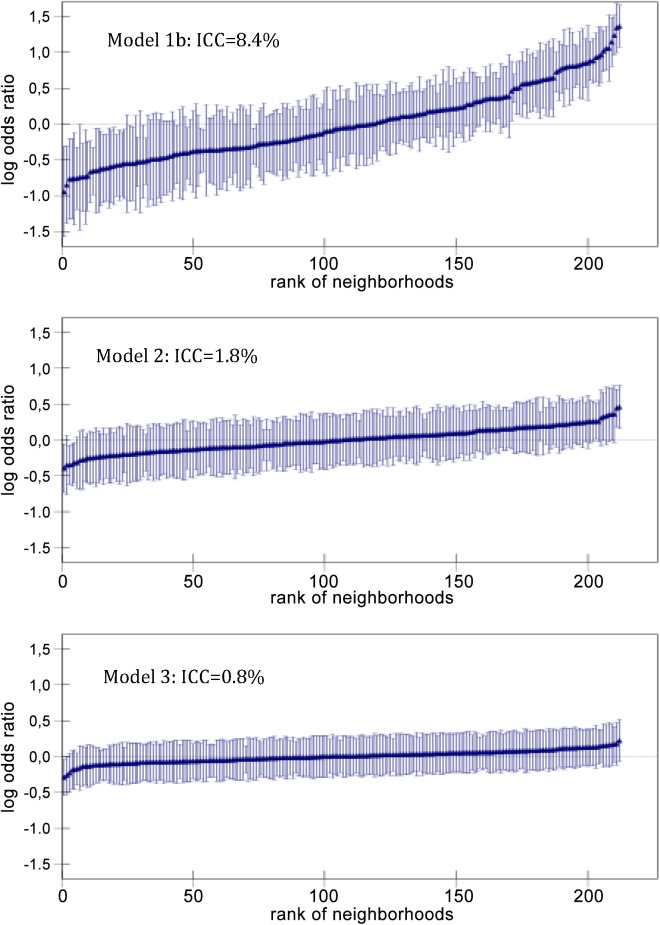
The prevalence of non-attendance among women was 18.3%. After adjusting for individual characteristics, the prevalence in the 212 neighborhoods was 3.6%. Neighborhood of residence had little influence on non-attendance. The multilevel analysis indicates that 8.4% of the total individual differences in the propensity of non-attendance were at the neighborhood level. However, when adjusting for specific individual characteristics this general contextual effect decreased to 1.8%. This minor effect was explained by the sociodemographic characteristic of the neighborhoods. The discriminatory accuracy of classifying women according to their non-attendance was 0.747 when considering only individual level variables, and 0.760 after including neighborhood level as a random effect.
Our results suggest that neighborhoods of residence in Malmö, Sweden (as defined by small-area market statistics (SAMS) areas) do not condition women's participation in population based mammography screening. Thus, interventions should be directed to the whole city and target women with a higher risk of non-attendance.
基于人群的乳腺钼靶筛查项目对公众健康的影响取决于高参与率。因此,监测参与率以及了解和考虑影响参与的因素非常重要。为了获取关于提高筛查参与率的适当干预水平的信息,我们的研究旨在:(1)考察除个体因素外,居住社区是否会影响女性不参加乳腺钼靶筛查,以及(2)评估仅了解女性的居住社区是否足以预测其不参加筛查的情况。
我们分析了2005年至2009年期间居住在瑞典马尔默市且被邀请参加乳腺钼靶筛查的所有女性。关于乳腺钼靶筛查参与情况的信息与来自瑞典统计局的居住地区、人口统计学和社会经济特征数据相关联。通过多水平逻辑回归分析评估个体和社区因素的影响,将29,901名女性嵌套在212个社区中。
女性不参加筛查的患病率为18.3%。在调整个体特征后,212个社区中的患病率为3.6%。居住社区对不参加筛查的影响很小。多水平分析表明,不参加筛查倾向的个体差异中,有8.4%存在于社区层面。然而,在调整特定个体特征后,这种一般的背景效应降至1.8%。这种微小效应可由社区的社会人口学特征来解释。仅考虑个体层面变量时,根据女性不参加筛查情况进行分类的判别准确率为0.747,将社区层面作为随机效应纳入后,准确率为0.760。
我们的结果表明,瑞典马尔默市的居住社区(由小区域市场统计(SAMS)区域定义)并不会影响女性参与基于人群的乳腺钼靶筛查。因此,干预措施应针对整个城市,并以不参加筛查风险较高的女性为目标。