Rubio Miguel Ángel, Napolitano Mauro, Ochoa de Alda Jesús A G, Santamaría-Gómez Javier, Patterson Carl J, Foster Andrew W, Bru-Martínez Roque, Robinson Nigel J, Luque Ignacio
Instituto de Bioquímica Vegetal y Fotosíntesis, C.S.I.C. and Universidad de Sevilla, Avda Américo Vespucio 49, E-41092 Seville, Spain.
Facultad de Formación del Profesorado. Universidad de Extremadura, Avda de la Universidad s/n. E-10003, Cáceres, Spain.
Nucleic Acids Res. 2015 Nov 16;43(20):9905-17. doi: 10.1093/nar/gkv1020. Epub 2015 Oct 12.
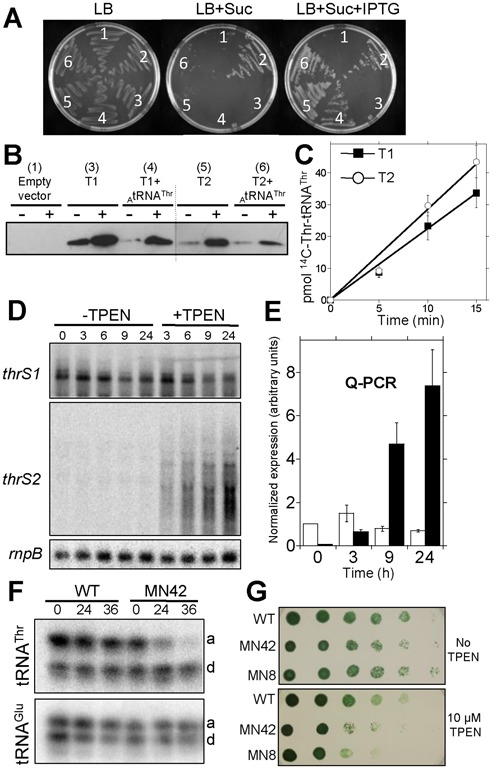
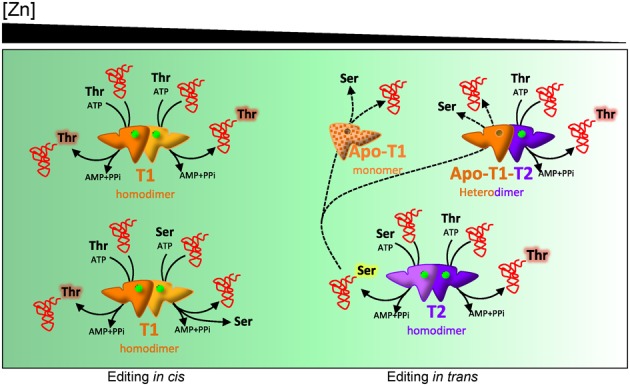
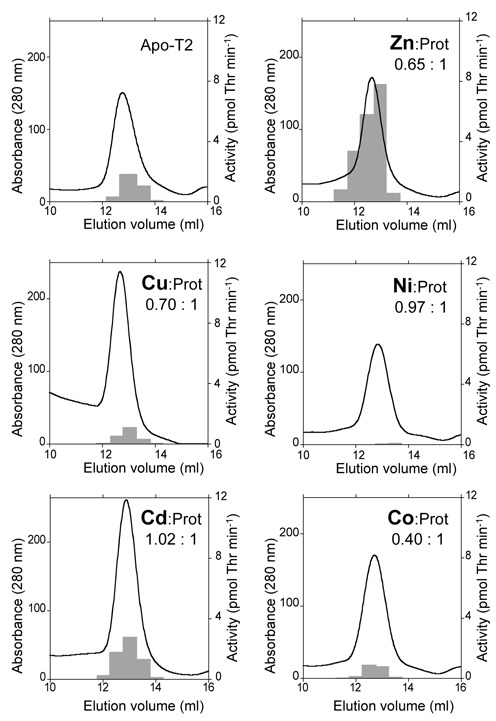
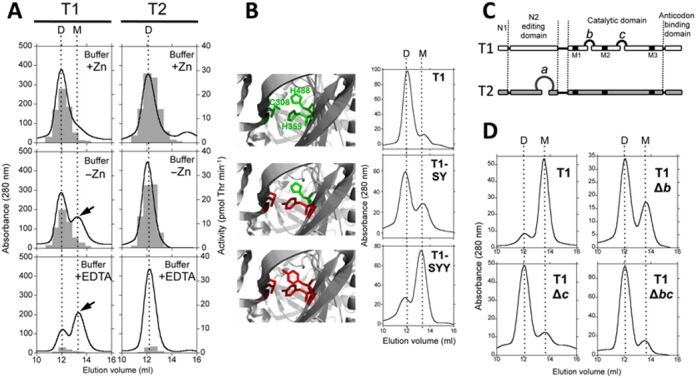
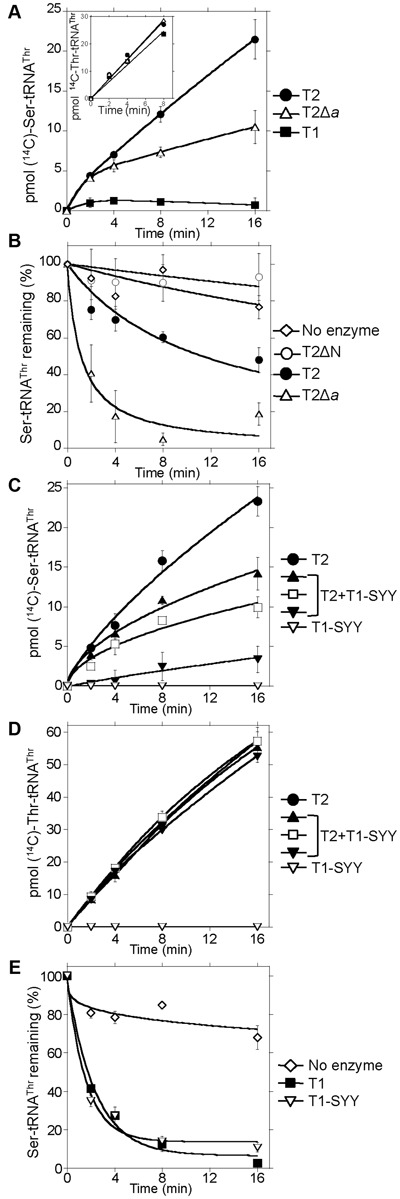
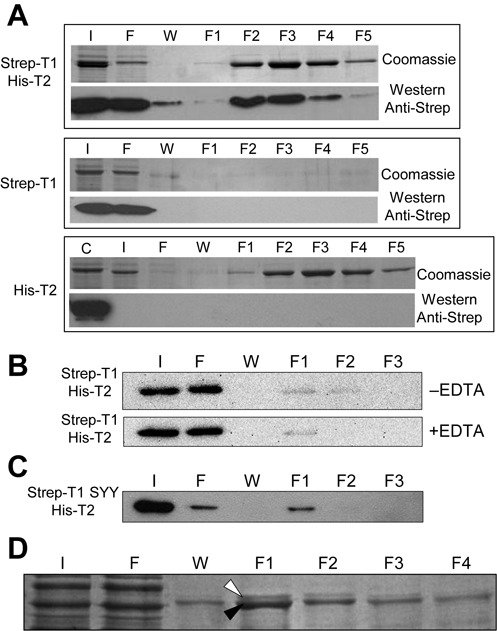
Aminoacyl-tRNA synthetases (aaRSs) play a key role in deciphering the genetic message by producing charged tRNAs and are equipped with proofreading mechanisms to ensure correct pairing of tRNAs with their cognate amino acid. Duplicated aaRSs are very frequent in Nature, with 25,913 cases observed in 26,837 genomes. The oligomeric nature of many aaRSs raises the question of how the functioning and oligomerization of duplicated enzymes is organized. We characterized this issue in a model prokaryotic organism that expresses two different threonyl-tRNA synthetases, responsible for Thr-tRNA(Thr) synthesis: one accurate and constitutively expressed (T1) and another (T2) with impaired proofreading activity that also generates mischarged Ser-tRNA(Thr). Low zinc promotes dissociation of dimeric T1 into monomers deprived of aminoacylation activity and simultaneous induction of T2, which is active for aminoacylation under low zinc. T2 either forms homodimers or heterodimerizes with T1 subunits that provide essential proofreading activity in trans. These findings evidence that in organisms with duplicated genes, cells can orchestrate the assemblage of aaRSs oligomers that meet the necessities of the cell in each situation. We propose that controlled oligomerization of duplicated aaRSs is an adaptive mechanism that can potentially be expanded to the plethora of organisms with duplicated oligomeric aaRSs.
氨酰 - tRNA合成酶(aaRSs)通过产生负载的tRNA在解读遗传信息中发挥关键作用,并配备了校对机制以确保tRNA与其同源氨基酸的正确配对。重复的aaRSs在自然界中非常常见,在26,837个基因组中观察到25,913个案例。许多aaRSs的寡聚性质引发了一个问题,即重复酶的功能和寡聚化是如何组织的。我们在一种模式原核生物中对这个问题进行了表征,该生物表达两种不同的苏氨酰 - tRNA合成酶,负责Thr - tRNA(Thr)的合成:一种准确且组成性表达(T1),另一种(T2)校对活性受损,也会产生错误负载的Ser - tRNA(Thr)。低锌促进二聚体T1解离成缺乏氨酰化活性的单体,并同时诱导T2表达,T2在低锌条件下对氨酰化有活性。T2要么形成同型二聚体,要么与提供反式必需校对活性的T1亚基形成异型二聚体。这些发现证明,在具有重复基因的生物体中,细胞可以协调aaRSs寡聚体的组装,以满足每种情况下细胞的需求。我们提出,重复aaRSs的可控寡聚化是一种适应性机制,可能会扩展到大量具有重复寡聚aaRSs的生物体中。