Arazi Hamid, Asadi Abbas, Purabed Morteza
Department of Exercise Physiology, Faculty of Physical Education and Sport Sciences, University of Guilan, Rasht, Iran.
Department of Exercise Physiology, Faculty of Physical Education and Sport Sciences, University of Guilan, Rasht, Iran ; Department of Physical Education and Sport Sciences, Payame Noor University, P.O. Box 19395-3697, Tehran, Iran.
J Sports Med (Hindawi Publ Corp). 2015;2015:389831. doi: 10.1155/2015/389831. Epub 2015 Aug 4.
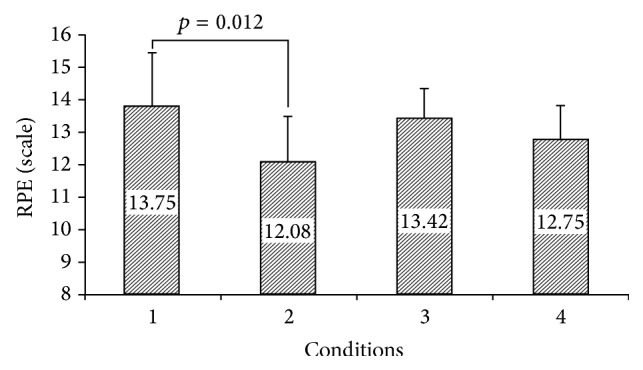
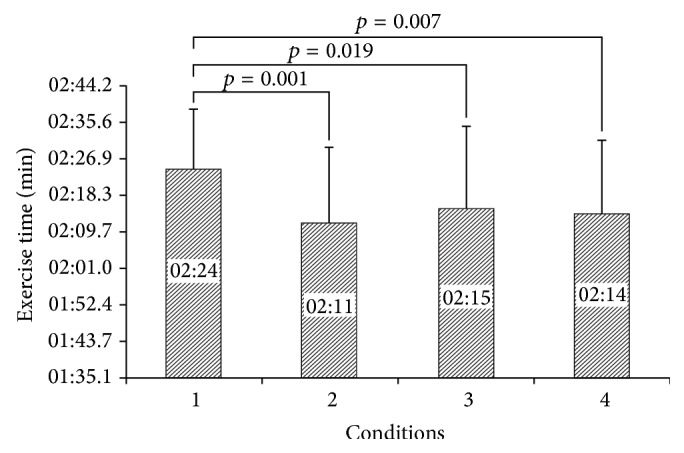
The purpose of this study was to assess the effects of listening to music during warm-up and resistance exercise on physiological (heart rate and blood pressure) and psychophysical (rating of perceived exertion) responses in trained athletes. Twelve strength trained male participants performed warm-up and resistance exercise without music (WU+RE without M), warm-up and resistance exercise with music (WU+RE with M), WU with M and RE without M, and WU without M and RE with M, with 48 hours space between sessions. After completing each session, the rating of perceived exertion (RPE) was measured. Also, heart rate (HR), systolic (SBP) and diastolic blood pressure (DBP), mean arterial pressure (MAP), and rate pressure product (RPP) were assessed before, after, and 15, 30, 45, and 60 min after exercise. Results indicated that RPE was higher for WU+RE without M condition in comparison with other conditions. All conditions showed increases in cardiovascular variables after exercise. The responses of HR, SBP, and RPP were higher for WU+RE without M condition. Thus, using music during warm-up and resistance exercise is a legal method for decreasing RPE and cardiovascular responses due to resistance exercise.
本研究的目的是评估在热身和抗阻运动期间听音乐对训练有素的运动员的生理(心率和血压)和心理生理(主观用力感觉评分)反应的影响。12名经过力量训练的男性参与者进行了无音乐的热身和抗阻运动(无音乐的WU+RE)、有音乐的热身和抗阻运动(有音乐的WU+RE)、有音乐的WU和无音乐的RE,以及无音乐的WU和有音乐的RE,各训练环节之间间隔48小时。在完成每个训练环节后,测量主观用力感觉评分(RPE)。此外,在运动前、运动后以及运动后15、30、45和60分钟评估心率(HR)、收缩压(SBP)和舒张压(DBP)、平均动脉压(MAP)以及率压积(RPP)。结果表明,与其他条件相比,无音乐的WU+RE条件下的RPE更高。所有条件在运动后心血管变量均增加。无音乐的WU+RE条件下HR、SBP和RPP的反应更高。因此,在热身和抗阻运动期间使用音乐是一种降低因抗阻运动引起的RPE和心血管反应的合理方法。