Chauke Thembisile M, van der Heever Hendry, Hoque Muhammad E
Graduate School of Business and Leadership, University of KwaZulu-Natal, Westville Campus.
Afr J Prim Health Care Fam Med. 2015;7(1):e1-e6. doi: 10.4102/phcfm.v7i1.755. Epub 2015 Sep 14.
Drinking behaviour by adolescents is a significant public health challenge nationally and internationally. Alcohol use has serious challenges that continue to deprive adolescents of their normal child growth and development. Drinking is associated with dangers that include fighting, crime, unintentional accidents, unprotected sex, violence and others.
The aim of the study is to investigate drinking patterns, and factors contributing to drinking, amongst secondary school learners in South Africa.
The sample included 177 male (46.6%) and 206 female (53.4%) respondents in the age range from 15–23 years, selected by stratified random sampling.
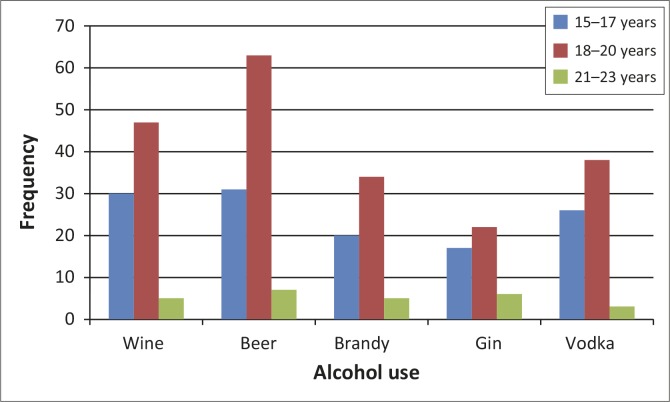
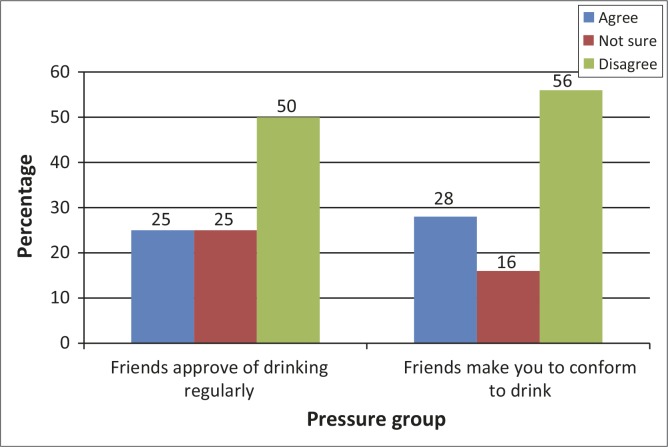
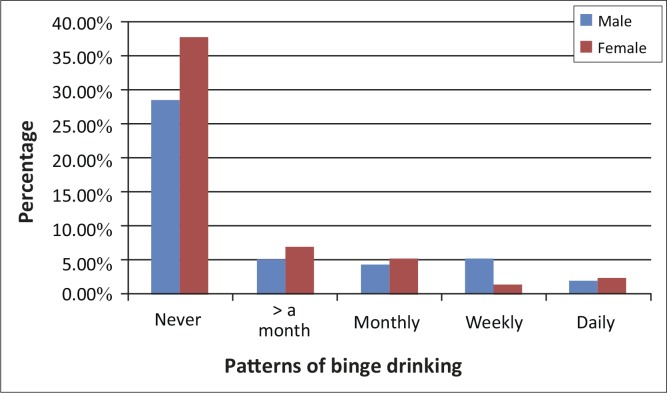
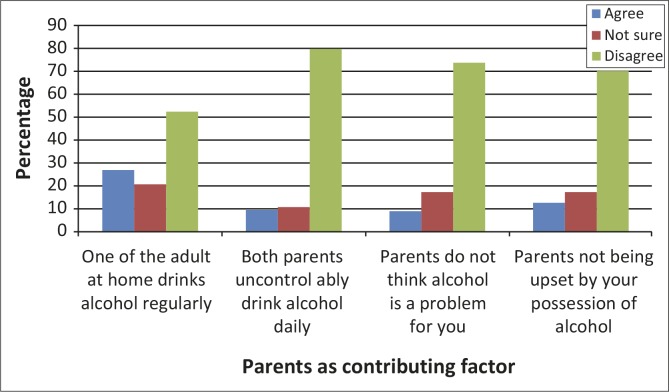
The results indicated that 35.5% of male and 29.7% of female respondents used alcohol. Both male and female respondents consumed six or more alcohol units (binge drinking) within 30 days; on one occasion the consumption was 17.5% and 15.9% respectively. It was found that alcohol consumption increases with age, 32.2% of 15–17 year-olds and 53.2% of 18–20 year-olds consumed different types of alcohol. It was deduced that 28.9% respondents reported that one of the adults at home drank alcohol regularly, and 9.3% reported that both their parents drank alcohol daily. It was found that 27.6% of the respondents agreed that friends made them conform to drinking. The tenth and eleventh grade reported 15.2% of male and 13.9% of female respondents were aware that alcohol can be addictive.
This study found that age, gender, parental alcohol use and peer pressure were found to be the major contributing factors to alcohol use amongst learners Prevention campaigns such as introducing the harmful effects of alcohol use amongst learners are of utmost importance in reducing alcohol use amongst learners in South Africa.
青少年饮酒行为在国内和国际上都是一项重大的公共卫生挑战。饮酒存在严重问题,持续阻碍青少年的正常生长发育。饮酒与诸多危险相关,包括打架、犯罪、意外事故、无保护性行为、暴力等。
本研究旨在调查南非中学生的饮酒模式及饮酒的影响因素。
通过分层随机抽样选取了177名男性(46.6%)和206名女性(53.4%)作为样本,年龄在15至23岁之间。
结果表明,35.5%的男性和29.7%的女性受访者饮酒。男性和女性受访者在30天内都有饮用六个或更多酒精单位(酗酒)的情况;有一次,这一比例分别为17.5%和15.9%。研究发现,饮酒量随年龄增长而增加,15至17岁的受访者中有32.2%,18至20岁的受访者中有53.2%饮用不同类型的酒。据推断,28.9%的受访者表示家中有一位成年人经常饮酒,9.3%的受访者表示父母双方每天都饮酒。研究发现,27.6%的受访者认为朋友使他们饮酒。十年级和十一年级的受访者中,15.2%的男性和13.9%的女性意识到酒精会上瘾。
本研究发现,年龄、性别、父母饮酒情况和同伴压力是学生饮酒的主要影响因素。在南非,开展诸如向学生介绍饮酒危害的预防活动对于减少学生饮酒至关重要。