Graves Roger, Quiring Dan T, Lucarotti Christopher J
Faculty of Forestry and Environmental Management, P.O. Box 4400, The University of New Brunswick, Fredericton, New Brunswick, E3B 5A3, Canada.
Natural Resources Canada, Canadian Forest Service - Atlantic Forestry Centre, 1350 Regent Street, Fredericton, New Brunswick, E3C 2G6, Canada.
Insects. 2012 Oct 19;3(4):989-1000. doi: 10.3390/insects3040989.
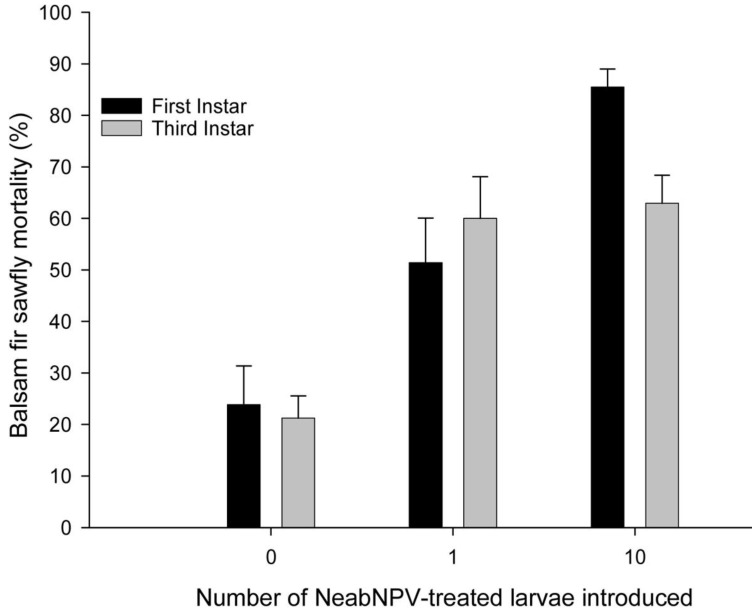
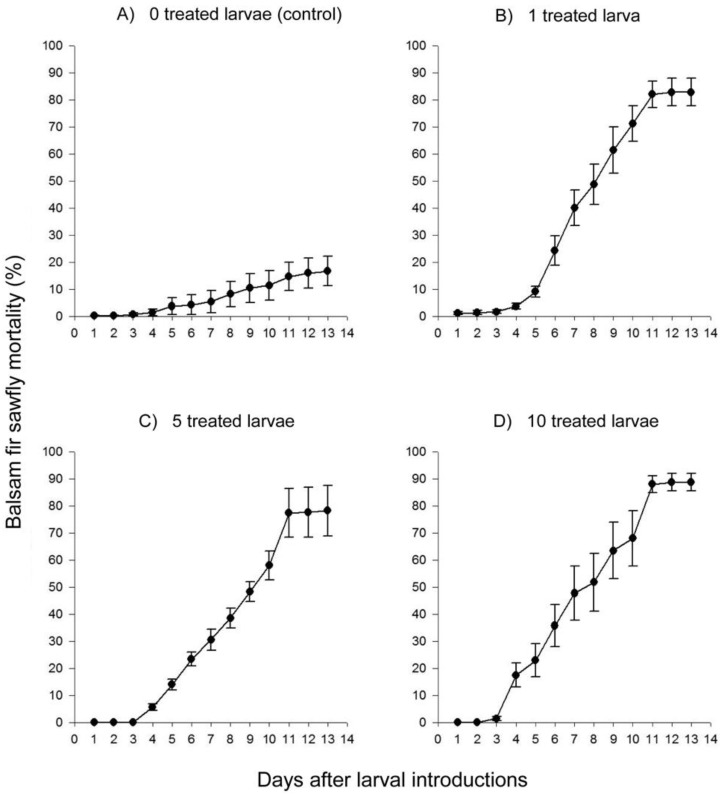
Nucleopolyhedroviruses (NPV: Gammabaculovirus: Baculoviridae) of diprionid sawflies (Diprionidae: Hymenoptera) are highly host specific and only infect the midgut epithelium. While still alive, infected sawfly larvae excrete NPV-laden diarrhea that contaminates food sources. The diarrhea can then be consumed by conspecific larvae, resulting in rapid horizontal transmission of the virus. To better understand the efficacy of Gammabaculovirus-based biological control products, the horizontal spread of such a virus (NeabNPV) within cohorts of balsam fir sawfly (Neodiprion abietis) larvae was studied by introducing NeabNPV-treated larvae into single-cohort groups at densities similar to those observed during the increasing (field study) and peak (laboratory study) phases of an outbreak. In field studies (200 N. abietis larvae/m² of balsam fir (Abies balsamea) foliage), NeabNPV-induced mortality increased positively in a density-dependent manner, from 23% (in control groups) to 51% with the addition of one first-instar NeabNPV-treated larva, to 84% with 10 first-instar-treated larvae. Mortality was 60% and 63% when one or 10 NeabNPV-treated third-instar larva(e), respectively, were introduced into groups. Slightly higher levels of NeabNPV-induced mortality occurring when NeabNPV-treated larvae were introduced into first- rather than third-instar cohorts suggests that early instars are more susceptible to the virus. In the laboratory (1330 N. abietis larvae/ m² of foliage), NeabNPV-caused mortality increased from 20% in control groups to over 80% with the introduction of one, five or 10 NeabNPV-treated larvae into treatment groups of first-instar larvae.
叶蜂核多角体病毒(NPV:γ杆状病毒属:杆状病毒科)感染叶蜂(叶蜂科:膜翅目),具有高度宿主特异性,仅感染中肠上皮。受感染的叶蜂幼虫在存活时会排出携带NPV的腹泻物,污染食物来源。然后,同物种的幼虫可能会摄入这种腹泻物,导致病毒迅速横向传播。为了更好地了解基于γ杆状病毒的生物防治产品的效果,通过将经NeabNPV处理的幼虫以与爆发期增加(田间研究)和高峰期(实验室研究)阶段观察到的密度相似的方式引入单组群体中,研究了这种病毒(NeabNPV)在香脂冷杉叶蜂(Neodiprion abietis)幼虫群体中的横向传播。在田间研究中(每平方米香脂冷杉(Abies balsamea)树叶上约有200只冷杉叶蜂幼虫),NeabNPV引起的死亡率呈密度依赖性正增长,从对照组的23%增加到添加1只一龄经NeabNPV处理的幼虫时的51%,添加10只一龄经处理的幼虫时死亡率达到84%。当分别将1只或10只经NeabNPV处理的三龄幼虫引入群体时,死亡率分别为60%和63%。当将经NeabNPV处理的幼虫引入一龄而非三龄群体时,NeabNPV引起的死亡率略高,这表明早期幼虫对病毒更易感。在实验室中(每平方米树叶上约有1330只冷杉叶蜂幼虫),将1只、5只或10只经NeabNPV处理的幼虫引入一龄幼虫处理组后,NeabNPV导致的死亡率从对照组的20%增加到超过80%。