Weiss William M, Murray Laura K, Zangana Goran Abdulla Sabir, Mahmooth Zayan, Kaysen Debra, Dorsey Shannon, Lindgren Kristen, Gross Alden, Murray Sarah McIvor, Bass Judith K, Bolton Paul
Department of International Health, Johns Hopkins Bloomberg School of Public Health, 615 N. Wolfe Street, Baltimore, MD, 21205, USA.
Department of Mental Health, Johns Hopkins Bloomberg School of Public Health, 624 N. Broadway Street, Baltimore, MD, 21205, USA.
BMC Psychiatry. 2015 Oct 14;15:249. doi: 10.1186/s12888-015-0622-7.
Systematic violence is a long-standing problem in Iraq. Research indicates that survivors often experience multiple mental health problems, and that there is a need for more rigorous research that targets symptoms beyond post-traumatic stress (PTS). Our objective was to test the effectiveness of two counseling therapies in Southern Iraq in addressing multiple mental health problems among survivors of systematic violence: (1) a transdiagnostic intervention (Common Elements Treatment Approach or CETA); and (2) cognitive processing therapy (CPT). The therapies were provided by non-specialized health workers since few MH professionals are available to provide therapy in Iraq.
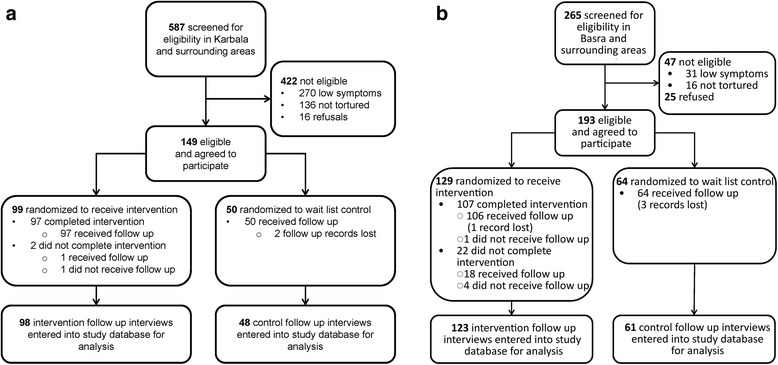
This was a randomized, parallel, two site, two-arm (1:1 allocation), single-blinded, wait-list controlled (WLC) trial of CETA in one site (99 CETA, 50 WLC), and CPT in a second site (129 CPT, 64 WLC). Eligibility criteria were elevated trauma symptoms and experience of systematic violence. The primary and secondary outcomes were trauma symptoms and dysfunction, respectively, with additional assessment of depression and anxiety symptoms. Non-specialized health workers (community mental health worker, CMHW) provided the interventions in government-run primary health centers. Treatment effects were determined using longitudinal, multilevel models with CMHW and client as random effects, and a time by group interaction with robust variance estimation, to test for the net difference in mean score for each outcome between the baseline and follow up interview. Multiple imputation techniques were used to account for missingness at the item level and the participant level. All analyses were conducted using Stata 12.
The CETA intervention showed large effect sizes for all outcomes. The CPT intervention showed moderate effects sizes for trauma and depression, with small to no effect for anxiety or dysfunction, respectively.
Both CETA and CPT appear to benefit survivors of systematic violence in Southern Iraq by reducing multiple mental health symptoms, with CETA providing a very large benefit across a range of symptoms. Non-specialized health workers were able to treat comorbid symptoms of trauma, depression and anxiety, and dysfunction among survivors of systematic violence who have limited access to mental health professionals. The trial further supports the use of evidence-based therapies in lower-resource settings.
This trial was registered at ClinicalTrials.gov on 16 July 2010 with an identifier of NCT01177072 as the Study of Effectiveness of Mental Health Interventions among Torture Survivors in Southern Iraq. The study protocol can be downloaded from the following website: http://tinyurl.com/CETA-Iraq-Protocol . In the protocol, the CETA intervention is given a different name: components-based intervention or CBI.
系统性暴力在伊拉克一直是个长期存在的问题。研究表明,幸存者经常会出现多种心理健康问题,而且需要开展更严谨的研究,针对创伤后应激障碍(PTSD)之外的症状进行研究。我们的目标是测试伊拉克南部两种咨询疗法在解决系统性暴力幸存者多种心理健康问题方面的有效性:(1)一种跨诊断干预(通用要素治疗法或CETA);以及(2)认知加工疗法(CPT)。由于伊拉克能够提供治疗的心理健康专业人员很少,这些疗法由非专业卫生工作者提供。
这是一项随机、平行、双地点、双臂(1:1分配)、单盲、等待列表对照(WLC)试验,在一个地点对CETA进行试验(99例CETA,50例WLC),在第二个地点对CPT进行试验(129例CPT,64例WLC)。纳入标准为创伤症状加重和有系统性暴力经历。主要和次要结局分别为创伤症状和功能障碍,另外还对抑郁和焦虑症状进行了评估。非专业卫生工作者(社区心理健康工作者,CMHW)在政府运营的初级卫生中心提供干预措施。使用纵向多水平模型确定治疗效果,将CMHW和服务对象作为随机效应,并通过组间时间交互作用和稳健方差估计来检验基线和随访访谈之间每个结局平均得分的净差异。采用多重填补技术处理项目层面和参与者层面的缺失数据。所有分析均使用Stata 12进行。
CETA干预对所有结局均显示出较大的效应量。CPT干预对创伤和抑郁显示出中等效应量,对焦虑或功能障碍分别显示出小到无效应。
CETA和CPT似乎都能通过减轻多种心理健康症状使伊拉克南部系统性暴力幸存者受益,CETA在一系列症状方面带来了非常大的益处。非专业卫生工作者能够治疗系统性暴力幸存者中存在的创伤、抑郁和焦虑共病症状以及功能障碍,这些幸存者获得心理健康专业人员服务的机会有限。该试验进一步支持在资源匮乏地区使用循证疗法。
该试验于2010年7月16日在ClinicalTrials.gov注册,标识符为NCT01177072,即伊拉克南部酷刑幸存者心理健康干预有效性研究。研究方案可从以下网站下载:http://tinyurl.com/CETA-Iraq-Protocol 。在方案中,CETA干预有一个不同的名称:基于成分的干预或CBI。