Jacobs Daniel A, Ferris Daniel P
School of Kinesiology, University of Michigan, 401 Washtenaw Ave CCRB, Ann Arbor, MI, USA.
J Neuroeng Rehabil. 2015 Oct 14;12:90. doi: 10.1186/s12984-015-0081-x.
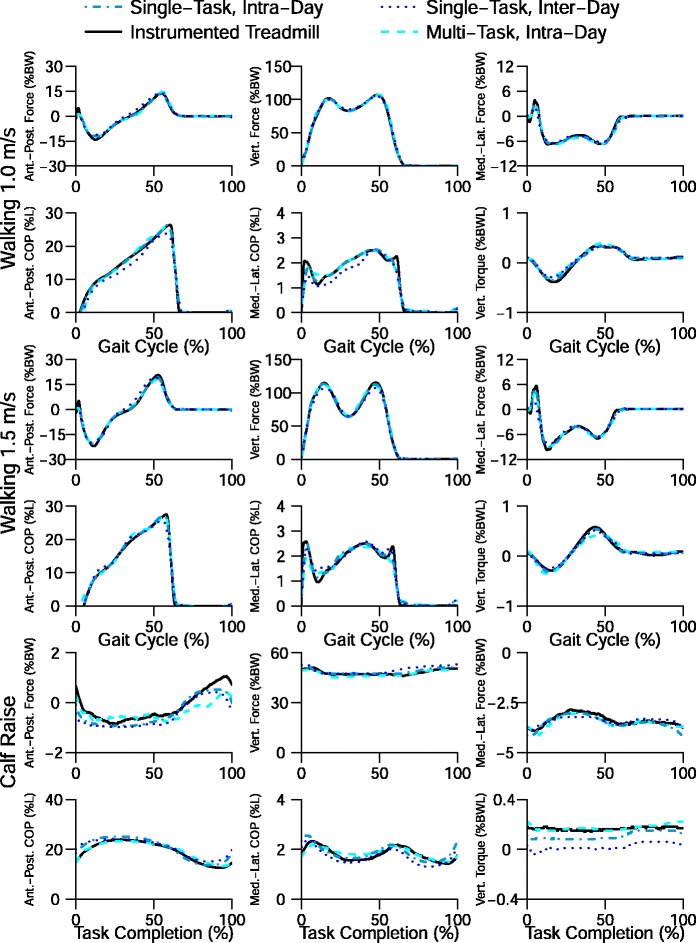
Wearable sensor systems can provide data for at-home gait analyses and input to controllers for rehabilitation devices but they often have reduced estimation accuracy compared to laboratory systems. The goal of this study is to evaluate a portable, low-cost system for measuring ground reaction forces and ankle joint torques in treadmill walking and calf raises.
To estimate the ground reaction forces and ankle joint torques, we developed a custom instrumented insole and a tissue force sensor. Six healthy subjects completed a collection of movements (calf raises, 1.0 m/s walking, and 1.5 m/s walking) on two separate days. We trained artificial neural networks on the study data and compared the estimates to a multi-camera motion system and an instrumented treadmill. We evaluated the relative strength of each sensor by testing each sensor's ability to predict the ankle joint torque calculated from a reference inverse kinematics algorithm. We assessed model accuracy through root mean squared error and normalized root mean square error. We hypothesized that the estimation of the models would have normalized root mean square error measures less than 10 %.
For walking at 1.0 and walking at 1.5 m/s, the single-task, intra-day and multi-task, intra-day predictions had normalized root mean square error less than 10 % for all three force components and both center of pressure components. For the calf raise task, the single-task, intra-day and multi-task, intra-day predictions had normalized root mean square error less than 10 % for only the anterior-posterior center of pressure. The multi-task, intra-day model had similar predictions to the single-task, intra-day model. The normalized root mean square error of predictions from the insole sensor alone were less than 10 % for walking at 1.0 m/s and 1.5 m/s. No sensor was sufficient for the calf raise task. The combination of the insole sensor and the tendon sensor had lower normalized root mean square error than the individual sensors for all three tasks.
The proposed sensor system provided accurate estimates for five of the six components of the ground reaction kinetics during walking at 1.0 and 1.5 m/s and one of the six components during the calf raise task. The normalized root mean square error of the predictions of the ground reaction forces were similar to published studies using commercial devices. The proposed system of low-cost sensors can provide useful estimations of ankle joint torque for both walking and calf raises for future studies in mobile gait analysis.
可穿戴传感器系统可为家庭步态分析提供数据,并为康复设备的控制器提供输入,但与实验室系统相比,其估计精度往往较低。本研究的目的是评估一种便携式、低成本系统,用于测量跑步机行走和提踵动作中的地面反作用力和踝关节扭矩。
为了估计地面反作用力和踝关节扭矩,我们开发了一种定制的仪器化鞋垫和一种组织力传感器。六名健康受试者在两天内完成了一系列动作(提踵、1.0米/秒行走和1.5米/秒行走)。我们根据研究数据训练人工神经网络,并将估计值与多摄像头运动系统和仪器化跑步机进行比较。我们通过测试每个传感器预测由参考逆运动学算法计算出的踝关节扭矩的能力,来评估每个传感器的相对强度。我们通过均方根误差和归一化均方根误差评估模型准确性。我们假设模型的估计将具有小于10%的归一化均方根误差测量值。
对于1.0米/秒行走和1.5米/秒行走,单任务日内和多任务日内预测对于所有三个力分量和两个压力中心分量的归一化均方根误差均小于10%。对于提踵任务,单任务日内和多任务日内预测仅对于前后压力中心的归一化均方根误差小于10%。多任务日内模型与单任务日内模型具有相似的预测。仅鞋垫传感器预测的归一化均方根误差对于1.0米/秒和1.5米/秒行走小于10%。没有一个传感器足以完成提踵任务。对于所有三个任务,鞋垫传感器和肌腱传感器的组合具有比单个传感器更低的归一化均方根误差。
所提出的传感器系统在1.0米/秒和1.5米/秒行走期间为地面反作用力动力学的六个分量中的五个提供了准确估计,在提踵任务期间为六个分量中的一个提供了准确估计。地面反作用力预测的归一化均方根误差与使用商业设备的已发表研究相似。所提出的低成本传感器系统可为未来移动步态分析研究中的行走和提踵提供有用的踝关节扭矩估计。