Hall Jacob B, Cooke Bailey Jessica N, Hoffman Joshua D, Pericak-Vance Margaret A, Scott William K, Kovach Jaclyn L, Schwartz Stephen G, Agarwal Anita, Brantley Milam A, Haines Jonathan L, Bush William S
Graduate Program in Human Genetics, Vanderbilt University, Nashville, TN, USA.
Department of Epidemiology and Biostatistics, Case Western Reserve University, Cleveland, OH, USA.
BMC Bioinformatics. 2015 Oct 14;16:329. doi: 10.1186/s12859-015-0760-4.
Age-related macular degeneration (AMD) is the leading cause of irreversible visual loss in the elderly in developed countries and typically affects more than 10% of individuals over age 80. AMD has a large genetic component, with heritability estimated to be between 45% and 70%. Numerous variants have been identified and implicate various molecular mechanisms and pathways for AMD pathogenesis but those variants only explain a portion of AMD's heritability. The goal of our study was to estimate the cumulative genetic contribution of common variants on AMD risk for multiple pathways related to the etiology of AMD, including angiogenesis, antioxidant activity, apoptotic signaling, complement activation, inflammatory response, response to nicotine, oxidative phosphorylation, and the tricarboxylic acid cycle. While these mechanisms have been associated with AMD in literature, the overall extent of the contribution to AMD risk for each is unknown.
In a case-control dataset with 1,813 individuals genotyped for over 600,000 SNPs we used Genome-wide Complex Trait Analysis (GCTA) to estimate the proportion of AMD risk explained by SNPs in genes associated with each pathway. SNPs within a 50 kb region flanking each gene were also assessed, as well as more distant, putatively regulatory SNPs, based on DNaseI hypersensitivity data from ocular tissue in the ENCODE project.
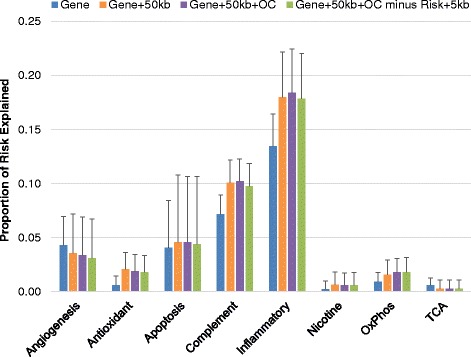
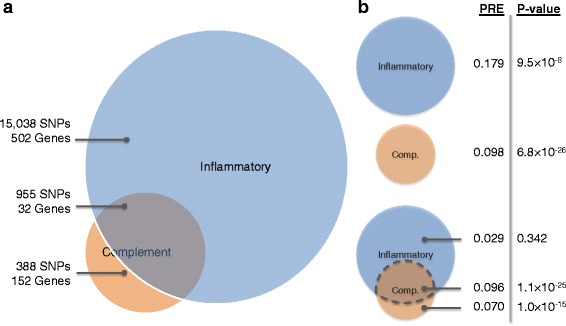
We found that 19 previously associated AMD risk SNPs contributed to 13.3% of the risk for AMD in our dataset, while the remaining genotyped SNPs contributed to 36.7% of AMD risk. Adjusting for the 19 risk SNPs, the complement activation and inflammatory response pathways still explained a statistically significant proportion of additional risk for AMD (9.8% and 17.9%, respectively), with other pathways showing no significant effects (0.3% - 4.4%).
Our results show that SNPs associated with complement activation and inflammation significantly contribute to AMD risk, separately from the risk explained by the 19 known risk SNPs. We found that SNPs within 50 kb regions flanking genes explained additional risk beyond genic SNPs, suggesting a potential regulatory role, but that more distant SNPs explained less than 0.5% additional risk for each pathway.
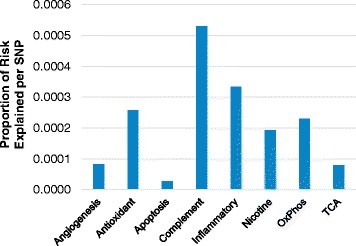
From these analyses we find that the impact of complement SNPs on risk for AMD extends beyond the established genome-wide significant SNPs.
年龄相关性黄斑变性(AMD)是发达国家老年人不可逆视力丧失的主要原因,通常影响超过10%的80岁以上个体。AMD具有很大的遗传成分,遗传率估计在45%至70%之间。已经鉴定出许多变体,它们涉及AMD发病机制的各种分子机制和途径,但这些变体仅解释了AMD遗传率的一部分。我们研究的目的是估计常见变体对与AMD病因相关的多种途径的AMD风险的累积遗传贡献,包括血管生成、抗氧化活性、凋亡信号传导、补体激活、炎症反应、对尼古丁的反应、氧化磷酸化和三羧酸循环。虽然这些机制在文献中已与AMD相关,但每种机制对AMD风险的总体贡献程度尚不清楚。
在一个对1813名个体进行了超过60万个单核苷酸多态性(SNP)基因分型的病例对照数据集中,我们使用全基因组复杂性状分析(GCTA)来估计与每个途径相关的基因中的SNP所解释的AMD风险比例。还评估了每个基因侧翼50 kb区域内的SNP,以及基于ENCODE项目中眼部组织的DNaseI超敏数据的更远距离的、推测具有调控作用的SNP。
我们发现,在我们的数据集中,19个先前与AMD风险相关的SNP导致了13.3%的AMD风险,而其余基因分型的SNP导致了36.7%的AMD风险。在调整了这19个风险SNP后,补体激活和炎症反应途径仍然解释了AMD额外风险的统计学显著比例(分别为9.8%和17.9%),其他途径没有显示出显著影响(0.3% - 4.4%)。
我们的结果表明,与补体激活和炎症相关的SNP对AMD风险有显著贡献,独立于19个已知风险SNP所解释的风险。我们发现基因侧翼50 kb区域内的SNP解释了基因SNP之外的额外风险,表明其具有潜在的调控作用,但更远距离的SNP对每个途径的额外风险解释不到0.5%。
从这些分析中我们发现,补体SNP对AMD风险的影响超出了已确定的全基因组显著SNP。