Wang Lu, Wang Jing, Fang Jiazhu, Zhou Hongyan, Liu Xialin, Su Shao Bo
State Key Laboratory of Ophthalmology, Zhongshan Ophthalmic Center, Sun Yat-sen University, Guangzhou, 510060 China ; Guangdong Province Hospital of Traditional Chinese Medicine, Guangzhou, 510120 China.
State Key Laboratory of Ophthalmology, Zhongshan Ophthalmic Center, Sun Yat-sen University, Guangzhou, 510060 China.
Diabetol Metab Syndr. 2015 Oct 13;7:89. doi: 10.1186/s13098-015-0086-4. eCollection 2015.
Hyperglycemia-induced inflammation causes the dysfunction of blood vessels, and Toll-like receptor 4 (TLR4) plays a key role in inflammation-induced angiogenesis. However, the impact of TLR4 on the pathogenesis of diabetic retinopathy (DR) is poorly understood. In this study, we examined the expression of TLR4 in retinal vascular endothelial cells of patients with DR and diabetic mice, and explored the role of TLR4 in mediating inflammatory responses by human microvascular endothelial cells (HMEC-1) under high-glucose condition.
The expression of TLR4 in retinal vascular endothelial cells of patients with proliferative diabetic retinopathy and diabetic mice induced by streptozotocin was examined using immunofluorescence. HMEC-1 cells were cultured and the expression of TLR4, MyD88 and Interleukin-1β (IL-1β) was examined under high-glucose condition. Endothelial cells with TLR4 silencing and antagonist of TLR4 as well as endothelial cells from TLR4 deficient mice were used to study the effect of activated TLR4 on inflammation induced by high-glucose treatment.
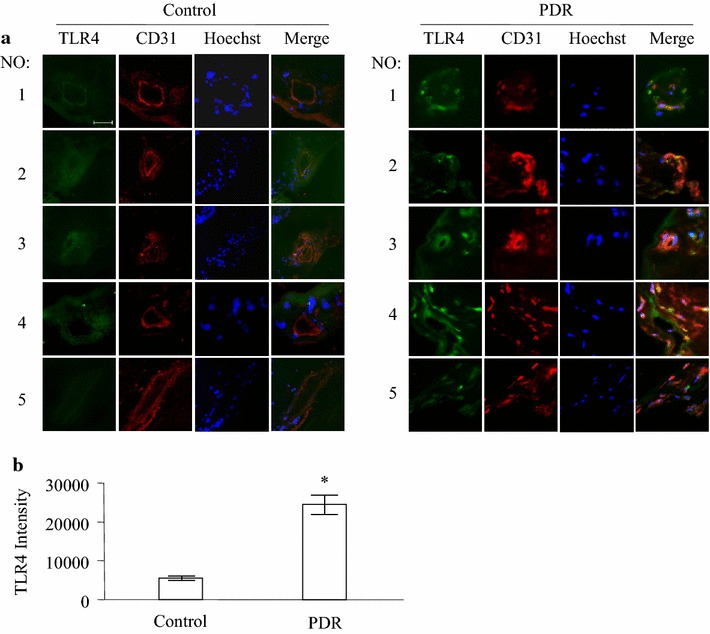
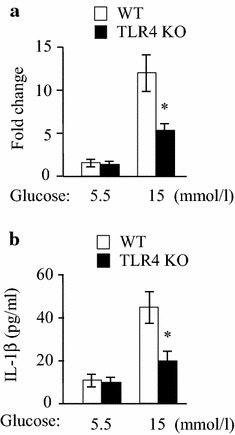
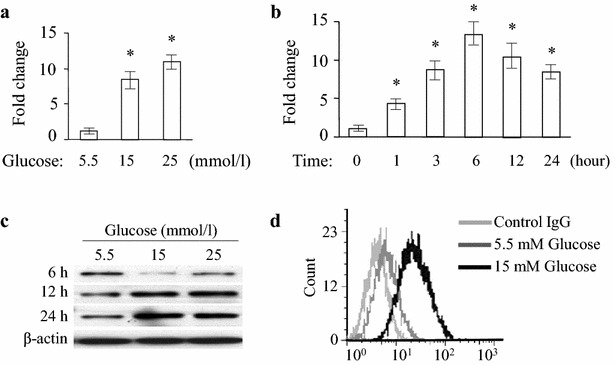
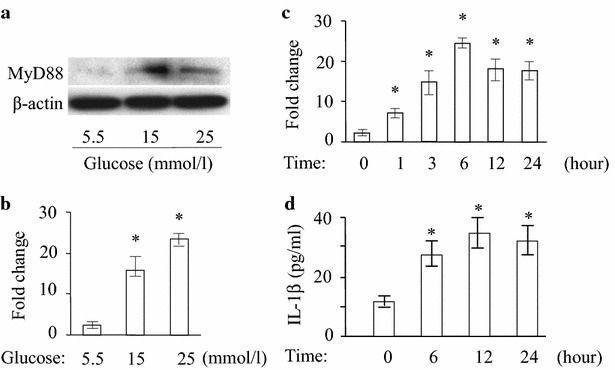
We observed that TLR4 was detected in CD31-labled human retinal vascular endothelia and its expression was markedly increased in fibrovascular membranes from DR patients and in retinal vascular endothelial cells of diabetic mice. The expression of TLR4, MyD88 and IL-1β was enhanced by high glucose in cultured HMEC-1 and the expression of TLR4 and IL-1β was inhibited by TLR4 siRNA knock-down and TLR4 antagonist. The expression of IL-1β by endothelial cells from TLR4 deficient mice under high glucose condition was decreased.
Our results revealed that hyperglycemia induced overexpression and activation of TLR4 in endothelial cells. This effect may lead to inflammatory responses contribute to the pathogenesis of diabetic retinopathy.
高血糖诱导的炎症会导致血管功能障碍,而Toll样受体4(TLR4)在炎症诱导的血管生成中起关键作用。然而,TLR4对糖尿病视网膜病变(DR)发病机制的影响尚不清楚。在本研究中,我们检测了DR患者和糖尿病小鼠视网膜血管内皮细胞中TLR4的表达,并探讨了高糖条件下TLR4在介导人微血管内皮细胞(HMEC-1)炎症反应中的作用。
采用免疫荧光法检测增殖性糖尿病视网膜病变患者和链脲佐菌素诱导的糖尿病小鼠视网膜血管内皮细胞中TLR4的表达。培养HMEC-1细胞,检测高糖条件下TLR4、髓样分化因子88(MyD88)和白细胞介素-1β(IL-1β)的表达。使用TLR4沉默的内皮细胞、TLR4拮抗剂以及来自TLR4缺陷小鼠的内皮细胞,研究激活的TLR4对高糖处理诱导的炎症的影响。
我们观察到在CD31标记的人视网膜血管内皮中检测到TLR4,其在DR患者的纤维血管膜和糖尿病小鼠的视网膜血管内皮细胞中的表达明显增加。高糖增强了培养的HMEC-1中TLR4、MyD88和IL-1β的表达,TLR4小干扰RNA敲低和TLR4拮抗剂抑制了TLR4和IL-1β的表达。高糖条件下,来自TLR4缺陷小鼠的内皮细胞中IL-1β的表达降低。
我们的结果表明,高血糖诱导内皮细胞中TLR4的过表达和激活。这种作用可能导致炎症反应,促进糖尿病视网膜病变的发病机制。