Song Jeong Ho, Choi Yoon Young, An Ji Yeong, Kim Dong Wook, Hyung Woo Jin, Noh Sung Hoon
Department of Surgery, Yonsei University Health System, Yonsei University College of Medicine, Seoul, Korea.
Department of Surgery, Yonsei University Health System, Yonsei University College of Medicine, Seoul, Korea. ; Department of Surgery, Samsung Medical Center, Sungkyunkwan University School of Medicine, Seoul, Korea.
J Gastric Cancer. 2015 Sep;15(3):159-66. doi: 10.5230/jgc.2015.15.3.159. Epub 2015 Sep 30.
Laparoscopic total gastrectomy (LTG) is more complicated than laparoscopic distal gastrectomy, especially during a surgeon's initial experience with the technique. In this study, we evaluated the short-term outcomes of and learning curve for LTG during the initial cases of a single surgeon compared with those of open total gastrectomy (OTG).
Between 2009 and 2013, 134 OTG and 74 LTG procedures were performed by a single surgeon who was experienced with OTG but new to performing LTG. Clinical characteristics, operative parameters, and short-term postoperative outcomes were compared between groups.
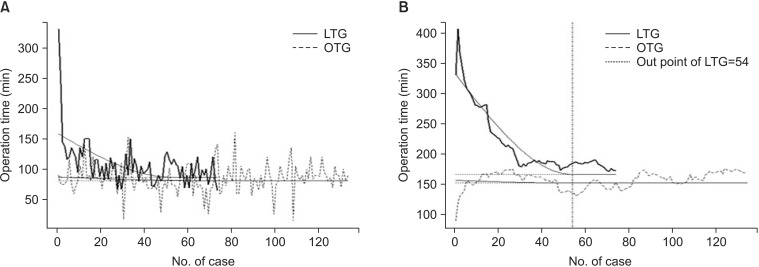
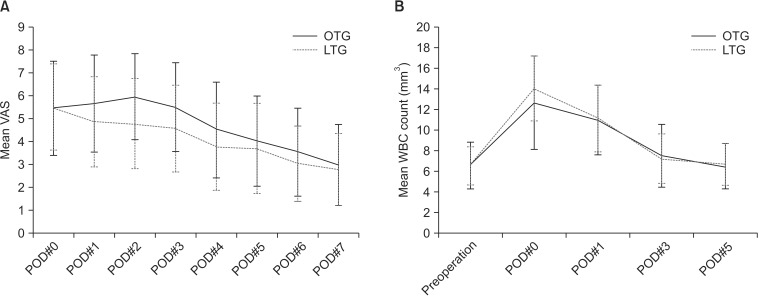
Advanced gastric cancer and D2 lymph node dissection were more common in the OTG than LTG group. Although the operation time was significantly longer for LTG than for OTG (175.7±43.1 minutes vs. 217.5±63.4 minutes), LTG seems to be slightly superior or similar to OTG in terms of postoperative recovery measures. The operation time moving average of 15 cases in the LTG group decreased gradually, and the curve flattened at 54 cases. The postoperative complication rate was similar for the two groups (11.9% vs. 13.5%). No anastomotic or stump leaks occurred.
Although LTG is technically difficult and operation time is longer for surgeons experienced in open surgery, it can be performed safely, even during a surgeon's early experience with the technique. Considering the benefits of minimally invasive surgery, LTG is recommended for early gastric cancer.
腹腔镜全胃切除术(LTG)比腹腔镜远端胃切除术更为复杂,尤其是在外科医生初次接触该技术时。在本研究中,我们评估了单一外科医生初次开展腹腔镜全胃切除术的短期疗效及学习曲线,并与开放全胃切除术(OTG)进行比较。
2009年至2013年间,由一位有开放全胃切除术经验但初次开展腹腔镜全胃切除术的外科医生实施了134例开放全胃切除术和74例腹腔镜全胃切除术。比较两组患者的临床特征、手术参数及术后短期疗效。
进展期胃癌及D2淋巴结清扫在开放全胃切除术组比腹腔镜全胃切除术组更为常见。虽然腹腔镜全胃切除术的手术时间显著长于开放全胃切除术(175.7±43.1分钟对217.5±63.4分钟),但在术后恢复指标方面,腹腔镜全胃切除术似乎略优于或类似于开放全胃切除术。腹腔镜全胃切除术组15例患者的手术时间移动平均值逐渐下降,在54例时曲线趋于平缓。两组术后并发症发生率相似(11.9%对13.5%)。未发生吻合口或残端漏。
虽然对于有开放手术经验的外科医生来说,腹腔镜全胃切除术技术难度大且手术时间长,但即使在外科医生早期开展该技术时,也能安全实施。考虑到微创手术的优势,推荐对早期胃癌行腹腔镜全胃切除术。