Wolin Kathleen Y, Steinberg Dori M, Lane Ilana B, Askew Sandy, Greaney Mary L, Colditz Graham A, Bennett Gary G
Coeus Health, Chicago, IL, United States of America.
Duke University, Durham, NC, United States of America.
PLoS One. 2015 Oct 15;10(10):e0140455. doi: 10.1371/journal.pone.0140455. eCollection 2015.
While eHealth approaches hold promise for improving the reach and cost-effectiveness of behavior change interventions, they have been challenged by declining participant engagement over time, particularly for self-monitoring behaviors. These are significant concerns in the context of chronic disease prevention and management where durable effects are important for driving meaningful changes.
"Be Fit, Be Well" was an eHealth weight loss intervention that allowed participants to self-select a self-monitoring modality (web or interactive voice response (IVR)). Participants could change their modality. As such, this study provides a unique opportunity to examine the effects of intervention modality choice and changing modalities on intervention engagement and outcomes.
Intervention participants, who were recruited from community health centers, (n = 180) were expected to self-monitor health behaviors weekly over the course of the 24-month intervention. We examined trends in intervention engagement by modality (web, IVR, or changed modality) among participants in the intervention arm.
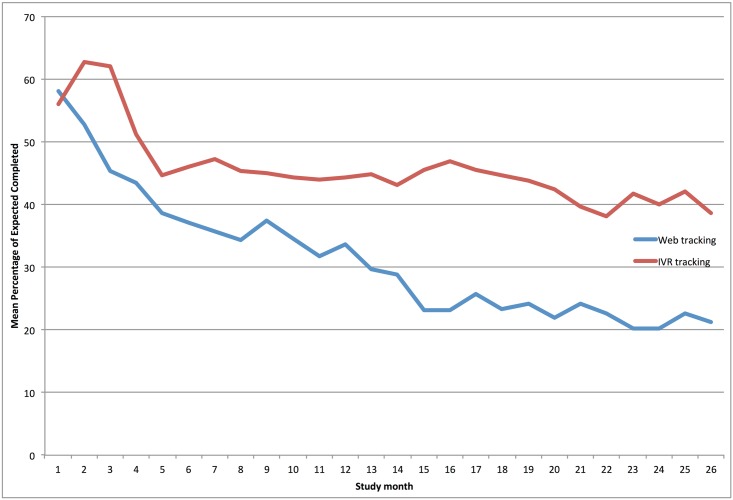
The majority (61%) of participants chose IVR self-monitoring, while 39% chose web. 56% of those who selected web monitoring changed to IVR during the study versus no change in those who initially selected IVR. Self-monitoring declined in both modalities, but completion rates were higher in those who selected IVR. There were no associations between self-monitoring modality and weight or blood pressure outcomes.
This is the first study to compare web and IVR self-monitoring in an eHealth intervention where participants could select and change their self-monitoring modality. IVR shows promise for achieving consistent engagement.
虽然电子健康方法有望提高行为改变干预措施的覆盖范围和成本效益,但随着时间的推移,参与者的参与度不断下降,尤其是在自我监测行为方面,这对它们构成了挑战。在慢性病预防和管理的背景下,这些都是重大问题,因为持久的效果对于推动有意义的改变至关重要。
“保持健康,身体安康”是一项电子健康减肥干预措施,允许参与者自行选择一种自我监测方式(网络或交互式语音应答(IVR))。参与者可以更改他们的方式。因此,本研究提供了一个独特的机会来检验干预方式选择和方式改变对干预参与度和结果的影响。
从社区卫生中心招募的干预参与者(n = 180)预计在为期24个月的干预过程中每周自我监测健康行为。我们研究了干预组参与者按方式(网络、IVR或改变方式)划分的干预参与度趋势。
大多数(61%)参与者选择IVR自我监测,而39%选择网络。在研究期间,选择网络监测的参与者中有56%改为IVR,而最初选择IVR的参与者则没有变化。两种方式的自我监测都有所下降,但选择IVR的参与者完成率更高。自我监测方式与体重或血压结果之间没有关联。
这是第一项在电子健康干预中比较网络和IVR自我监测的研究,在该干预中参与者可以选择并更改他们的自我监测方式。IVR显示出实现持续参与的前景。