Tate D F, Crane M M, Espeland M A, Gorin A A, LaRose J G, Wing R R
Gillings School of Global Public Health, Department of Health Behavior and Nutrition University of North Carolina at Chapel Hill Chapel Hill North Carolina USA.
Department of Preventive Medicine Rush University Medical Center Chicago Illinois USA.
Obes Sci Pract. 2019 Mar 13;5(2):103-110. doi: 10.1002/osp4.333. eCollection 2019 Apr.
Digital tools are widely used and effective in weight management interventions; however, usage declines over time. Strategies to promote continued engagement should be explored. We examined the effects of offering additional modes of weight reporting as well as periodic online campaigns to promote engagement, assessed by frequency of weight reporting, in a weight gain prevention study for young adults.
Using an observational design, self-reported weights obtained through digital tools were pooled across participants assigned to two interventions ( = 312). Analysis examined the effects before during and after introduction of an additional reporting modality (email) and for three time-limited refresher campaigns over 2 years.
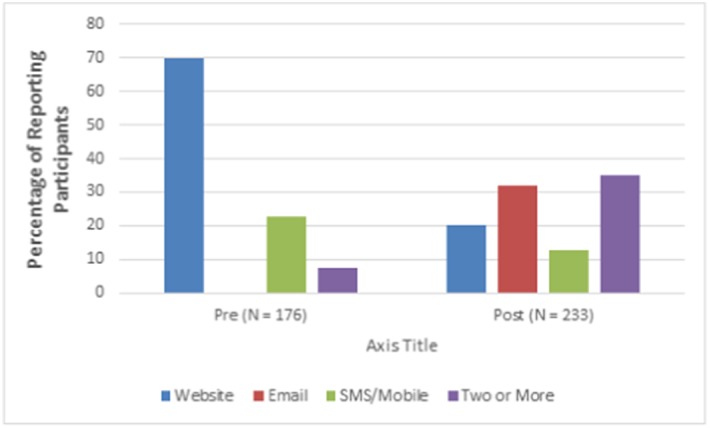
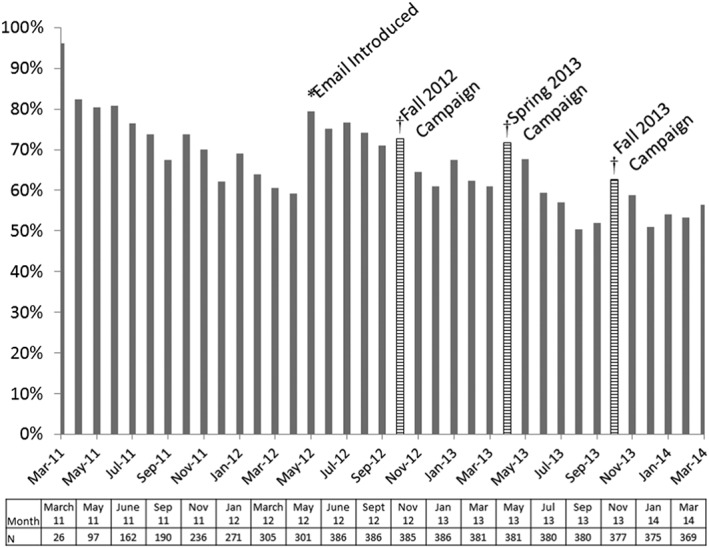
Adding a new modality to the three existing modes (SMS, web, and mobile web) increased weight reporting as well as the number of modalities participants used to report weights. The use of several modes of reporting was associated with more weights submitted ( < 0.01). Refresher campaigns did not increase the proportion of participants reporting; however, the number of weights submitted during the 4-week campaigns increased compared with the 4 weeks before the campaign ('s ≥ 0.45, <0.001, respectively).
Using multiple digital modalities and periodic campaigns shows promise for sustaining engagement with weight reporting in a young adult population, and incorporating such strategies may mitigate typical declines in eHealth and mHealth interventions.
数字工具在体重管理干预中被广泛使用且效果显著;然而,随着时间推移其使用量会下降。应探索促进持续参与的策略。在一项针对年轻人的体重增加预防研究中,我们研究了提供额外的体重报告模式以及定期开展线上活动以促进参与度(通过体重报告频率评估)的效果。
采用观察性设计,将通过数字工具获得的自我报告体重汇总到分配给两种干预措施的参与者中(n = 312)。分析考察了引入额外报告方式(电子邮件)之前、期间和之后的效果,以及在两年内开展的三次限时复习活动的效果。
在现有的三种模式(短信、网络和移动网络)基础上增加一种新模式,增加了体重报告以及参与者用于报告体重的模式数量。使用多种报告模式与提交的体重数量增加相关(P < 0.01)。复习活动并未增加报告参与者的比例;然而,在为期4周的活动期间提交的体重数量与活动前4周相比有所增加(P值分别≥0.45,<0.001)。
使用多种数字模式和定期活动有望在年轻人群体中维持对体重报告的参与度,纳入此类策略可能减轻电子健康和移动健康干预中常见的使用量下降情况。