Tibu F, Sheridan M A, McLaughlin K A, Nelson C A, Fox N A, Zeanah C H
Institute of Child Development,Bucharest,Romania.
University of North Carolina,Chapel Hill,USA.
Psychol Med. 2016 Feb;46(3):529-41. doi: 10.1017/S0033291715002020. Epub 2015 Oct 16.
Young children raised in institutions are exposed to extreme psychosocial deprivation that is associated with elevated risk for psychopathology and other adverse developmental outcomes. The prevalence of attention deficit hyperactivity disorder (ADHD) is particularly high in previously institutionalized children, yet the mechanisms underlying this association are poorly understood. We investigated whether deficits in executive functioning (EF) explain the link between institutionalization and ADHD.
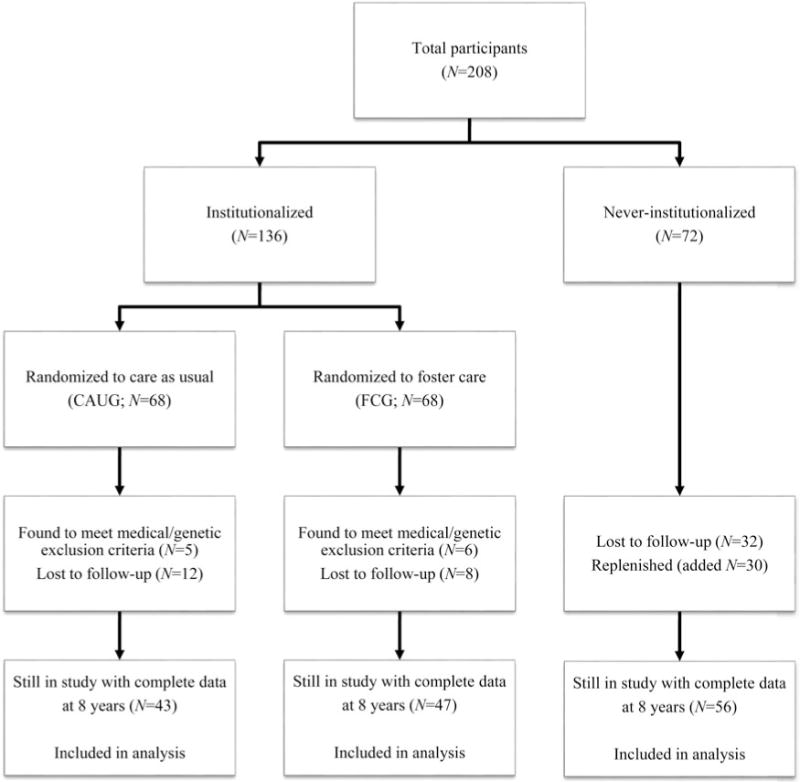
A sample of 136 children (aged 6-30 months) was recruited from institutions in Bucharest, Romania, and 72 never institutionalized community children matched for age and gender were recruited through general practitioners' offices. At 8 years of age, children's performance on a number of EF components (working memory, response inhibition and planning) was evaluated. Teachers completed the Health and Behavior Questionnaire, which assesses two core features of ADHD, inattention and impulsivity.
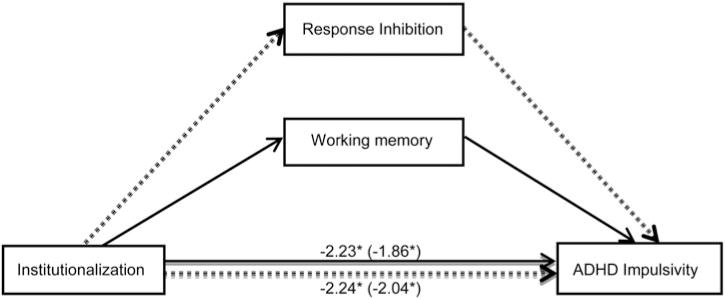
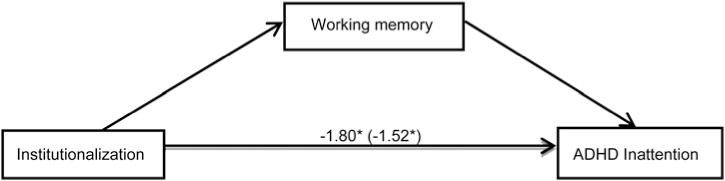
Children with history of institutionalization had higher inattention and impulsivity than community controls, and exhibited worse performance on working memory, response inhibition and planning tasks. Lower performances on working memory and response inhibition, but not planning, partially mediated the association between early institutionalization and inattention and impulsivity symptom scales at age 8 years.
Institutionalization was associated with decreased EF performance and increased ADHD symptoms. Deficits in working memory and response inhibition were specific mechanisms leading to ADHD in previously institutionalized children. These findings suggest that interventions that foster the development of EF might reduce risk for psychiatric problems in children exposed to early deprivation.
在福利院长大的幼儿面临着极端的心理社会剥夺,这与精神病理学风险升高及其他不良发育结果相关。注意缺陷多动障碍(ADHD)在曾在福利院生活过的儿童中患病率尤其高,但这种关联背后的机制却鲜为人知。我们调查了执行功能(EF)缺陷是否能解释福利院生活经历与ADHD之间的联系。
从罗马尼亚布加勒斯特的福利院招募了136名儿童(年龄在6 - 30个月之间),并通过全科医生办公室招募了72名年龄和性别匹配的从未在福利院生活过的社区儿童。在8岁时,评估了儿童在一些执行功能组件(工作记忆、反应抑制和计划)方面的表现。教师完成了健康与行为问卷,该问卷评估了ADHD的两个核心特征,即注意力不集中和冲动性。
有福利院生活经历的儿童比社区对照儿童有更高的注意力不集中和冲动性,并且在工作记忆、反应抑制和计划任务上表现更差。工作记忆和反应抑制方面的较低表现,但不是计划方面,部分介导了早期福利院生活经历与8岁时注意力不集中和冲动性症状量表之间的关联。
福利院生活经历与执行功能表现下降和ADHD症状增加有关。工作记忆和反应抑制缺陷是导致曾在福利院生活过的儿童患ADHD的特定机制。这些发现表明,促进执行功能发展的干预措施可能会降低早期经历剥夺的儿童出现精神问题的风险。