Tibu Florin, Sheridan Margaret A, McLaughlin Katie A, Nelson Charles A, Fox Nathan A, Zeanah Charles H
Institute of Child Development Bucharest, Romania.
Department of Psychology and Neuroscience, University of North Carolina, Chapel Hill NC, USA.
Front Psychol. 2016 Nov 24;7:1850. doi: 10.3389/fpsyg.2016.01850. eCollection 2016.
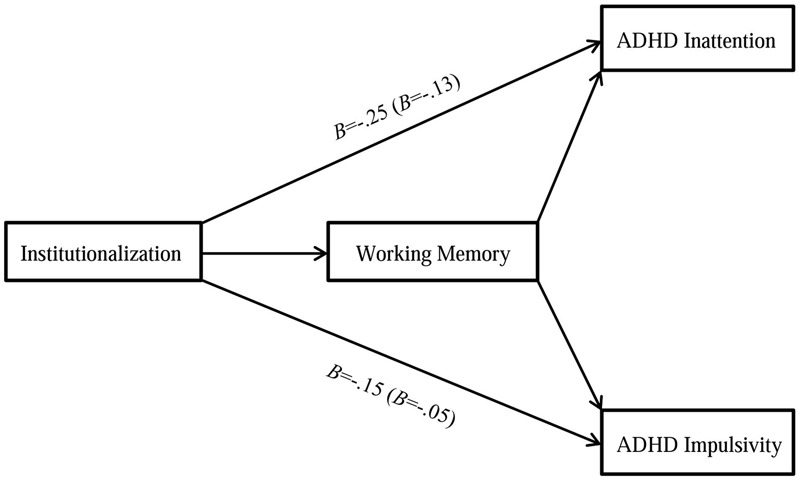
Children who are raised in institutions show severe delays across multiple domains of development and high levels of psychopathology, including attention deficit/hyperactivity disorder (ADHD). Low performance in executive functions (EFs) are also common in institutionally reared children and often do not remediate following improvements in the caregiving environment. ADHD symptomatology also remains elevated even after children are removed from institutional care and placed in families. We investigate whether poor EF is a mechanism explaining elevated rates of ADHD in children reared in institutional settings in the Bucharest Early Intervention Project (BEIP). In the current study, we examine the potentially mediating role of poor EF in the association between institutionalization and symptoms of ADHD at age 12 years. A total of 107 children were assessed with the Cambridge Neuropsychological Test Automated Battery (CANTAB) on working memory, set-shifting and planning. We also obtained concurrent teacher reports on their levels of ADHD symptoms (inattention and impulsivity separately). Institutionalization strongly predicted elevations in symptoms of inattention and impulsivity at age 12 years (s < 0.01). Indices of working memory and planning were also associated with ADHD after controlling for potential confounders (s < 0.03). Mediation analyses revealed that poor working memory performance mediated the link between exposure to early institutionalization and higher scores of both inattention and impulsivity. These results replicate and extend the findings that we reported in the BEIP sample at age 8 years. Together, they suggest that compromised working memory is a key mechanism that continues to explain the strikingly high levels of ADHD in late childhood among children institutionalized in early life. Interventions targeting working memory may help to prevent ADHD among children exposed to institutional care.
在机构中长大的儿童在多个发展领域表现出严重滞后,且心理病理学水平较高,包括注意力缺陷/多动障碍(ADHD)。执行功能(EFs)表现不佳在机构抚养的儿童中也很常见,并且在照料环境改善后往往无法得到改善。即使儿童脱离机构照料并被安置在家庭中,ADHD症状仍会持续升高。我们在布加勒斯特早期干预项目(BEIP)中研究了EF较差是否是解释机构抚养儿童中ADHD发病率升高的一种机制。在当前研究中,我们考察了12岁时EF较差在机构化与ADHD症状之间关联中的潜在中介作用。共有107名儿童接受了剑桥神经心理测试自动成套系统(CANTAB)的工作记忆、任务切换和计划能力评估。我们还同时获得了教师对他们ADHD症状水平(分别为注意力不集中和冲动)的报告。机构化强烈预测了12岁时注意力不集中和冲动症状的升高(p<0.01)。在控制了潜在混杂因素后,工作记忆和计划指标也与ADHD相关(p<0.03)。中介分析表明,较差的工作记忆表现介导了早期机构化暴露与注意力不集中和冲动得分较高之间的联系。这些结果重复并扩展了我们在BEIP样本中8岁时报告的发现。综合来看,它们表明工作记忆受损是一个关键机制,继续解释了早年在机构中抚养的儿童在童年晚期ADHD发病率极高的现象。针对工作记忆的干预措施可能有助于预防机构照料儿童中的ADHD。