Donzelli Sabrina, Poma Salvatore, Balzarini Luca, Borboni Alberto, Respizzi Stefano, Villafane Jorge Hugo, Zaina Fabio, Negrini Stefano
ISICO (Italian Scientific Spine Institute), Via Roberto Bellarmino 13/1, 20141, Milan, Italy.
Physical and Rehabilitation Medicine Specialty, University of Milan, Milan, Italy.
J Neuroeng Rehabil. 2015 Oct 16;12:91. doi: 10.1186/s12984-015-0083-8.
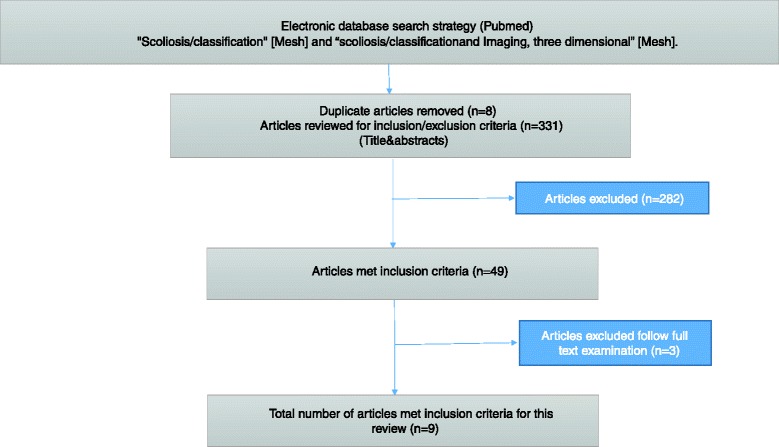
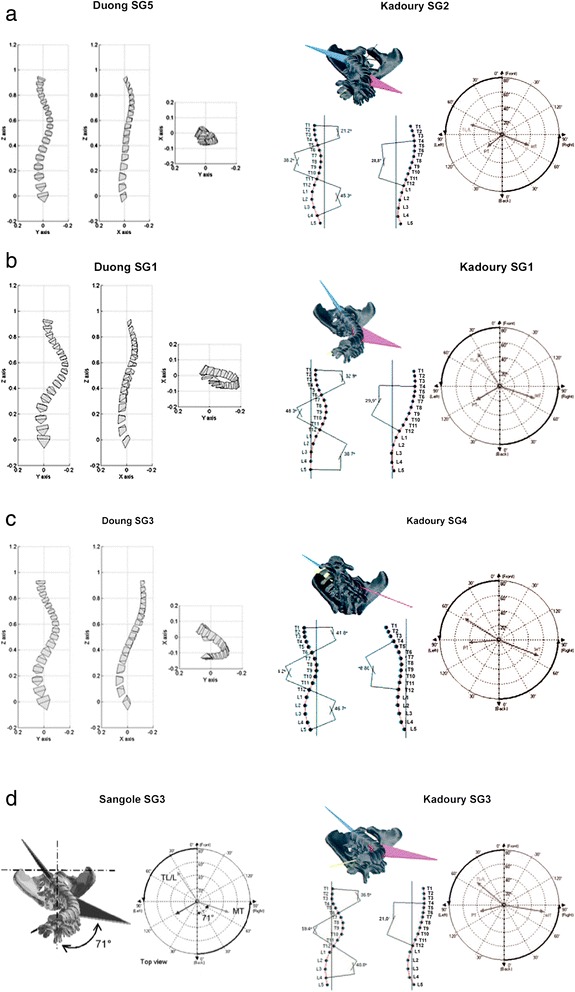
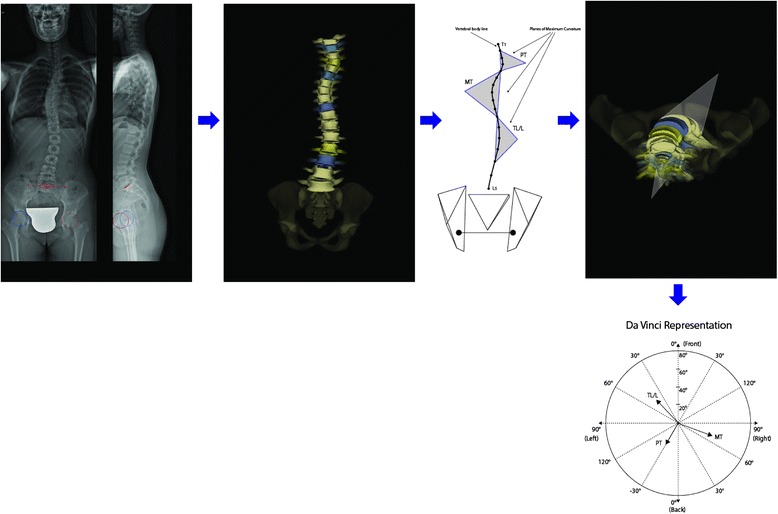
Scoliosis is a complex three dimensional (3D) deformity: the current lack of a 3D classification could hide something fundamental for scoliosis prognosis and treatment. A clear picture of the actually existing 3D classifications lacks. The aim of this systematic review was to identify all the 3D classification systems proposed until now in the literature with the aim to identify similarities and differences mainly in a clinical perspective.After a MEDLINE Data Base review, done in November 2013 using the search terms "Scoliosis/classification" [Mesh] and "scoliosis/classification and Imaging, three dimensional" [Mesh], 8 papers were included with a total of 1164 scoliosis patients, 23 hyperkyphosis and 25 controls, aged between 8 and 20 years, with curves from 10° to 81° Cobb, and various curve patterns. Six studies looked at the whole 3D spine and found classificatory parameters according to planes, angles and rotations, including: Plane of Maximal Curvature (PMC), Best Fit Plane, Cobb angles in bodily plane and PMC, Axial rotation of the apical vertebra and of the PMC, and geometric 3D torsion. Two studies used the regional (spinal) Top View of the spine and found classificatory parameters according to its geometrical properties (area, direction and barycenter) including: Ratio of the frontal and the sagittal size, Phase, Directions (total, thoracic and lumbar), and Shift. It was possible to find similarities among 10 out of the 16 the sub-groups identified by different authors with different methods in different populations.In summation, the state of the art of 3D classification systems include 8 studies which showed some comparability, even though of low level. The most useful one in clinical everyday practice, is far from being defined. More than 20 years passed since the definition of the third dimension of the scoliosis deformity, now the time has come for clinicians and bioengineers to start some real clinical application, and develop means to make this approach an everyday tool.
脊柱侧弯是一种复杂的三维(3D)畸形:目前缺乏三维分类可能会掩盖脊柱侧弯预后和治疗的一些基本要素。对于实际存在的三维分类,目前还缺乏清晰的认识。本系统评价的目的是识别文献中迄今为止提出的所有三维分类系统,主要从临床角度识别它们的异同。在2013年11月对MEDLINE数据库进行检索,使用检索词“Scoliosis/classification”[医学主题词]和“scoliosis/classification and Imaging, three dimensional”[医学主题词],纳入了8篇论文,共涉及1164例脊柱侧弯患者、23例脊柱后凸患者和25例对照,年龄在8至20岁之间,Cobb角在10°至81°之间,且有各种弯曲模式。六项研究观察了整个三维脊柱,并根据平面、角度和旋转确定了分类参数,包括:最大曲率平面(PMC)、最佳拟合平面、身体平面和PMC中的Cobb角、顶椎和PMC的轴向旋转以及几何三维扭转。两项研究使用了脊柱的区域(脊柱)顶视图,并根据其几何特性(面积、方向和重心)确定了分类参数,包括:前后径与矢状径之比、相位、方向(总体、胸椎和腰椎)以及偏移。不同作者在不同人群中采用不同方法确定的16个亚组中,有10个可以找到相似之处。总之,三维分类系统的现状包括8项显示出一定可比性的研究,尽管可比性较低。在日常临床实践中最有用的分类系统,目前还远未确定。自脊柱侧弯畸形三维定义以来已过去20多年,现在临床医生和生物工程师是时候开始一些实际的临床应用,并开发方法使这种方法成为日常工具了。