Sun Jiajie, Aswath Kshama, Schroeder Steven G, Lippolis John D, Reinhardt Timothy A, Sonstegard Tad S
Animal Genomics and Improvement Laboratory, USDA-ARS, BARC-East, Beltsville, MD, 20705, USA.
School of Systems Biology, George Mason University, 10900 University Boulevard, Manassas, VA, 20110, USA.
BMC Genomics. 2015 Oct 16;16:806. doi: 10.1186/s12864-015-2044-9.
Milk exosomes are a rich source of microRNAs (miRNAs) that are protected from degradation. Ingestion of milk and subsequent absorption of miRNAs into recipient cells by endocytosis may play a role in the regulation of neonatal innate and adaptive immunity. In contrast, the miRNA content of milk exosomes may also be indicative of a lactating animal's health; whereby, the presence or absence of specific miRNAs could serve as biomarkers for early detection of bacterial infection that can lead to mastitis. In the present study, we therefore analyzed and compared miRNA expression profiles of milk exosomes from four Holstein cows obtained during mid-lactation prior to and after infection (48 h) of the mammary gland with Staphylococcus aureus.
Milk exosomes, purified from control and S. aureus infected cows, were extracted for RNA. Following preparation indexed libraries from both groups the samples were subjected to next generation sequencing.
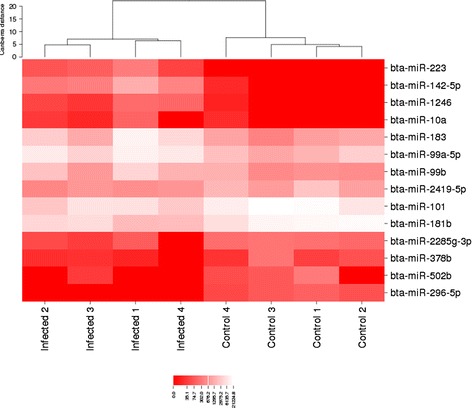
Next generation sequencing of eight, unpooled small RNA libraries derived from milk exosomes produced about 60.5 million high-quality, bovine-specific sequence reads for comparison of miRNA expression between treatments. Sequence identity analysis showed the miRNAs make up about 13 % of the average RNA content of these exosomes. Although 417 known bovine miRNAs were identified, miRNAs represented the least diverse class of RNA accounting for only 1 % of all unique sequences. The 20 most prevalent unique sequences within this class accounted for about 90 % of the total miRNA-associated reads across samples. Non-annotated, unique reads provided evidence for another 303 previously unknown bovine miRNAs. Expression analyses found 14 known bovine microRNAs significantly differed in frequency between exosomes from infected and control animals.
Our survey of miRNA expression from uninfected milk exosomes and those produced in response to infection provides new and comprehensive information supporting a role for delivery into milk of specific miRNAs involved in immune response. In particular, bta-miR-142-5p, and -223 are potential biomarkers for early detection of bacterial infection of the mammary gland. Additionally, 22 mammary-expressed genes involved in regulation of host immune processes and response to inflammation were identified as potential binding targets of the differentially expressed miRNAs.
乳外泌体是富含受保护不被降解的微小RNA(miRNA)的来源。摄入牛奶以及随后通过内吞作用将miRNA吸收到受体细胞中可能在新生儿先天性和适应性免疫调节中发挥作用。相反,乳外泌体的miRNA含量也可能指示泌乳动物的健康状况;据此,特定miRNA的存在与否可作为早期检测可能导致乳腺炎的细菌感染的生物标志物。因此,在本研究中,我们分析并比较了四头荷斯坦奶牛在乳腺感染金黄色葡萄球菌之前和之后(48小时)泌乳中期获得的乳外泌体的miRNA表达谱。
从对照奶牛和感染金黄色葡萄球菌的奶牛中纯化乳外泌体,提取RNA。在两组制备索引文库后,对样品进行下一代测序。
来自乳外泌体的八个未合并的小RNA文库的下一代测序产生了约6050万个高质量的牛特异性序列读数,用于比较不同处理之间的miRNA表达。序列同一性分析表明,miRNA约占这些外泌体平均RNA含量的13%。虽然鉴定出了417种已知的牛miRNA,但miRNA是RNA中多样性最少的类别,仅占所有独特序列的1%。该类别中20个最普遍的独特序列约占样品中与miRNA相关的总读数的90%。未注释的独特读数为另外303种先前未知的牛miRNA提供了证据。表达分析发现,14种已知的牛微小RNA在感染动物和对照动物的外泌体之间的频率存在显著差异。
我们对未感染乳外泌体和感染后产生的乳外泌体的miRNA表达的调查提供了新的全面信息,支持了参与免疫反应的特定miRNA传递到牛奶中的作用。特别是,bta-miR-142-5p和-223是乳腺细菌感染早期检测的潜在生物标志物。此外,22个参与宿主免疫过程调节和炎症反应的乳腺表达基因被鉴定为差异表达miRNA的潜在结合靶点。